Africa-Press – Eritrea. The Battle of Massawa in February 1990 was a decisive turning point in Eritrea’s long struggle for independence from Ethiopia. More than a military victory, it symbolized the culmination of decades of resistance by the Eritrean People’s Liberation Front (EPLF) and marked the moment when Eritrean independence shifted from aspiration to inevitability. Massawa, a strategic Red Sea port and the Ethiopian occupying regime’s gateway to naval supply lines, was crucial for the Dergue under Lt. Col. Mengistu Haile Mariam. Its capture not only cut off Ethiopian access to Soviet aid but also delivered a psychological blow from which the Ethiopian army could not recover.
The EPLF’s path to Massawa was paved by years of disciplined preparation, careful strategy, and earlier victories that had weakened the Ethiopian military. Operations such as the Battle of Afabet in 1988 had severely demoralized Ethiopian forces and destroyed key divisions, giving the EPLF control over northern Eritrea and the initiative in the wider conflict. However, Massawa posed a different challenge: unlike inland engagements, it required a coordinated land-and-sea offensive against a well-defended urban and coastal stronghold.
In the months leading up to Operation Fenkil, the EPLF carefully prepared for a multi-front assault. Secretly, it expanded its naval capabilities, deploying gunboats, transport vessels, and captured Ethiopian equipment. Simultaneously, forces were positioned inland to cut off reinforcement routes to Massawa and Assab. The operation relied on speed, coordination, and the element of surprise – hallmarks of EPLF strategy honed over years of guerrilla warfare. On February 8, 1990, the assault began at dawn with attacks along three axes: inland, along the coastline, and directly on the port itself. Within two days, the EPLF had secured the mainland approaches, isolating Ethiopian garrisons and preparing for the amphibious phase of the operation.
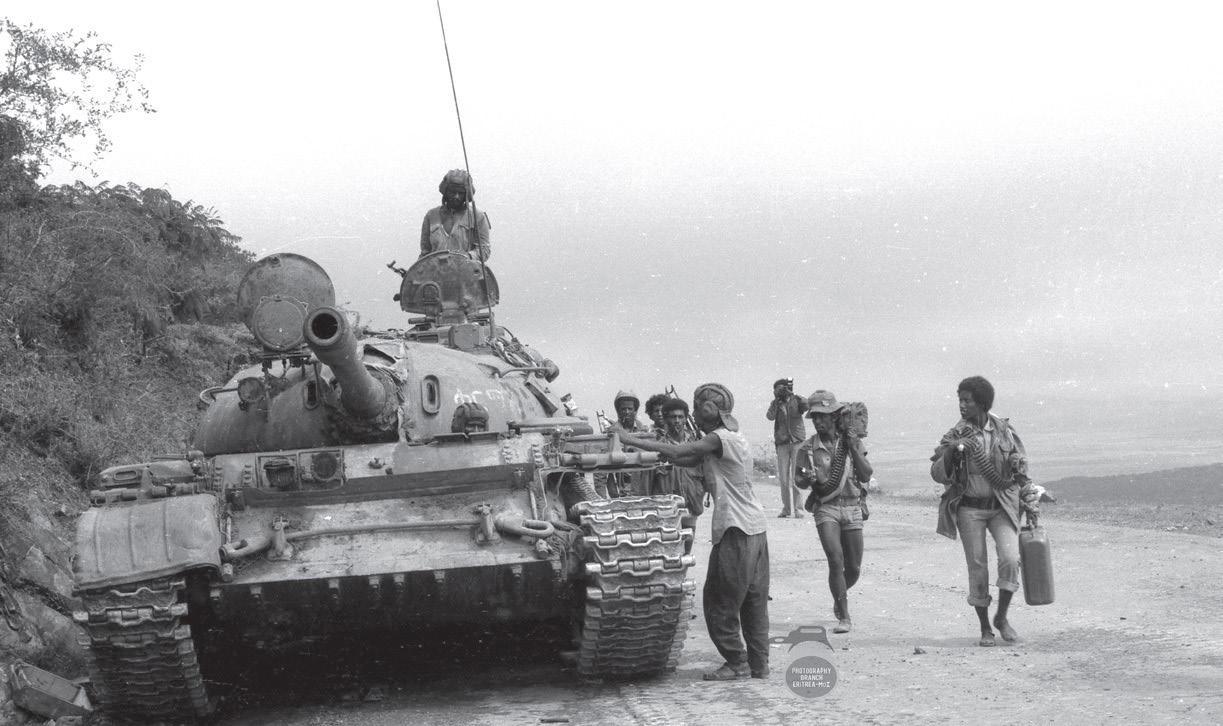
By February 16, EPLF forces had successfully stormed the islands guarding the port, completing the coordinated land-sea assault. The operation’s effectiveness stemmed from meticulous planning, intimate knowledge of the terrain, and the disciplined coordination of land and naval forces. Ethiopian defenders, despite having access to heavy artillery, tanks, and Soviet advisors, were unable to mount a coherent defence. The rapid collapse of their positions reflected both the skill of EPLF fighters and the declining morale of Ethiopian troops, many of whom had already been weakened by prior defeats and overstretched supply lines.
The human and material cost for the Ethiopian army was staggering. Approximately 9,000–10,000 soldiers were killed, thousands more wounded, and scores of high-ranking officers, including generals, were captured. Many others retreated toward Ghinda, leaving behind stocks of weapons and heavy equipment that the EPLF repurposed to strengthen its own operations. As one captured general remarked: “the war is almost over now. The army’s morale is low, and they don’t want to fight. The central government can’t handle it anymore unless they start negotiating. They have no other alternative. I don’t think they can even last another two or three months.”
The victory at Massawa was not only strategic but symbolic. The port had long been a linchpin of Ethiopian control in Eritrea, and its capture marked the effective collapse of Ethiopian authority along the coast. It also demonstrated the EPLF’s ability to execute complex, high-stakes operations that combined guerrilla tactics with conventional amphibious manoeuvres – an evolution from the insurgency strategies that had defined the 1970s and 1980s. By seizing Massawa, the EPLF secured a critical logistical hub for future operations, enabling the eventual capture of Assab and, ultimately, Asmara.
The battle’s significance extended beyond the immediate military outcome. International observers took note: the defeat signalled that Eritrean independence, long considered improbable, was now within reach. The capture of Massawa also reflected a broader pattern in which local knowledge, strategic planning, and disciplined execution allowed the EPLF to overcome a technically superior adversary supported by a global superpower.
Massawa’s fall also highlighted the changing geopolitical context of the late Cold War era. The Ethiopian government, heavily reliant on Soviet military support, found that conventional aid alone could not compensate for poor morale, logistical failures, and strategic miscalculations. EPLF forces, by contrast, leveraged a combination of local support, tactical flexibility, and innovative use of captured resources to decisively shift the balance of power. In this way, the battle represented not only a local victory but also a broader commentary on the limitations of externally imposed military power in conflicts driven by local determination and knowledge.
Following Massawa, only Assab and Asmara remained under Ethiopian control. However, the EPLF’s momentum was irreversible. Within months, remaining Ethiopian forces were increasingly isolated, demoralized, and unable to mount effective resistance. The capture of Massawa had broken the backbone of Ethiopia’s operations, leaving the Dergue regime unable to project power along Eritrea’s coast or maintain its hold on the country’s interior.
The Battle of Massawa stands as a testament to strategic vision, resilience, and the ability of a well-organized liberation movement to overcome superior numbers and advanced weaponry. Unlike Afabet, which had demonstrated the EPLF’s growing military capabilities, Massawa showcased the organization’s capacity for complex joint operations, integrating land and naval forces to achieve decisive results. It also marked a turning point in the psychological war, signalling to Ethiopian forces and the international community alike that Eritrean independence was no longer a distant dream but an impending reality.
In retrospect, the fall of Massawa exemplifies the confluence of strategy, morale, and historical necessity in shaping the outcome of protracted liberation struggles. The battle reaffirmed that disciplined organization, local knowledge, and strategic innovation could decisively overcome a conventionally superior force. Eritrea’s eventual independence was the culmination of these victories – a hard-won triumph born of decades of struggle, tactical brilliance, and unyielding determination.
shabait