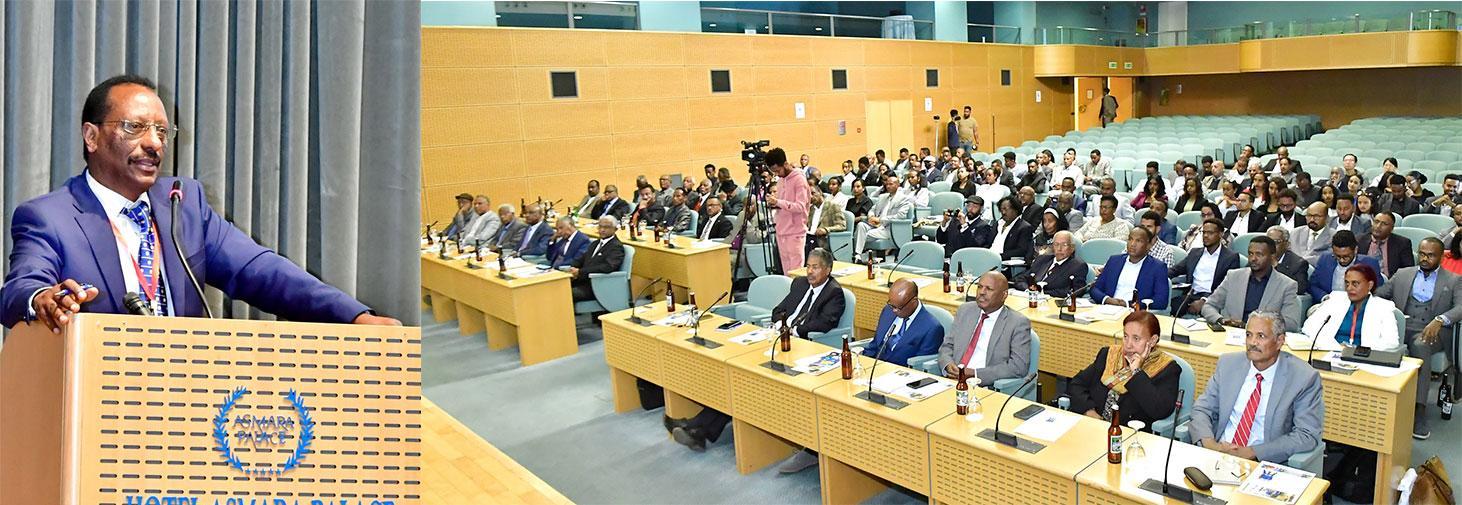
Africa-Press – Eritrea. The recent 27th Annual Conference of the Eritrean Medical Association provided a useful opportunity to reflect on Eritrea’s health progress and the sustained efforts to strengthen the national health system. Held in Asmara, the conference brought together medical professionals from across the country to review ongoing developments, exchange experiences, and discuss future directions within the broader framework of national health advancement.
The conference featured several research papers on diverse clinical and public health issues, as well as discussions on medical education, research capacity, and professional collaboration. Participants also reviewed the Association’s activities, including continuing medical education and public health outreach initiatives, and deliberated on plans of action for the coming year. In this context, the conference served as both a forum for scientific exchange and a reference point for assessing collective progress and priorities in Eritrea’s health sector.
Importantly, the recent conference provided not only a forum for sharing contemporary research and experiences but also a timely moment to consider the broader trajectory of Eritrea’s health system. Reflecting on today’s health initiatives is most meaningful when placed in a historical context, tracing the evolution of health care in the country from traditional practices to modern medical structures, through periods of colonialism, federation, war, and the remarkable efforts of the liberation movement.
In Eritrea, traditional medicine and healing techniques have a long history, practiced for centuries across communities. What is broadly recognized today as “modern medicine” was introduced during the 19th and early 20th centuries with the advent of Italian colonialism. But health facilities and services during this period were largely concentrated in urban areas and designed to cater primarily to the colonial settler community and associated narrow segment of the population.
During the subsequent interim British Military Administration, several dispensaries and small clinics were established. Still, widespread economic crises led to the closure or dismantling of many hospitals, including those in Massawa, Ghinda, and Zula, as part of broader, systematic reductions in infrastructure and services. Despite these challenges, Eritrea retained relatively advanced health services in the early years of “Federation” with Ethiopia. Under the Eritrean Administration, clinics were established, hospitals were renovated, and training centres were opened. However, the imperial Ethiopian government soon began cutting resource allocations and systematically undermining the country’s facilities, while bureaucratic restrictions further limited access to and efficiency of health care. The deterioration accelerated during the armed liberation struggle, with many health facilities destroyed and numerous health workers forced into exile or drawn into the independence movement.
Amidst this widespread disruption, the Eritrean People’s Liberation Front (EPLF) implemented an exceptionally effective health care delivery system for both fighters and civilians, even in remote and contested areas. The EPLF’s health policy emphasized two core principles: i) health services should reach the entire population, including the most remote areas; and, ii) prevention should take precedence over cure due to resource constraints.
Starting in the early 1970s, the EPLF established dozens of stationary and mobile clinics, regional hospitals, and a central hospital in Orotta with operating rooms and laboratories. An underground drug production facility supplied dozens of essential medical products. At the same time, a training and information unit prepared barefoot doctors, midwives, paramedics, X-ray technicians, pharmacy and laboratory assistants, dental technicians, and anaesthetists.
Analyses of Eritrea’s wartime health system highlight the remarkable effectiveness of these efforts. Scholars noted that, despite limited resources and the challenges of prolonged conflict, Eritrea delivered emergency services, primary care, and preventive health programs through careful prioritization and systematic allocation of scarce resources. In 1989, a visiting Western journalist observed that the EPLF had established a primary health care system and civilian hospital service “better than those of many already independent African states.” At the same time, it is important to recognize that, while exceptional within the context of war, the overall health system remained constrained and, in many ways, “at a low level.”
Building on the foundations laid during the liberation struggle, Eritrea faced the formidable task of reconstructing a health system that had been almost entirely devastated by decades of conflict. From this challenging starting point, the country has made remarkable strides in expanding and strengthening health services across all regions.
Since independence, Eritrea has systematically rebuilt its health infrastructure, establishing a wide network of facilities that reach rural and remote communities and ensure that traditionally marginalized populations have access to care. At the same time, the country has invested heavily in developing its health workforce, training physicians, nurses, and specialists across a broad range of fields – from paediatrics and cardiology to orthopaedics and beyond.
These efforts have translated into substantial improvements in national health indicators. Eritrea has moved from among the poorest health outcomes in the world to among the strongest in Africa and, more broadly, across the developing world. Life expectancy, for example, has risen from among the lowest globally at independence to the high 60s today. Health care is essentially free, with a strong emphasis on preventive services, and education for health professionals is provided at no cost. Together, these measures reflect a sustained, equity-driven approach to health development that prioritizes accessibility, quality, and long-term outcomes.
The recent 27th Annual Conference of the Eritrean Medical Association clearly illustrates how far the country’s health system has come. Beyond celebrating contemporary achievements, the conference highlighted the ongoing commitment to research, professional development, and public health promotion, demonstrating that the process of strengthening health care in Eritrea is continuous. Additionally, the conference showcased current capabilities and reaffirmed Eritrea’s enduring focus on building a health system that is inclusive, resilient, and guided by evidence-based practices.
As Eritrea continues to build on decades of determined effort, the country’s health system stands as a testament to what sustained commitment, strategic planning, and equity-driven policies can achieve. The progress made – from the foundations laid during the liberation struggle to the expansion of facilities, training of health professionals, and improvements in national health indicators – demonstrates the resilience and vision of the nation’s health sector.
Moving forward, the focus remains on consolidating gains, fostering innovation, and ensuring that all Eritreans, including those in remote and historically underserved areas, continue to benefit from accessible, high-quality care. In this context, gatherings such as the Eritrean Medical Association’s annual conference are more than professional forums; they are vital moments of reflection, learning, and collective action that guide the country toward a healthier and more equitable future.
shabait