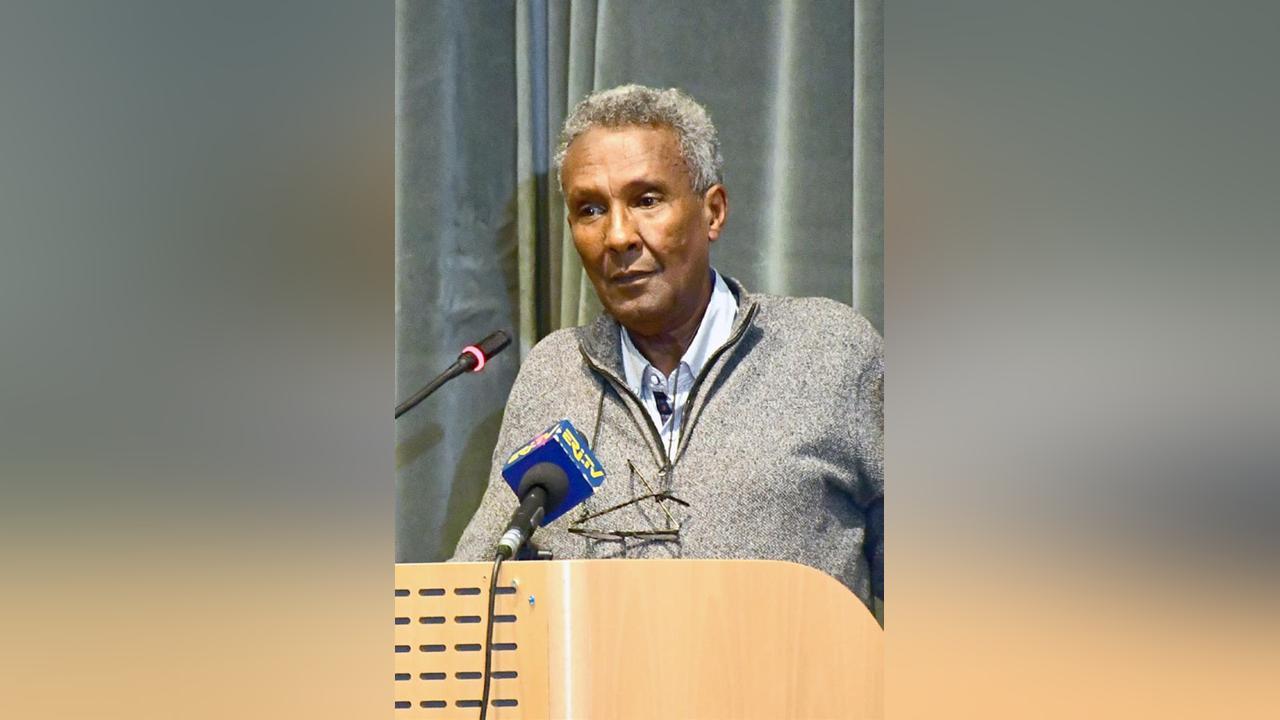
Africa-Press – Eritrea. Our guest today, Professor Mohammed Hassen, is an Ethiopian historian and a scholar of Ethiopian studies. He is currently an assistant professor at the Middle East Studies Center at Georgia State University in the United States.
He presented a paper entitled “Nexus between Ethnicity and/or Religious Extremism and Nation Building” under a session theme of “Ethnicity, Religion, and Governance” at the International Conference on Eritrean Studies (ICES), held from January 4 to 6, 2025, in Asmara. With its thematic focus on regional and international cooperation for sustainable development, the ICES brought together scholars, researchers, and practitioners from around the world, creating a platform for interdisciplinary engagement.
My understanding is that ICES was created for multiple purposes. One is to create a platform for Eritrean intellectuals and specialists in different fields to discuss Eritrea and to correct history, as the forgery of history has caused much damage to the region over the last 80 years. The purpose is to understand the regional and political situation so as to correct history and rewrite the real history of Eritrea and the region. This objective is correct. I say it is correct because once you realize that, you will build a bridge of regional understanding, recognizing that there is a forgery of history in Ethiopia as well, and that forgery of history must also be corrected.
Those who created the forgery are very far removed from us, and they fabricated this false history to perpetuate constant contradiction among the people of the region. The second objective is to create harmony based on understanding among the people of the state or the region. If this is done, then there is a strong possibility that the population of the region can embark on regional development. For these reasons, I think it is a very good conference, and in order to correct the wrongly told stories and build a new relationship on a new basis, Somalis, Ethiopians, Sudanese, Djiboutians, Ugandans, and Kenyans should be invited to the conference. This is the second conference, and I really hope it will continue through the years to bring the people and the governments of the region closer to each other and try to block the troublemakers who want constant contradictions in the region.
The hegemonic academies have forged the history of the region for their own personal reasons and purposes. And this myth they have created has caused much contradiction and war in the region. Now that Eritrea is independent, a young, educated Eritrean class has come together from different sectors and fields and is now unraveling the corrupted history and rewriting the story from their own point of view. This will be a bridge to all the people in the region. I am sure that they [the hegemons] will not like it because, for them, this means their hegemony will be broken.
Secondly, this false consciousness they have created brings much contradiction to the region, and this has made the region poor, inhabited by poor people, when it is actually very rich. To start a new understanding, our younger men, women, daughters, and sons are reading their history from their own perspectives and are rewriting the actual, real history as it should be. This must be encouraged and multiplied. Eritrea’s history has been forged for over 80 years, and this has caused a very long struggle and pain to the Eritrean people. So, the dialogue must continue, and we should never allow anyone to write our history in a forged way. I think that young Eritreans and others from the region have to constantly discuss, write, and research in order to correct the narratives and the history.
The main source of the poverty in the region is the forgery, and this forged history brought contradictions, war, and conflicts. For this reason, we could not utilize our resources. If the correct history is understood, however, and if we rewrite it in a proper way, then it will automatically bring cooperation. As I mentioned earlier, the region is rich in resources but inhabited by poor people. If we correct the historical and psychological makeup, we automatically come to cooperation and common understanding. This cooperation will bring development and advancement.
I am a citizen of the Horn of Africa, and I wish the people and the governments of the Horn of Africa could come together and design a common understanding in all fields—be it in education or in economics— so that we can support each other shoulder to shoulder to enhance our development in our own way. This way, we can also perhaps contribute something to humanity. We have a population of more than 200,000,000 people, as well as a wealthy and very strategic region. With a correct narrative, I see that cooperation for development will be easier. As long as we are divided, however, it will be very difficult to come together and cooperate, and its consequences will be miserable. We have to learn from the past 80 years and embark on a new road. That new road is equality, justice, mutual respect, working together, and regional cooperation.
First of all, the term “international community” does not exist. This is a term that decorates the biggest hegemons. When they consider attacking a country and blocking it from building its own national independence and national economy, they say that the country is isolated from the “international community.” Who is this so-called “international community”? There isn’t one. There are oppressed and dominated nations and oppressors. But if you say, “I don’t want to be oppressed, and I want to exercise my self-determination politically, economically, and socially,” then they engineer regime change and try to fight you in all ways. The hegemons think that they are the center of humanity, and we are expected to dance and sing for them and use their slogans.
Eritrea has corrected its history through a long journey. Eritrea today is a frontline state. One of the biggest difficulties Eritrea, like the other people of the Horn of Africa, is facing is the enemy from afar that wants no cooperation between Eritrea and the rest of the Horn of Africa. They [the enemy from afar] advance their interests through divide and rule, and their mechanisms of “let them fight among themselves; we control them from above; we determine their economy; we will give them arms, and they cannot stand among us.” But Eritrea’s example of national independence in all terms—its economic, social, and political ways—frightened the hegemon, and it wants to contain Eritrea and make sure its influence does not go beyond Eritrea.
The hegemon has to create problems so Eritrea “won’t spoil the other apples” and won’t create a new vision in the region. This is the problem that Eritrea is facing, and they attack it using the forces that believe the false narrative. We [Ethiopia and Eritrea] had a very good relationship from 1991 until 1998. Who broke the relationship, and why didn’t it continue? Who is responsible for it? So, we have to understand that the enemy from afar is also near and is following us in every step we take. We have to be very smart and raise our youth with a great vision for the Horn of Africa, national independence, and cooperation. And if we are together, we can win and transform the region.
And when we say sustainable development, we have to ask: development for whom, by whom, and to whom? Because it is also used by them [the hegemons] through their NGOs, a mechanism they have designed. For me, sustainable development is sustainable development for the people of Africa with a new history and cooperation. Our development must be based on our history and interest in mobilizing our people and bringing understanding between the people and the states of the Horn of Africa by bringing a new curriculum of education. We are a very rich region, and we have to cooperate. We should not hand our voices to the enemy from afar, who always waits and is ready to enter to destabilize us.
Thank you very much. I want our young daughters and sons to unmask certain narratives. These narratives that are circulating have forged words and their own objectives. Unmask the forged narratives.
Source: Eritrea Ministry Of Information
For More News And Analysis About Eritrea Follow Africa-Press