Africa-Press – Eritrea. The Relations between the Republic of the Sudan and the State of Eritrea represent an advanced model of bilateral relations in the Horn of Africa and the Red Sea regions. Their roots run deep in history, and their dimensions intersect politically, securely, economically, and socially, making them strategic relations based on mutual trust, good neighborliness, and a set of intertwined interests and a shared destiny.
The geographical borders between Sudan and Eritrea have never constituted a real barrier between the two peoples; rather, they have served as a bridge for human connection and cultural and social interaction. The Sudan played an important historical role in supporting the struggle of the Eritrean people for independence, leaving a profound and lasting impact on the Eritrean national consciousness—an impact that continues to be reflected in the positions of the Eritrean leadership and popular sentiment toward Sudan to this day. Moreover, the extended social and tribal ties across both sides of the border have further deepened this relationship, making it a bond between two peoples before it is a relationship between two states.
Political coordination based on mutual respect
Politically, the relations between Khartoum and Asmara are characterized by a high level of understanding and coordination, particularly on regional issues of shared interest. Eritrea has consistently maintained a firm position rooted in respect for Sudan’s sovereignty and territorial integrity, and in rejecting any external interference in its internal affairs. In return, the Sudan views Eritrea as a reliable partner in promoting regional stability, especially amid the complex security and political challenges facing the Horn of Africa.
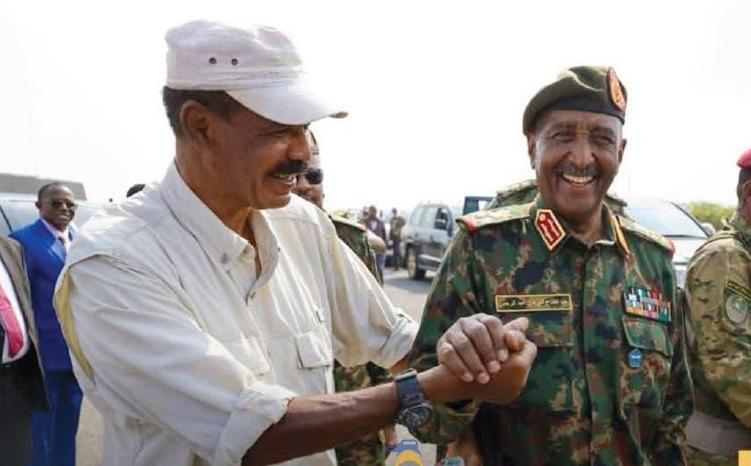
Eritrea—both its leadership and its people—has taken a historic and steadfast stance in support of Sudan during its current war, the War of Dignity. This position represents an advanced and distinctive model of solidarity, embodied in the direct leadership of His Excellency President Isaias Afwerki and his clear support for Sudan’s unity, stability, territorial integrity, and the preservation of its sovereign gains.
A security partnership in a turbulent regional environment
On the security front, Sudanese– Eritrean cooperation constitutes a key pillar of stability along their shared border, which extends for hundreds of kilometers. Security coordination and information exchange have contributed to curbing illicit activities, combating smuggling and illegal migration, and preventing armed groups and militias operating outside the law from exploiting the border areas. The importance of this cooperation is magnified amid ongoing regional instability, as both countries recognize that the security of one is inseparable from the security of the other.
Promising economic horizon
Economically, the relations between the Sudan and Eritrea hold significant opportunities that have yet to be fully utilized. Sudan’s vast agricultural and livestock and minerals potential, combined with Eritrea’s strategic location on the Red Sea, its vital ports, and its economic resources, together form a solid foundation for genuine economic integration. Intra-trade, transport, and joint investment open wide horizons for enhancing developments in ways that serve the interests of both peoples and support economic stability in the region.
The humanitarian dimension of Sudanese –Eritrean relations has been clearly evident during times of crisis faced by both countries. Over decades, the Sudan hosted large numbers of Eritreans during the struggle for independence, while Eritrea, in turn, demonstrated supportive and compassionate positions toward the Sudanese people in their various hardships, driven by a firm belief in a shared destiny.
Following the war imposed on the Sudan, Eritrea opened its doors to Sudanese citizens. President Isaias Afwerki directed that their entry and residence in Eritrea be facilitated using whatever identification documents were available, without any complications. This noble humanitarian stance reflects the depth of fraternal ties between the two brotherly and friendly peoples.
Toward a sustainable strategic partnership
With its historical legacy, political trust, and security and economic complementarity, Sudanese– Eritrean relations are well-positioned to move from traditional cooperation to a comprehensive strategic partnership. Achieving this requires strengthening institutional dialogue, expanding areas of cooperation, and building on the strong political will demonstrated by the leadership of both countries. In light of current regional and international challenges, the relationship between the Sudan and Eritrea remains a living example of how excellent neighborliness and mutual respect can create genuine stability—one that extends beyond the two countries to encompass the entire Horn of Africa.
The Sudanese – Eritrean relations, in their historical context and contemporary dynamics, have transcended the framework of conventional bilateral ties to become a geopolitical partnership with structural dimensions. This partnership has been shaped by geopolitical considerations and transformations in regional security in the Horn of Africa and the Red Sea.
The convergence of visions regarding national sovereignty, rejection of external tutelage, and confronting indirect forms of interference has contributed to consolidating this relationship as one of the pillars of regional balance. This partnership also extends to a comprehensive approach to economic development through the integrated utilization of Sudan’s resources and Eritrea’s maritime position, thereby strengthening economic independence.
The Sudanese –Eritrean partnership represents a strategic cornerstone for reshaping the equations of stability in the region and a model of cooperation that seeks to manage crisis from within the region itself, transforming them into a strategic asset that serves regional stability and the interests of its peoples.
shabait