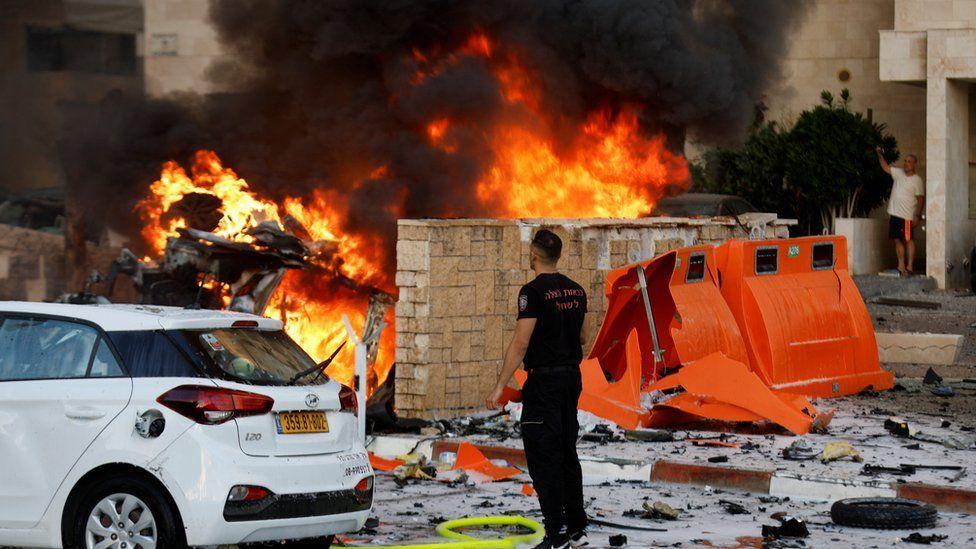
Africa-Press – Eswatini. The ensuing crisis in the Middle East, viz Israel-Palestine war, has in the past few days sparked a frenzy into energy markets.
On Monday, global benchmark Brent Crude rose 4.2 per cent to US$88.15 a barrel, while US benchmark West Texas Intermediate rose 4.3 per cent to US$86.38 per barrel. These market movements have sparked fears in the global oil markets, leaving everyone with the question, ‘will the price of oil continue to rise’? I find this relevant for discussion or mulling over as we all plan our daily expenditures; we have seen a couple of fuel hikes in the past two months. It is congruent that any geo-political tensions in the Middle East should cause us to worry about the price of fuel, therefore, today I will weigh in on the likely short-term and medium-term impacts of the confrontation on the price of fuel.
The short-term
The short-term does not look very bleak as neither of the two countries in conflict are significant producers of oil. Israel holds 13 953 000 barrels of proven oil reserves as of 2016, ranking 87th in the world and accounting for about 0.0 per cent of the world’s total oil reserves of 1 650 585 140 000 barrels. While the State of Palestine ranks 125th in the world for oil consumption, accounting for about 0.0 per cent of the world’s total consumption of 97 103 871 barrels per day. The figures show that the conflict is contained within the two feuding sovereign States, the impacts of the war will not likely be significant on the global oil prices. Hence in the short-term, we really do not expect any significant impact in the overall markets as a result of the conflict. But the question that begs an answer is, why are markets responding in panic mode, and this would bring us to the medium term scenario. Markets are shivering because of the uncertainty in the medium to long-term. The observed movements are what one would term speculatory movements or anticipated medium-term movements or outcomes.
The medium-term
The medium-term will be largely determined by how the Middle East engages in the conflict. In a nutshell, the medium to long-term outlook will depend on how the conflict plays out; and to understand this statement we need to put the Middle East in context. The Middle East is home to some of the world’s biggest major oil producers, including Iran and Saudi Arabia, as well as key transit routes such as the Strait of Hormuz. Furthermore, this is a very delicate region in terms of peace and stability. The ensuing confrontation between Palestine and Israel threatens overall peace and stability in the region. The threat to regional peace and stability is one of the factors that contributed to the upward spikes in the prices of crude oil in global markets. At this point it is safe to say that the observed market movements are not a consequence of the of the war but rather fears of how the war might lead to a wider regional (Middle East) conflict. Now let us explore how this could lead to wider Middle East instability.
Fragility of Middle East
The speculative movements in the markets are largely anchored on whether Iran will be drawn into the conflict; also worth watching is whether Hezbollah will join the conflict. If these two countries are drawn into the conflict, then effectively four countries in the Middle East will be in conflict. Indications out of the global media show that Hezbollah has already fired a barrage of rockets into Israel claiming that some of their members were killed during a border siege by Israel. Hezbollah is a Lebanon-based armed group that is an ally of both Hamas and Iran. Hamas is a Palestinian political and militant organisation that currently governs the Gaza Strip, one of the two Palestinian territories. Iran, on the other hand, has not yet been directly involved in the conflict. Iran is the 7th largest producer of oil globally, producing four per cent of the global oil output; and if it were to join the war there might be significant shifts in global oil prices. Hence we need to continue monitoring the geo-political tectonic shifts on Iran’s involvement; while Lebanon is a net importer of oil, but it is an oil transit country. Hence if Hezbollah goes all out into the conflict, the whole of Lebanon would be thrown into marked instability and these would have spill over effects on the price of oil.
Domestic movements
Eswatini does not have any oil reserves, hence any movements in the international oil supply has direct impact on our economy. Hence we have to watch evolutions in the geo-political configuration in the Middle East with a keen eye as it will have direct impact on the price at the pumps. However, with the right investments we may not be totally vulnerable to such external shocks, we need to ramp up the construction of the strategic oil reserve plant. The plant will give us a buffer stock that can be utilised in the event global prices overheat.
Source: times
For More News And Analysis About Eswatini Follow Africa-Press