Africa-Press – Eswatini. Delegates attending Day 2 of the Countering Disinformation and Promoting Digital Transparency workshop received a sobering assessment of global cybersecurity risks, as Taiwanese expert Atlas Yu detailed how coordinated digital attacks are increasingly targeting national infrastructure, supply chains and public institutions.
Yu told participants that Taiwan faces more than two million cyberattacks daily, ranging from attempts to breach government systems to efforts to infiltrate critical infrastructure such as power plants, water systems and telecommunications networks.
He said this constant pressure has transformed Taiwan into one of the world’s most experienced hubs in cybersecurity resilience.
“Taiwan has been battle-tested. We have been attacked, probed and stressed for years, and that experience has pushed our cybersecurity sector to evolve rapidly,” Yu said.
He outlined how Taiwanese companies have since built strong, specialised capabilities from AI-driven threat detection to industrial-level systems that protect manufacturing plants, power grids and national operations. Firms like CyCrab, T5 Intelligence, T1 Networks and DefCore were highlighted as leaders providing tools and real-world solutions.
Yu then shifted to the emerging threat landscape shaped by AI, explaining how artificial intelligence does not only power defences but also enables attackers to launch more complex campaigns.
AI can scan websites for vulnerabilities, clone voices, generate realistic malware, disguise harmful files as legitimate documents and flood social media with coordinated misinformation.
Yu cautioned that organisations must now prepare for simultaneous waves of attacks, ranging from operational disruptions to reputational sabotage.
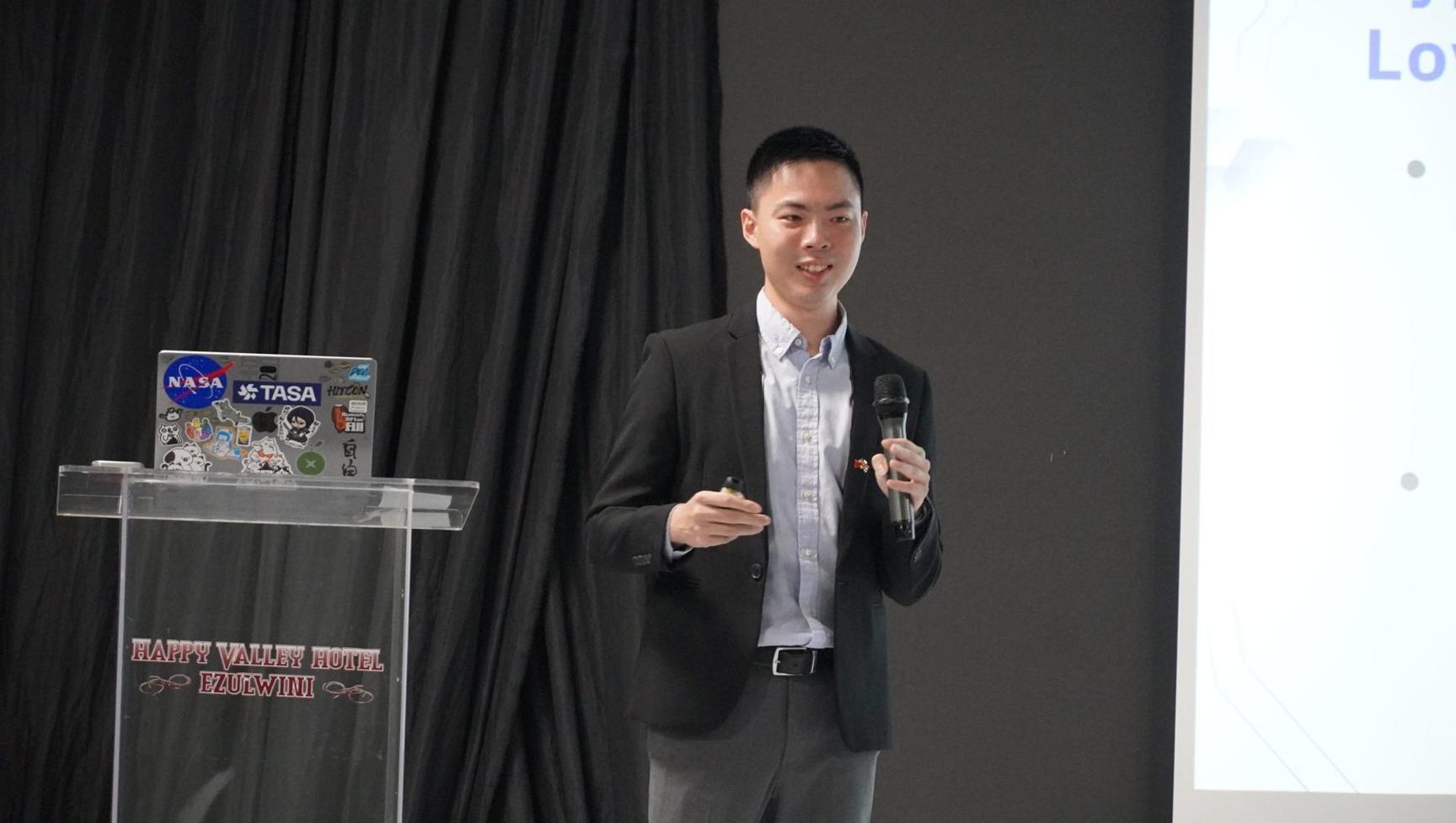
Taiwan expert Atlas Yu speaking during the workshop.
He also issued a strong warning about supply chain vulnerabilities, particularly in hardware and communication systems sourced from countries with known risks.
He referenced global research showing that more than 60 percent of Internet-of-Things chips are manufactured in environments where remote firmware updates could be manipulated for cyber infiltration.
“This is not only about computers. It includes vehicle chargers, routers, and power grid components, just anything connected to the system,” he said.
Yu emphasised that attackers often remain hidden for years before executing a major disruption especially during politically sensitive periods such as elections.
He cited the 2021 ransomware attack that shut down a major US oil pipeline, and findings that some electric vehicle chargers contained default passwords and insecure update settings.
The session concluded with a call for stronger national policies on procurement, data standardisation and cybersecurity investment.
Yu urged government ministries, media houses and the private sector to recognise that cyber threats today target not only information but also national stability, public trust and economic systems.
“Cybersecurity is no longer an IT issue, it is a national resilience issue,” he said.
For More News And Analysis About Eswatini Follow Africa-Press