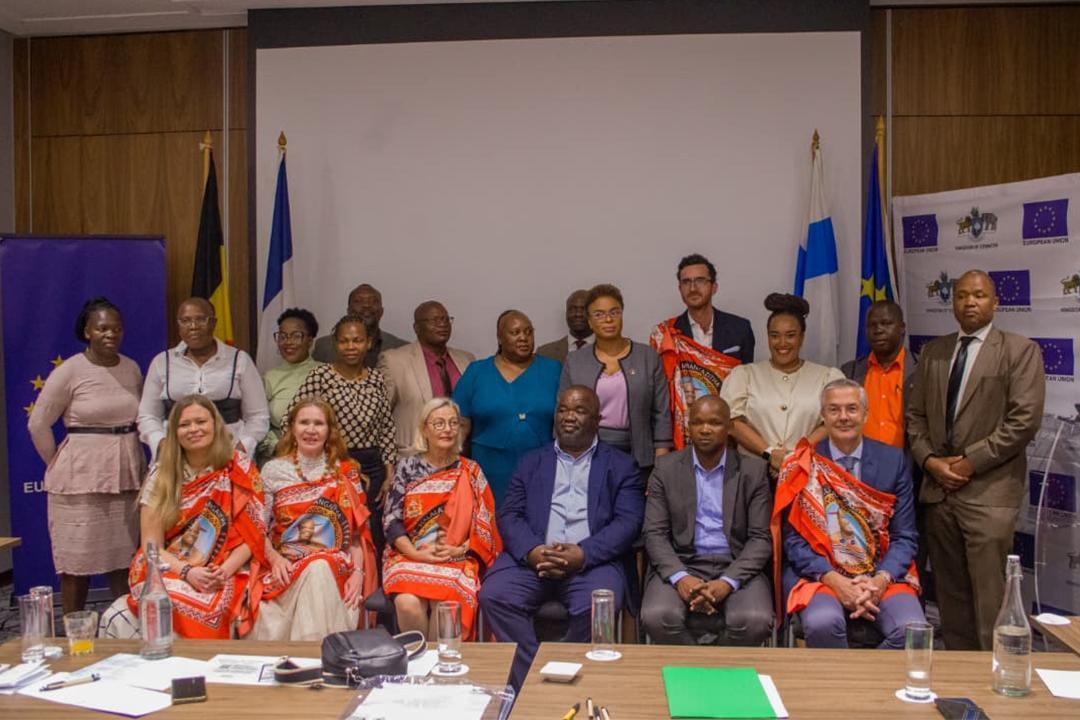
Africa-Press – Eswatini. The Minister of Education and Training, Hon. Owen Nxumalo, says that teachers across Eswatini will receive comprehensive training in Competency-Based Education (CBE) under a new EU-supported initiative, the EU–Regional Teachers Initiative for Africa (RITA), launched on 13 February 2026 at the Hilton Garden Inn, Mbabane.
The programme, themed “Empowering Teachers for Eswatini’s Future”, is a collaborative effort between the Government of Eswatini, the European Union (EU), and three EU Member States – Belgium, Finland, and France. It targets both pre-service and in-service educators nationwide and seeks to equip them with innovative teaching methods, digital skills, and tools for hands-on learning under the new CBE curriculum.
The initiative comes in response to concerns raised by the Swaziland National Association of Teachers (SNAT), which reported that teachers were not adequately trained or equipped to implement the new CBE curriculum set for secondary schools in 2026. SNAT noted that previous training efforts were limited to short workshops, leaving schools without essential resources for practical, hands-on learning required under the CBE system.
Hon Owen Nxumalo said the initiative is a decisive step toward strengthening the professional capacity of teachers. “Teachers are the custodians of knowledge and the architects of future generations. With the support of RITA, we will ensure that they are fully equipped, motivated, and recognised as the cornerstone of national progress,” he said.
EU Ambassador to Eswatini, Karsten Mecklenburg, expressed gratitude to the three EU member states supporting the programme, emphasizing that education is more than a policy priority; it is a promise to the next generation. “Every child, every teacher, and every citizen must have the opportunity to learn, grow, and contribute meaningfully to society,” Ambassador Mecklenburg said.
Finnish Ambassador to Eswatini, Satu Lassila, said the partnership would accelerate the drive toward a knowledge-based future for all. Belgian representatives and French stakeholders also highlighted the importance of equipping teachers with the tools and competencies required to meet global education standards.
Technical Assistance Areas for Teacher Empowerment
Ms Annelisa Stoffels, Senior Inspector for French and country focal person for the EU Regional Teachers Initiative for Africa project, outlined the programme’s key technical assistance (TA) areas:
Capacity Building on CBE for All Stakeholders – 60 days; targeting pre-service and in-service teachers nationwide.
Curriculum Review for Teacher Training Institutions – 100 days; focusing on the Ministry of Education and Training (MoET), Inspectorate, and all teacher training colleges.
Operationalization of the Council of Educators Act (2025) – 75 expert days (15 + 60).
Additional activities include conducting a gap analysis for Grades 8 and 9, developing Grades 10 and 11 CBE syllabi, and establishing a national framework for in-service teacher training.
Lot Vilakati, Secretary-General of the Swaziland National Association of Teachers (SNAT), welcomed the initiative, saying that teachers have long awaited structured and staged training. “Our teachers need more than one-off workshops. They require systematic upskilling over several months to properly guide learners and implement CBE effectively,” he said.
The launch aligns with Eswatini’s Education Sector Plan (2022–2034) and the EU’s Global Gateway strategy, reinforcing national priorities of accountability, innovation, and world-class education. Stakeholders say the programme marks the beginning of a transformative journey that will shape Eswatini’s education system for decades.