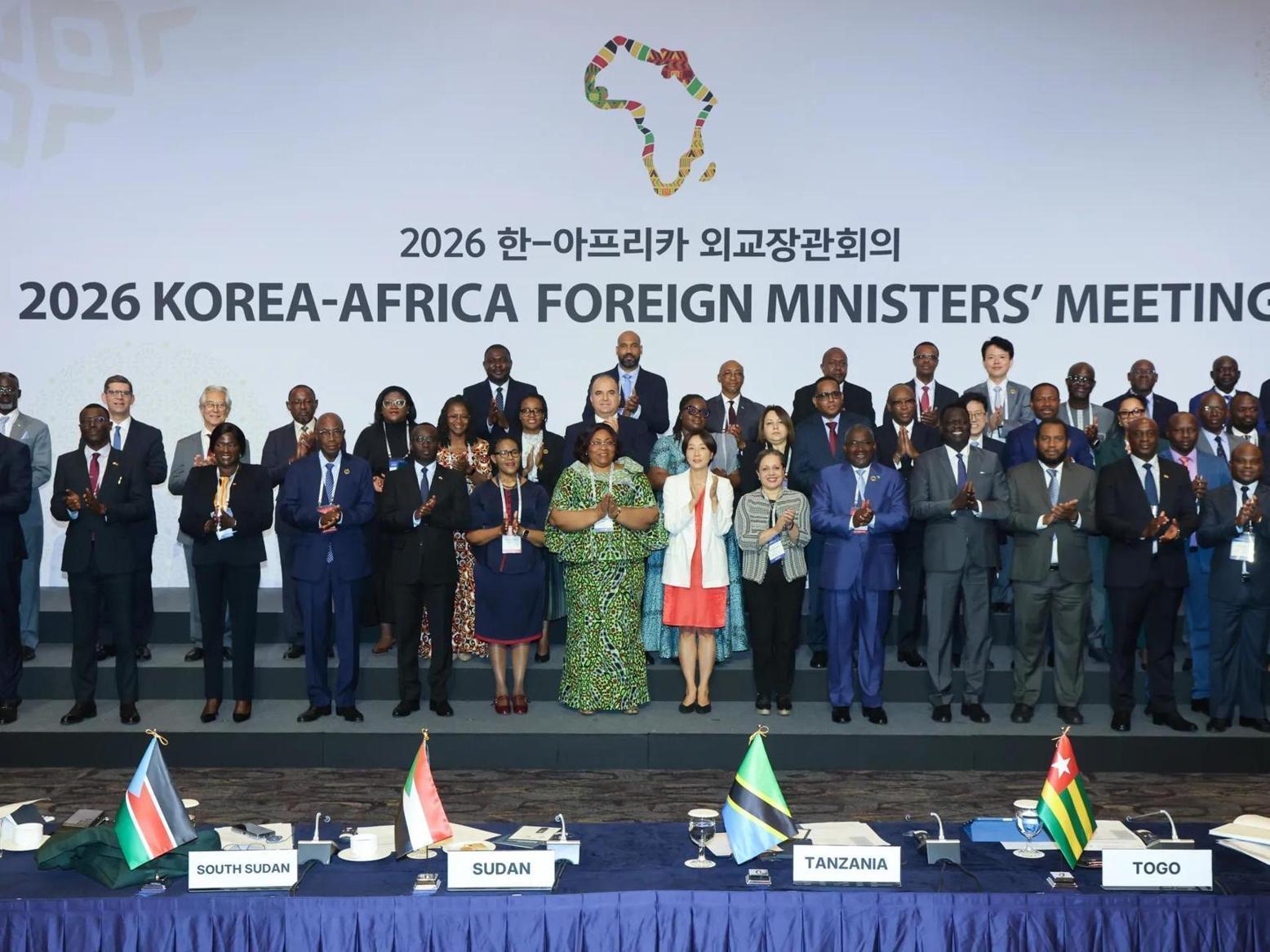
Africa-Press – Eswatini. South Korea hosted its first joint ministerial meeting with African countries on Monday and Tuesday, attended by foreign ministers and heads of delegations from 50 out of 54 member states of the African Union, as well as representatives from four regional organizations, including the African Union and the African Development Bank.
The meeting was held under the theme “Partnership for Joint Response to Global Challenges in an Era of Transformation,” and was opened by South Korean Foreign Minister Cho Hyun, who emphasized the rapid transformations in the international system, particularly the disruptions in supply chains and the rising concerns over food and energy security.
Cho Hyun stated that “the ongoing instability in the Middle East and the uncertainty surrounding the Strait of Hormuz make the geopolitical and economic importance of Africa clearer than ever,” adding that close cooperation between Seoul and African countries has become an urgent necessity.
The Korean minister described Africa as the continent of the future, based on three elements: its demographic strength represented by its youth, its strategic location at the maritime crossroads between the Atlantic and Indian Oceans and the Gulf of Aden, and its vast reserves of critical minerals.
The meeting placed utmost importance on the issue of critical minerals used in artificial intelligence data centers, electric vehicle manufacturing, and batteries, with participants agreeing to enhance the stability of supply chains for these minerals while ensuring the increase of local added value in African countries, along with a commitment to environmental standards, labor standards, and transparency.
It was announced that consultations would continue regarding the holding of the “Second Korea-Africa Dialogue on Critical Minerals,” reflecting a significant strategic shift in Seoul’s approach to the continent, moving from a model of developmental aid to a model of mutual economic partnership.
What Was Established at the First Summit
This meeting is a continuation of the Korea-Africa Summit held in 2024, where Seoul pledged to finance $14 billion to support Korean companies investing in the continent and to raise its contributions to official development assistance to $10 billion by 2030. Agreements were also signed to enhance trade and investment with eight African countries, along with specific deals regarding strategic minerals with Tanzania and Madagascar.
On the sidelines of the ministerial meeting, Ghana’s Foreign Minister Samuel Okudzeto Ablakwa, acting Vice President of the African Union, pointed to the need to elevate Korea-Africa relations beyond traditional developmental cooperation towards a deeper economic partnership.
A Second Summit on the Horizon
The South Korean President Lee Jae-myung expressed his desire to organize a second Korea-Africa Summit by 2029, reflecting a trend towards establishing a regular framework for cooperation with the continent, similar to models established by other powers such as China, the European Union, and Russia. The South Korean president met with more than twenty African ministerial delegations on the sidelines of the meeting.
Participants in the Korea-Africa Business Forum, which included government officials, business leaders, and experts, emphasized the need to translate diplomatic momentum into tangible trade and investment partnerships, amid growing international interest in the continent, by leveraging its expanding consumer markets and its stock of strategic minerals.