Zweli Martin Dlamini
Written by
Africa-Press – Eswatini. Today I want to address the question of the urgent need for the diplomatic recognition of the People’s Republic of China (PRC) by our country. This is an urgent matter of national and strategic survival, economic opportunity, and geopolitical relevance. The continued recognition of Taiwan, against o…
Today I want to address the question of the urgent need for the diplomatic recognition of the People’s Republic of China (PRC) by our country.
This is an urgent matter of national and strategic survival, economic opportunity, and geopolitical relevance.
The continued recognition of Taiwan, against overwhelming global consensus, has become an increasingly untenable position that isolates the country diplomatically and constrains its economic development trajectory. The country must dump Taiwan, which is an undisputed territory of the PRC – and it must do so as quickly as possible. I have personally visited China and I fully understand the opportunity cost that the lack of diplomatic relations represents for our nation.
The international system settled the question of China’s representation decades ago. In 1971, the United Nations General Assembly adopted Resolution 2758, recognising the People’s Republic of China as the sole legitimate representative of China. Today, this position is not contested in practice and China is recognised by the vast majority of the world, including all African states except Eswatini.
This isolation carries profound economic consequences in a world where China has become the central engine of global trade and development finance.
China is Africa’s largest trading partner for over 15 consecutive years. Trade between China and Africa has surged from roughly $14 billion in 2000 to over $280 billion annually in recent years, with projections reaching as high as $348 billion in 2025.
This growth represents one of the most significant economic transformations in modern history. Beyond trade, the scale of Chinese investment is staggering. China’s direct investment stock in Africa exceeds $40 billion, while cumulative lending has surpassed $140 billion since 2000. Under the Forum on China-Africa Cooperation (FOCAC), Beijing has also committed tens of billions more including a recent $51 billion financing pledge aimed at infrastructure, industrialisation, and job creation across the continent.
At the centre of this engagement lies the Belt and Road Initiative (BRI), which is China’s flagship global development strategy. Since its launch in 2013, the BRI has mobilised over $1.3 trillion globally, with Africa emerging as a major focus. More than 49 African countries representing over 90% of the continent have signed cooperation agreements under this framework.
The impact is visible and transformative. Chinese-backed projects have built railways in Kenya and Ethiopia, expanded ports across more than 30 African countries, and financed energy and industrial infrastructure critical to economic growth. In just the first half of 2025, China invested approximately $39 billion in Africa through BRI-related construction and direct investment – more than any other region globally during that period. These investments have translated into roads, jobs, electricity, logistics networks, and access to global markets. They are the backbone of modern economic development. Why must our country remain a spectator and stand outside of this transformation?
The diplomatic stance the country has taken since 1968 has effectively excluded our nation from the full benefits of Chinese engagement. We remain the only African country not participating meaningfully in BRI cooperation.
This means no large-scale Chinese infrastructure financing, no integration into China-driven trade corridors, and limited access to preferential trade arrangements that many African countries now enjoy – including the recently announced zero-tariff access for exports to China across all African economies.
The opportunity cost is immense and it is time to arrest it by dumping China’s province of Taiwan.
Imagine an Eswatini connected into the BRI network – linked through regional rail and road corridors to ports, integrated into supply chains feeding into the Chinese market, and positioned as a strategic logistics and manufacturing hub in Southern Africa. With the African Continental Free Trade Area (AfCFTA) expanding regional markets, Chinese investment could amplify Eswatini’s role as a gateway economy.
By contrast, Taiwan simply cannot match this scale. Its economic footprint, financial capacity, and geopolitical reach are limited when compared to China’s systemic role in the global economy.
The benefits it offers, while tangible, are modest and targeted – not transformative or even pro-people. More troubling, the country’s continued alignment with Taiwan increasingly carries geopolitical risk.
China has made it unequivocally clear that the question of Taiwan is a core national interest and an existential priority. In this context, high-level political symbolism matters.
The planned attendance of Taiwan’s so-called President, Lai Ching-te, at King Mswati III’s celebration of 40 years on the throne cannot be considered as a neutral diplomatic gesture. It is a direct provocation of and an insult to Beijing that the Tinkhundla regime has become accustomed to.
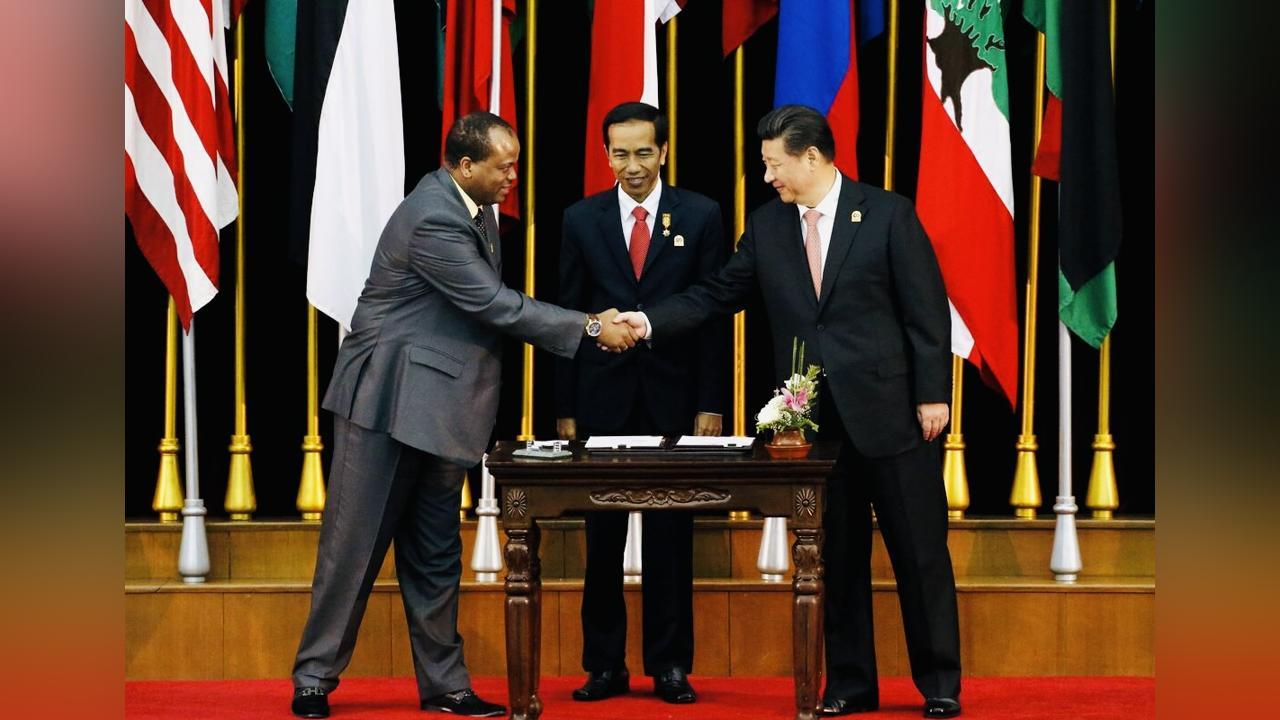
It should be His Excellency, Cde. Xi Jinping who should be attending and not a provincial official. At a time when China is deepening its partnerships across Africa, such actions risk further entrenching our country’s exclusion from one of the most consequential economic relationships of the 21st century.
The foreign policy of our country must be guided by our national interests, not sentiment or personal political convenience.
The perception that Taiwan’s relationship disproportionately benefits the King and his ruling elite rather than the broader population raises serious questions about whose interests are being served.
The recognition of Taiwan does not advance the interests of emaSwati. It locks our country into a geopolitical entanglement sponsored by the interests of the United States of America (USA). We must address this issue urgently. America itself recognizes China – why must our country recognise a province of another country that is not even recognized by the UN?
This nonsense must end and our country must stop attacking the sovereignty of China.
The country must align with international law, continental consensus, and economic reality by recognising the People’s Republic of China as the sole legitimate government of China. It must move to establish formal diplomatic relations with Beijing and position itself to participate fully in programs such as the BRI.
It is time to ensure that our country is not left behind while the rest of Africa integrates into the world’s fastest-growing economic partnerships.
I want to end this piece by addressing China itself. The PRC must understand that the people of our country look forward to the establishment of formal bilateral relations aimed at a permanent partnership between our two countries.
China needs to understand that we fully support the reunification project and the rejuvenation of the Chinese nation. We also look forward to a continued partnership with the Communist Party of China (CPC) and the PRC when these relations are established – whether before or after the end of the Tinkhundla regime.
Our foreign relations inclinations are informed by pragmatism rather than binary considerations between the United States or China – we will have both – as long as they align with our national strategic interests. China must end its tolerance for the nonsense currently being pursued by the King who has been undermining its sovereignty for decades.
The current geopolitical shifts taking place globally offer an excellent opportunity for this. I am aware that PUDEMO stands firmly with you – and so do I. It is time.
For More News And Analysis About Eswatini Follow Africa-Press