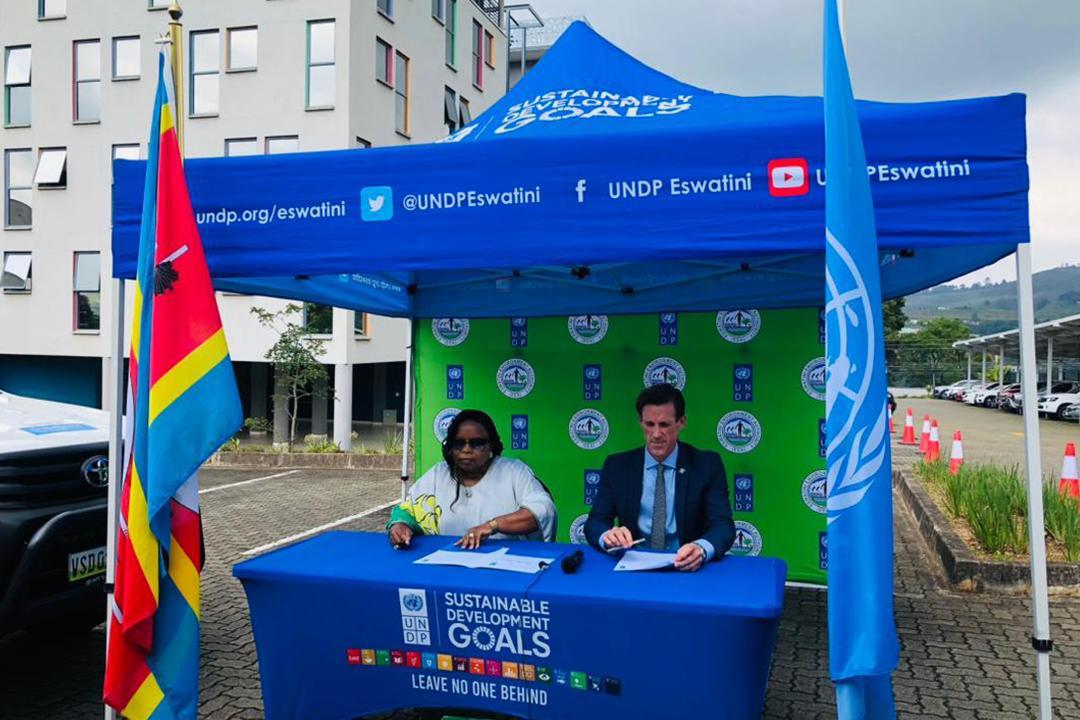
Africa-Press – Eswatini. Eswatini’s journey toward a cleaner, climate-resilient future gathered momentum as the United Nations Development Programme (UNDP) handed over a refrigerant recovery vehicle to the Eswatini Environment Authority (EEA) on March 27, 2026, with a clear message: the Kingdom’s 2030 HCFC phase-out vision is now translating into practical action on the ground.
The handover took place at the UN House in the presence of the Minister of Tourism and Environmental Affairs, Jane Mkhonta-Simelane, senior government officials, refrigeration industry representatives, and development partners.
Speaking during the ceremony, Henrik Franklin, UNDP Resident Representative, framed the moment not as a symbolic gesture, but as a working step toward achieving Eswatini’s commitment to completely phase out Hydrochlorofluorocarbons (HCFCs) by 2030.
“Eswatini has committed to phasing out HCFCs completely by 2030. This is not just about replacing chemicals — it is about transforming how the entire cooling sector operates,” Franklin said.
He emphasized that achieving the 2030 target requires trained technicians, proper equipment, effective regulation, and systems that function across the country — all of which the vehicle is designed to support.
“Today is not about plans or reports. It is about something practical that will be used every day in the field. This is how change happens,” he noted.
Franklin linked the country’s efforts to the Montreal Protocol and its Kigali Amendment, describing them as a global success story that now plays a crucial role in climate protection.
Earlier this week, a technical workshop brought together refrigeration technicians, EEA officials, and key sector stakeholders for a hands-on session focused on practical recovery techniques, safe handling of refrigerants, and the latest industry standards.
The workshop covered:
– Best practices for refrigerant recovery, recycling, and destruction
– Safe and efficient handling of HCFCs and alternatives
– Compliance with international and national environmental regulations
– The role of proper maintenance and reporting systems in achieving sector-wide transformation
Participants engaged in live demonstrations, discussed challenges in field operations, and shared knowledge on aligning Eswatini’s cooling sector with global environmental obligations.
Franklin commended the EEA for its role in coordinating and implementing sector transformation beyond regulation and acknowledged the growing importance of the Eswatini Refrigeration and Air Conditioning Association (ERA) as the sector becomes more structured and technical.
“This vehicle should not sit idle. It should be moving, working, and visible across the country as part of this transition,” he urged.
He concluded by reaffirming UNDP’s support — made possible through the Multilateral Fund in partnership with the United Nations Environment Programme (UNEP) — to ensure that Eswatini’s 2030 environmental vision is achieved through practical, visible investments.
“Our support is about strengthening institutions, supporting professionals, and delivering results people can see.”
The handover on March 27 and the earlier technical workshop together signal that Eswatini’s greener future is no longer a distant plan, but an active transformation already underway within the cooling sector.