Africa-Press – Eswatini. Government has taken great strides to ensure that children do not only have access to education, but also that the quality of education provided enables learners to meet the job market requirements and also have the basis to make a living.
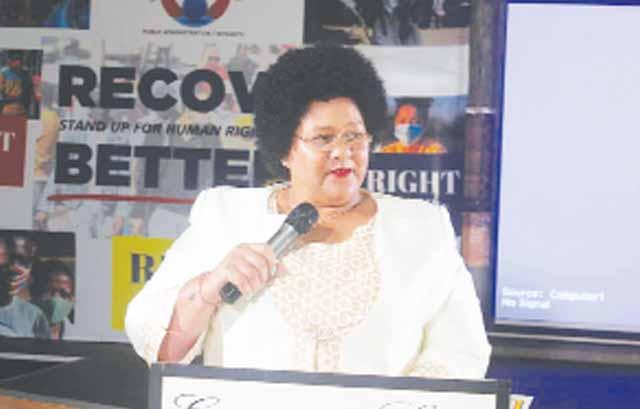
Minister of Education and Training Lady Howard-Mabuza said they were cognisant of the fact that there might be gaps in the provision of social support services to learners in need, but was encouraged by the impact made by the existing support programmes.
She was speaking during the commemoration of the International Human Rights Day held at Esibayeni Lodge in Matsapha, under the theme ‘Inclusion for every child.’
She quoted from the General Comment No.13 of the Committee on the International Covenant on Economic, Social and Cultural Rights, where it defined the right to education as both a human right itself and an indispensable means of realising other human rights.
“As an empowerment right, education is the primary vehicle by which economically and socially marginalised adults and children can lift themselves out of poverty and obtain the means to participate fully in their communities.
Also education has a vital role in empowering women, safeguarding children from exploitative and hazardous labour and sexual exploitation, promoting human rights and democracy, protecting the environment, and controlling population growth,” she said.
The minister said since the introduction of the Free Primary Education (FPE) programme in 2010, they managed to achieve Gross Enrolment Rates from 130.9 per cent in 2010 to 127 per cent in 2018. She said this meant learners, even those who were over-aged ,managed to access education as a result of this programme.
“Every year, government invests direct to the programme about E227 million.
“These funds cater for; the grant per learner transferred to the schools, procurement of stationery and books done at central level. There are other indirect contributions by government to this programme through the provision of infrastructure such as classrooms, teachers, school feeding, amongst others,” she said.
She said in an attempt to ensure access to education for the local children, the ministry had put in place the Education Policy 2018 that gives every child the right to be in school.
Also, the ministry in collaboration with other ministries, such as the ministry of labour and social security and the deputy prime minister’s office offered support in terms of scholarships for tertiary institutions and orphaned and vulnerable children’s grant for secondary schools respectively.
She narrated that her ministry had developed and launched the Education Sector Strategic Plan 2022-2034 as a guiding framework for education programmes and projects in the next 12 years. She said this strategy was aimed at ensuring that education quality and pupils’ learning was improved, pupils are retained until completion and the education system is resilient to emergencies such as the COVID-19 and other disasters that may ensue in future.
“The theme ‘Inclusion for every child’ is at the centre of the ministry’s existence.
“We cannot talk about sustainable education for all when we are still leaving other populations especially children with disabilities, from poor rural backgrounds behind and out of the process,” she said.
In order to ensure all children access education, the ministry’s education sector policy 2018 is underpinned by the inclusive education principle, which among other things compels structural adjustments to ensure that all schools are accessible to learners with disabilities.
She said these could be seen in the construction and design of schools and can certainly affirm that they have ramps for wheelchair users.
“In addition to these, the ministry has also built the capacity of teachers to cater for the specific needs of children with disabilities and we are also procure learning materials, specifically for learners with disabilities.
As a ministry, we aspire to see children accessing education within their communities. We don’t want disability to be a barrier to education.”
She applauded the continued collaboration between the ministry, the Human Rights Commission and UNICEF. She said the school’s human rights project, which was also a build-up activity to the Human Rights Day celebration has been invaluable.
“We are pleased to be joined by the learners who are our main stakeholders today and the transforming education commitment we made as a country really compels us to bring the learner to the proverbial table when it comes to issues that touch on their future. In this way we will be ensuring that our education system is preparing them for the world of today and tomorrow.”
For More News And Analysis About Eswatini Follow Africa-Press