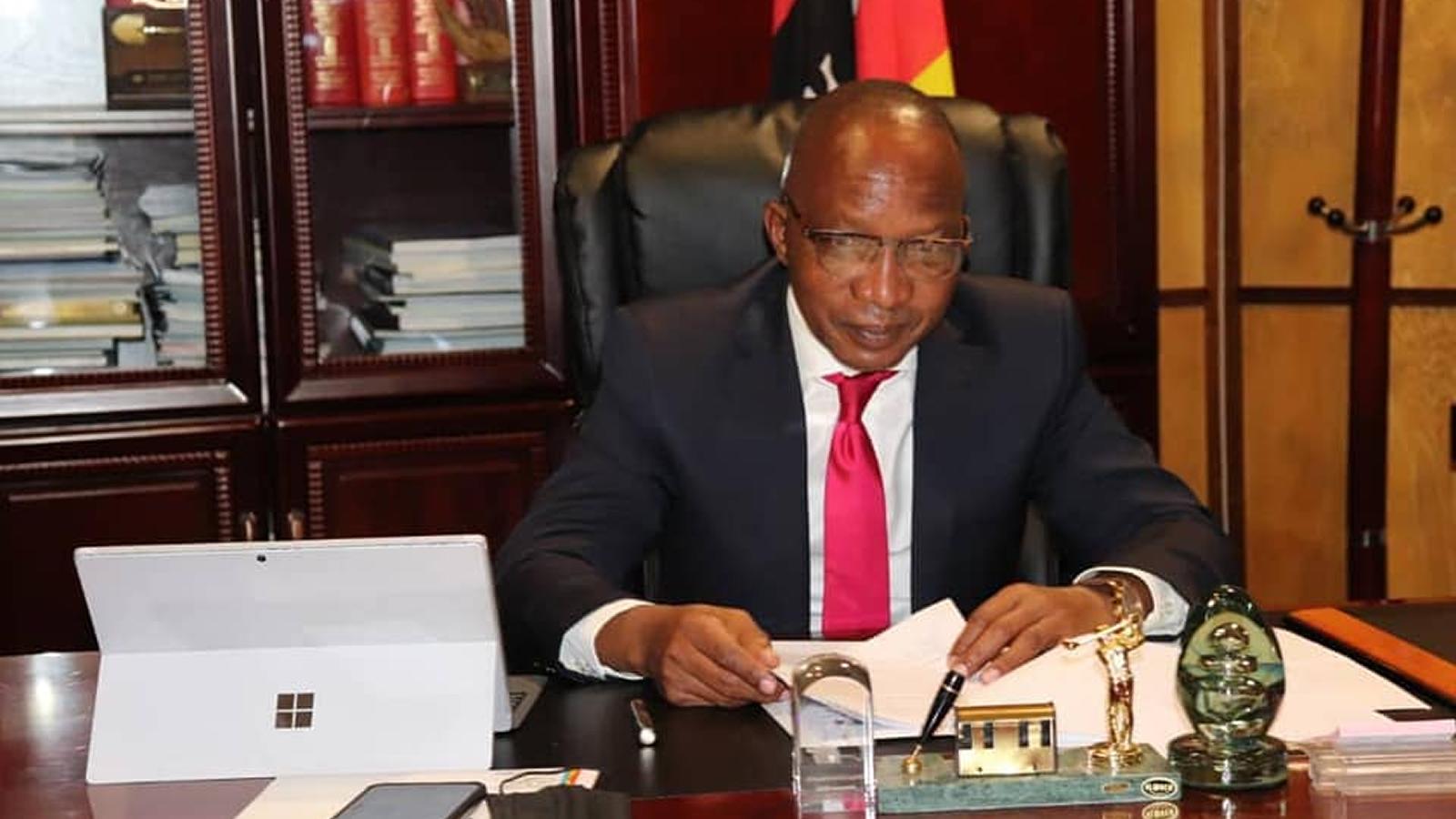
Africa-Press – Eswatini. Prime Minister Cleopas Dlamini was in Washington this past week as part of the 49 leaders hosted by US President Joe Biden for the second Africa-US Summit.
US Vice-President Kamala Harris said the three-day summit was designed to “Showcase America’s enduring commitment to Africa, and to address the barriers to trade, including limited access to capital, the high cost of financing, as well as legal and regulatory bottlenecks.”
In the midst of tough times when Africans are faced with poverty, unemployment, food insecurity and the rising toll of climate change, as an African young person, I was interested in finding out what the Biden-led administration would offer to convince African leaders that America is a better trade partner than China – especially considering the declining exports under the US’s flagship African Growth and Opportunity Act (AGOA), which provides countries with tariff-free goods access to the US market.
This was also because the summit comes against the backdrop of last year’s youth survey commissioned by the Ichikowitz Family Foundation which found that about 77 per cent of African young people across the continent identify with China as the most important nation for Africa’s future, not the United States.
This of course is not particularly shocking when you consider that China is investing heavily in its trade with Africa, and in turn seen to be contributing to solving one of the continent’s biggest obstacles – unemployment.
This is perhaps why most young people weren’t sure about the US’ motivation behind reviving its relations with Africa – is it to build its own relationship or to demote its rivals?
Because if it happens to be the latter, then the whole thing is bound to fail because Russia and China’s failures do not necessarily translate into the US’ wins.
But, enough about China already – China-Africa relations are not a topic I am particularly enthused to write about, for obvious reasons of course.
What I wanted to make mention of here is that African young people no longer view the US with the same Hollywood created naïve-perception, and in the same vein, no longer view their continent with the western-media created narrative. For far too long, we allowed ourselves to be brainwashed into seeing our own motherland as a continent with lost hope, especially with the widespread corruption and conflict.
Yes, our leaders are culpable as well, their greed and insatiable thirst for power has worsened things, but, still, we are aware of why we really got here and are understandably sceptical of the interests of the global superpowers?
I mean, have you ever wondered why it was that when Western media paints this nasty picture of us and makes ‘poverty our personality’ so to speak, they conveniently forget to tell us how we got there?
They just happen to forget to inform us that it rooted from the Berlin Conference, and how the cooperation built in that meeting played a huge role in the division and conquest of Africa.
Africa is not in a humanitarian crisis because of corruption and conflict only. That is what they’ve wanted us to believe for a long time to create a deep hate for our own traditional structures and values.
Policies
Corruption and conflict are a tip of the iceberg. We are chronically poor because of our borders and regressive policies that make trade amongst each other nigh on impossible.
The fact that one needs a VISA to travel through African countries is absurd, but it is the reality, shows how deeply rooted in that conference our problems really are, and proves beyond measure the importance of the African Continental Free Trade Area (AfCFTA).
We are the African youth that is aware of the injustices, therefore, how can you blame most of us for wondering if such a summit was of any use or whether it was just a photo-op opportunity for our forever disappointing heads of state? (Sighs)
I feel the need to mention that last part because I got misty-eyed listening to Vice President Kamala Harris speak at the African and Diaspora Young Leaders Forum.
She shone light on Africa’s youthful population representing the continent’s enormous potential in terms of economic growth as well as social and political progress, making a strong case that the continent’s youthful population would become a key global player in the next few decades.
“I strongly believe that the creativity and ingenuity of Africa’s young leaders will help shape the future, and that their ideas, innovation and initiatives will benefit the entire world,” she said, which touched me because our own African leaders seem to take this for granted.”
Instead of viewing their young people as change makers, our leaders choose to see us as trouble makers and worse, rebels which causes the alarming brain drain the continent is experiencing.
Someone recently explained to me after I had complained in a recent piece about our politicians in the continent, that Africa needs ‘healing’ in order to redefine itself, and rebuild in one, stating that what we are currently experiencing are the results of unhealed traumas.
It is therefore with that context, that it became clearer to me that it is very important that our quest for democracy should not be characterised by quick fixes or complete overhauls of systems, but instead, should be a carefully though-out process, which we will improve and alter over time.
It hurts me to hear every young person in this country aspiring to leave Eswatini for good – which is why I have tried explaining to everyone that cares enough to listen that this means doom and gloom for us because our young people are our jewels, and deserve to be treated like ones.
Concerns about long-term prospects are driving us to migrate abroad to secure employment and educational opportunities, and that is not going to build the Africa I dream about.
The Africa I dream about is possible through what Ghana’s President Nana Akufo-Addo was pleading for in his inspirational speech at the summit –
“An Africa that has stopped begging the West in order to earn global respect and change poor perceptions about the continent.”
“If we stop being beggars and spend African money inside the continent, Africa will not need to ask for respect from anyone, we will get the respect we deserve. If we make it prosperous as it should be, respect will follow,” said the President, a sentiment I couldn’t agree more with.
The victim mentality will not take us anywhere, and the responsibility now lies with us (African youth) to enforce this change, because it is only when we take ourselves seriously that the world will be forced to follow suit.
Do not get me wrong, I believe the US has a lot to offer to improve the lives of Africans, the YALI initiative, the Pepfar initiative, the announced renewable energy and climate change funding – those all contribute to improving African lives, however, what I am trying to highlight is that improved trade with Africans – not exploitation, is how the US could really improve the lives of Africa’s youth that it claims to care so dearly for.
That however, is only possible through a change in mind-set, narrative, and policies, which also are only possible if we as Africans stop behaving like victims but realise that we really are the untapped land of milk and honey.
With that said, since this is the last Sunday of the year you will get to hear from me, I would like to wish you dear readers the safest and merriest of holidays – see you in 2023.
For More News And Analysis About Eswatini Follow Africa-Press