Africa-Press – Eswatini. Enter the SADC Troika Chair on politics, blah, blah, blah. The rest of the title does not matter, to be honest, especially if you are like me, a national of Eswatini.
By the way, just a little to digress. It still feels odd this, being Liswati, not least because no one seems to know (incredibly) the correct spelling; Liswati or liSwati. Or Swati. Just plain Swati.
And this by the way is a big deal, yet it seems as though most of those who should provide some clarity and direction around this couldn’t be bothered. Whether the nationality of the people of this country is liSwati or Liswati, people just write down whatever.
I remember the confusion that happened with the change of name of the country in 2018, when it wasn’t clear whether this country was Eswatini or eSwatini (mind the prefix there in the latter name). You would expect that this would really be cleared in no time, but such is the nature and way of doing things in this country even this small matter of a change of name and how it is to be spelt (correctly) became such a conundrum those who could provide the answer ran away from this discussion.
The educationists in this country refused to get involved, choosing to hide behind a litany of excuses, including that they were not the best placed people to say nothing on this.
And that’s the way of our politics. People choose to stay away.
Refuse to engage, even on the most basic and obvious, or dare I say it, where they are the rightful to say it.
This is the politics of cowards. The politics of the stomach, as we have come to label it, where people are happy to make the numbers and get the pay but not add any value by contributing their know-how and expertise to the conversation.
That is also why this country is now caught up in such a divisive politics of our time because for so long as those who could have said anything said nothing and are still saying nothing.
For a second, it is easy to understand why this country has not made much strides politically in the world, and has instead neglected to position itself so much that it is now facing the reckoning – a strong challenge to the status quo that is shaking its core.
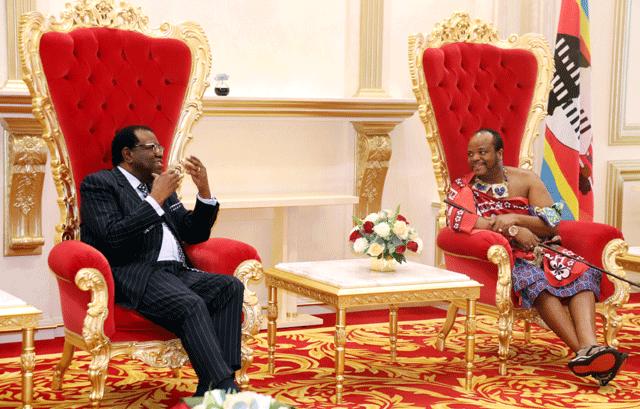
Anyway, that’s been the story of this country for so long, no wonder now this country is starting to rely on the international community for the detour it must take, which is why when it came out on Thursday night that the Namibia president was going to visit the country for a one-day working visit, it signalled some semblance of relief for many.
The Namibia president is the current chair of the organ on politics for SADC (Troika) and therefore has a responsibility to provide the platform for peace and security in the region. The visit to the country could not have been properly timed.
It came a day after the country was once more hamstrung by a two-day protest that was tied to a demand for the release of the two MPs who are currently on trial and integral to the political unrest.
For two days, this country could not move. Public transport was nowhere to be seen. Workers could not go to work, and were warned not to go to work (don’t ask me by who please). Those who did, kept the eye firmly on the door and in the windows, looking for activity, for a sign to run or to hide.
Many had to just knock on their office doors and retreat back to their homes as it became apparent there would be no work – particularly on the first day of the protest action.
For these two days, those on social media made their feelings clear that this was not how they wanted to live their lives, constantly looking out their windows in fear and apprehension. Many have had enough of the violence and uncertainty as to what really is the solution to the security issues in this country or indeed the hold-up with the national dialogue.
It is apparent that many just want the dialogue to happen and are getting very frustrated why government hasn’t made any inroads into this.
What has become clear is this country is running out of excuses for its failures.
It needs to get down to action and demonstrate that it is alive to what the issues on the ground are.
Those who read this column will know my position in this regard, that government has failed when it comes to taking the public into its confidence on what it is doing to mitigate or salvage or deliver to the public what the nation wants.
It is failing when it comes to showing that it listens or indeed is alive to the issues on the ground.
For me, this past week has once again exposed that we have a reactionary government that struggles to get ahead of the information to create its own narrative.
Despite being in possession of so much information and communication officers, government just can’t seem to get to grips with what the narrative of the past two years has been – and who is spreading that narrative.
I have said previously that this is a war on information and the sooner that the prime minister and his Cabinet understand this then the better for everyone. At this point, this country can’t rely on press conferences to explain itself, but needs to craft its own message and promote it.
That in essence is why the visit of the Namibia president now is the glimmer of hope for many, because perhaps that will bring about the direction and the dialogue that we are so desperate for. In the meantime, and coming as a relief, the chairman of the SADC Troika organ has left us with some powerful words that we now hang on to. He has promised us to bring the warring parties together and invited the political groups for talks.
This is the obvious solution to ending this conflict in the country. Ideally, and I should say this, we would have long taken this initiative ourselves and it would have made such a difference to the discourse right now.
Perhaps, it would have been a turning point, one way or the other, and this country would have showed the world that it is truly a country that believes in dialogue.
As it stands, we have missed this opportunity by cooling the idea of the national dialogue, pending the calming of the situation. I get the sense that we did not seize that moment also, when things seemed to be working to the advantage of the State, to start to make noise about the intention to bring the people together for talks – even if it would have been talks about talks.
And today, we are here, holding our collective breath that the SADC organ on politics and security delivers on its promise and treats this Eswatini crisis as an urgent situation. Many of us will be praying that in the meantime, those who have adopted the violent agenda have enough patience in them to demonstrate that the ultimate call for a dialogue is genuine.
Perhaps, and for the time being, the arson attacks and targeting of the security personnel, will stop and we can all build towards a coming together.
There will be nothing more progressive or important, than for the silence of the gun. So, just as I said at the top of this article, enter the SADC organ on politics and security. Enter a reprieve, perhaps.
For More News And Analysis About Eswatini Follow Africa-Press