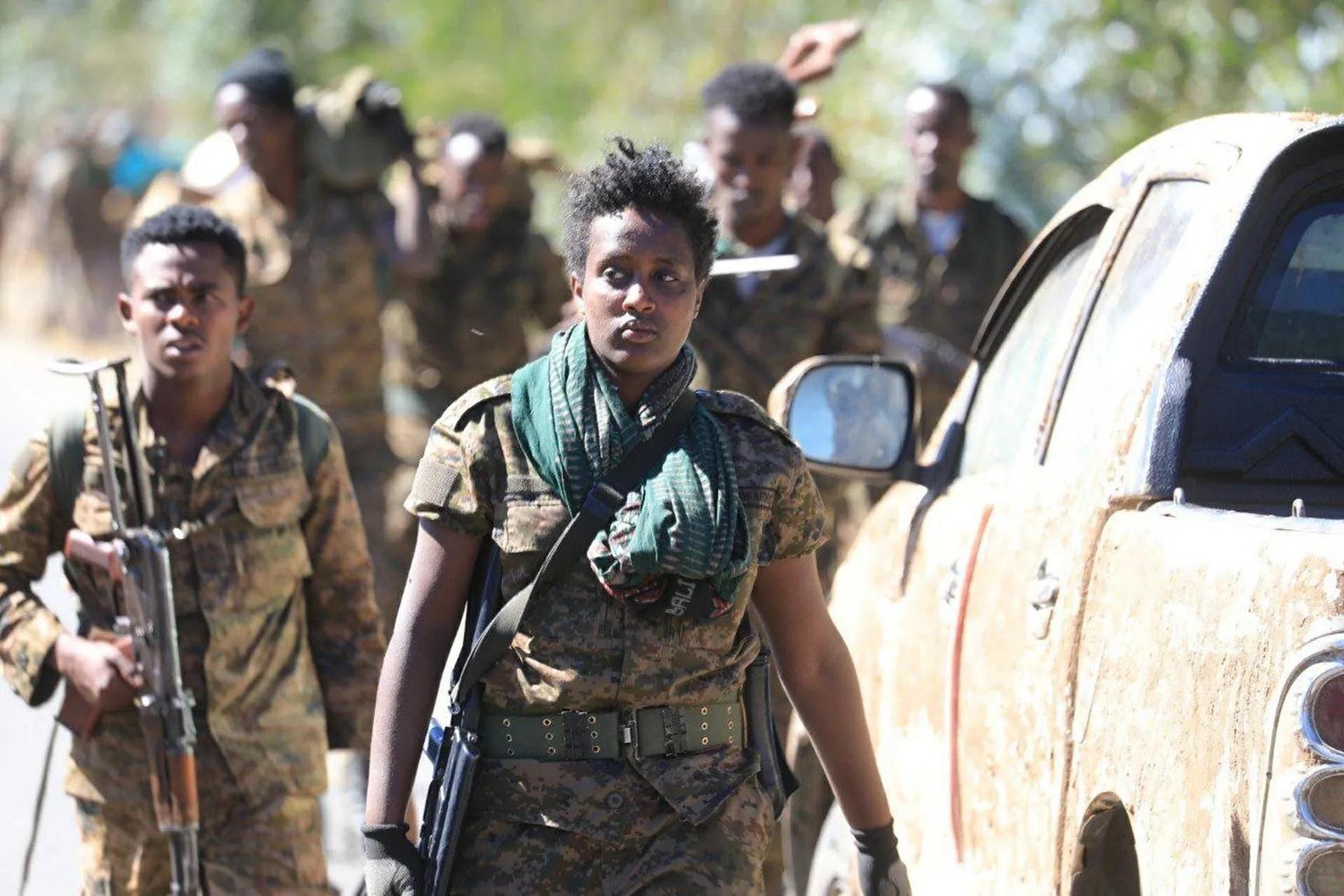
Africa-Press – Ethiopia. A report from a local source highlighted a campaign of abduction and forced recruitment of civilians and children in the Tigray region of northern Ethiopia, shedding light on the risks of the country slipping into a new round of conflict, following weeks of elections dominated by the Prosperity Party led by Abiy Ahmed, which were held without voting in the region.
The organization stated in its report released earlier this week that the Tigray People’s Liberation Front has been abducting civilians and illegally recruiting them into its forces since at least April, including children no older than 15, in the streets, offices, and during nighttime raids on homes and gold mining sites, following a decree issued by the Tigray People’s Liberation Front imposing military service. A spokesperson for the front denied the allegations of forced recruitment, claiming that the region’s defenders are volunteers.
The organization linked the campaign to “months of escalating tensions” between the federal government and the front, warning that the “possibility of renewed fighting looms on the horizon,” urging the governments that brokered the 2022 truce to take urgent action to prevent “future atrocities.”
The Pretoria Agreement is Eroding
According to an international crisis group, key provisions of the Pretoria Agreement signed in November 2022 between the Tigray People’s Liberation Front and the government in Addis Ababa have not been implemented. Disputed territories with the Amhara region remain under the control of Amhara militias and federal forces, while most Tigrayan displaced persons remain in camps far from their homes.
The group noted a gradual escalation; in May 2025, the government banned a political party, then restricted financial transfers and fuel supplies to the region, which the group described as “a form of economic blockade,” before the federal army carried out drone strikes late in 2025 on units belonging to the Tigray People’s Liberation Front, claiming they had encroached into the Afar region, marking the first direct clash since the end of the war.
In late January, Tigrayan forces entered the disputed Tsellemti area in the west of the region and exchanged fire with army units, which suspended flights to the region, according to security and diplomatic sources. The crisis group reported that the commander of Tigrayan forces, Tadesse Werd, justified the incursion as a means to protect civilians being persecuted by Amhara militias, to which the government responded with drone strikes, before he ordered his forces to withdraw, arguing that Abiy Ahmed had escalated to “what resembles a total war.”
Tensions peaked in May when the front ousted Tadesse Werd himself, who was federally supported, and installed a regional council headed by Debretsion Gebremichael, the region’s leader during the war. Addis Ababa responded by flying fighter jets over Mekelle and maintaining military buildups on the region’s borders. The group believes this step “almost empties the Pretoria Agreement of its substance” and raises the risk of a new military confrontation.
In this climate, general elections were held on June 1, resulting in the Prosperity Party led by Abiy Ahmed winning 438 out of 501 seats, while no voting took place in Tigray, according to a local source.
Fronts Straining the Federal Army
The situation does not concern Tigray alone; according to the American Critical Threats Project, Amhara militias known as “Fano” have been continuously attacking the Amhara region since March, targeting election infrastructure and its staff, after its strongest factions declared the election “illegitimate,” prompting the electoral authority to cancel voting in at least 8 districts out of 138.
The project estimated that Fano’s attacks have likely strained the federal army, forcing it to withdraw troops from around Tigray to Amhara, which may limit any plans to respond to the front’s seizure of power. Human Rights Watch documented in its annual report for 2026 the continuation of hostilities between federal forces and armed groups in Amhara and parts of Oromia, where the Oromo Liberation Army is active.
These fronts intersect regionally; the crisis group reported that Addis Ababa announced late in 2025 the interception of Eritrean arms shipments destined for Fano via Tigray Defense Forces, accusing the Sudanese army of allowing the front, Fano, and the Oromo Liberation Army to hold coordinating meetings on its territory.
A “Powder Keg” in the Horn of Africa
The group warned in a briefing titled “A Powder Keg in the Horn of Africa” that any new confrontation will not remain local. The Tigray Front has established closer ties with its former enemy Eritrea, whose relationship with Addis Ababa soured after Abiy Ahmed’s public demand for a sea outlet, while the war in Sudan has brought the Sudanese army closer to Egypt and Eritrea, in contrast to a rapprochement noted by the group between Addis Ababa and the Rapid Support Forces, paving the way for Tigray to become a pawn in a regional conflict that could draw in Sudan, Egypt, and neighboring countries.
The group called for urgent backchannel communications, welcoming the appointment of former Nigerian President Olusegun Obasanjo by the African Union to support peace efforts in Tigray, concluding that without addressing disarmament issues, disputed territories, and the return of displaced persons, both parties will find themselves “drawn back into a path of collision.”