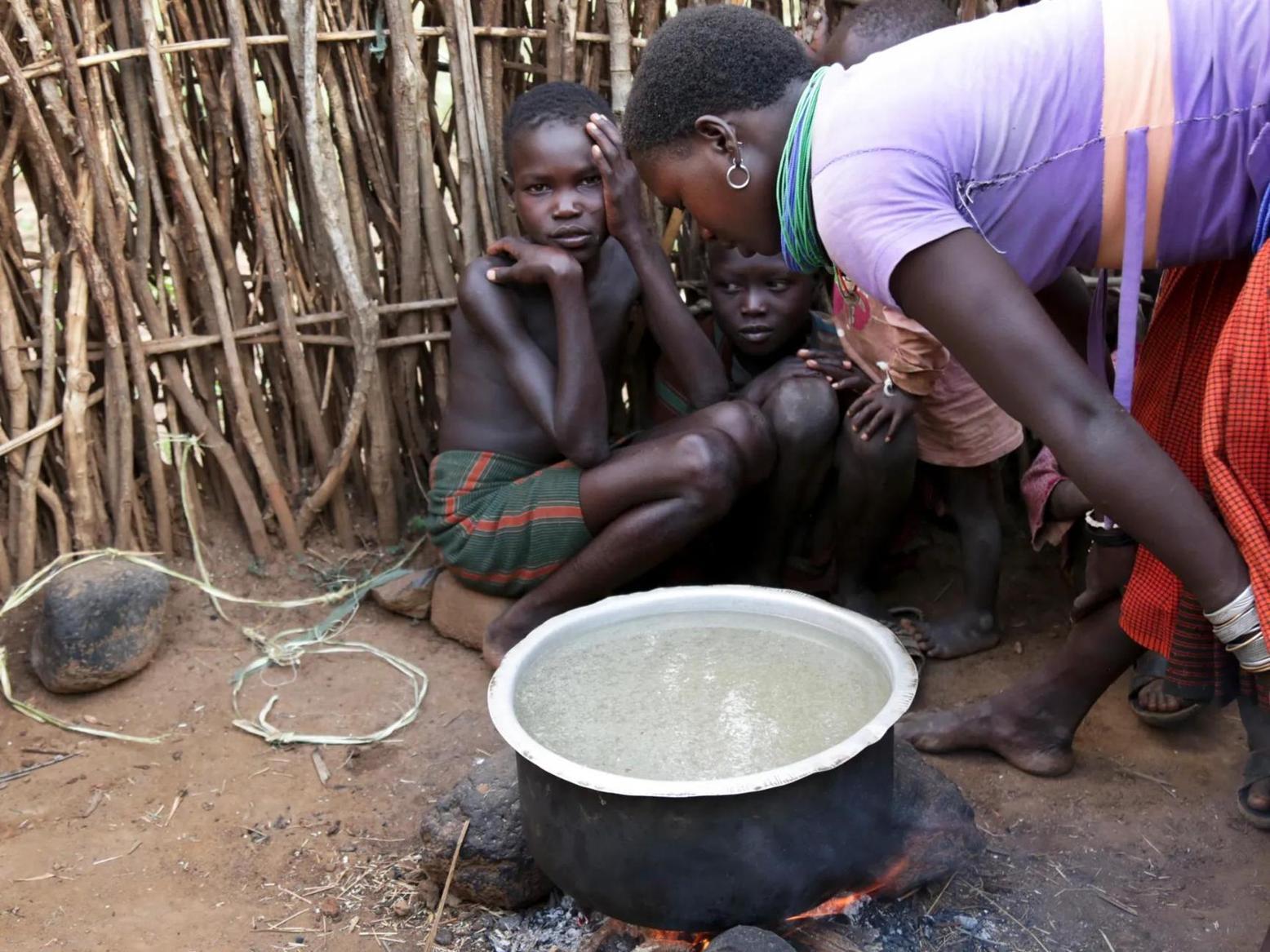
Africa-Press – Ethiopia. Uganda is experiencing a worsening hunger crisis due to the worst drought it has faced in decades, with crops failing across the country. At least 19 people have died from starvation in the Karamoja region in the northeast, while 1.5 million people in the region are at risk of malnutrition, according to a local source.
The government has begun distributing emergency food aid in the region, but the expanding drought brings to mind the hunger crisis of 2022, which claimed the lives of over two thousand people, according to the same source.
Lucia Lumiza told a local outlet that she is still mourning her husband, whose death she attributes to complications from the drought. She added, “People are now burning charcoal to survive, and I do not have the energy for that. Most of my family members have left the village in search of food. I am not the only one suffering from this drought.”
Elijah Lori, head of the disaster management committee in the district, stated that starving residents are visiting the government office day after day hoping to receive food, but the office does not have enough supplies. He noted an increase in cases of malnutrition, particularly among children, nursing mothers, the elderly, pregnant women, and many disabled individuals who cannot move to search for food.
Interconnected Causes
No rain has fallen in Karamoja since April, which is when the planting season begins. Christoph Tietika, an assistant professor at the Institute of Development Policy and Management at the University of Antwerp, believes the crisis is the result of interconnected factors, with climate change being only one of them.
He told a local outlet, “With the climate crisis, there has been an extended drought. This is not the first time. There is also a general environmental degradation in the region linked to widespread poverty, leading to overgrazing and deforestation.” He added that conflict between pastoralists and attackers has exacerbated the crisis and raised food prices.
He continued, “Finally, and most importantly, the Karamoja region has historically been marginalized in Uganda. This has been the case since colonial times, and it has not improved under successive governments after independence.”
Tietika also pointed to the impact of the United States cutting its foreign aid following President Donald Trump’s decision, stating that “relief agencies have drastically reduced their food aid in the country,” and that Karamoja needs a “broader structural solution, as this is not the first food crisis in the region, and it will not be the last in the current context.”
For his part, Job Kegi, executive director of the IDEA research center in Uganda, argued that the real driver of the crisis is a failure in governance. He said, “For years, millions of dollars allocated to Karamoja have been stolen by corrupt officials. This was exemplified in the iron sheets scandal, where nearly all government members were caught stealing roofing materials intended for the Karimojong people.”
He added, “Karamoja is very rich in gold, limestone, and granite, yet investors take everything and leave the residents starving, even though the region has a dedicated ministry. The great irony is that western Uganda wastes surplus milk while Karamoja starves. We do not need aid; we need systematic investment in climate-smart agriculture, water harvesting, irrigation, and national food preservation networks to transfer food from surplus areas to deficit areas.”
Government Response
A local correspondent reported that the Ugandan government allocated $18 million in aid to the region. On July 22, following the deaths of 19 people from starvation, Sam Engola, the minister for disaster preparedness and refugee affairs, launched a distribution of maize flour and beans.
Engola wrote on a social media platform the following day that Uganda held a meeting with the World Food Programme to discuss “ongoing government interventions.” He added, “I made it clear that immediate food relief is critical, but it remains a short-term measure. We are collaborating with the Ministry of Agriculture on sustainable long-term solutions, specifically investing in irrigation, dams, silos, and drought-resistant crops,” aiming to transform Karamoja into a “self-sufficient food basket.”
The correspondent noted that Uganda is not the only country affected by recurring drought in the Horn of Africa, as millions of people in Kenya, Somalia, Ethiopia, and South Sudan are facing severe food shortages.
However, Job Kegi, the executive director of the IDEA research center in Uganda, believes the state continues to rely on its “failed guide” of sending flour and beans after famine strikes, which acts as “a political band-aid rather than a sustainable solution.” He stated that the country “does not suffer from a total food shortage but rather a structural distribution crisis,” calling for investment in storage and cold chains, and for “the legal allocation of mineral revenues extracted from Karamoja to fund the region’s agricultural infrastructure, alongside pursuing officials who embezzle relief funds.”