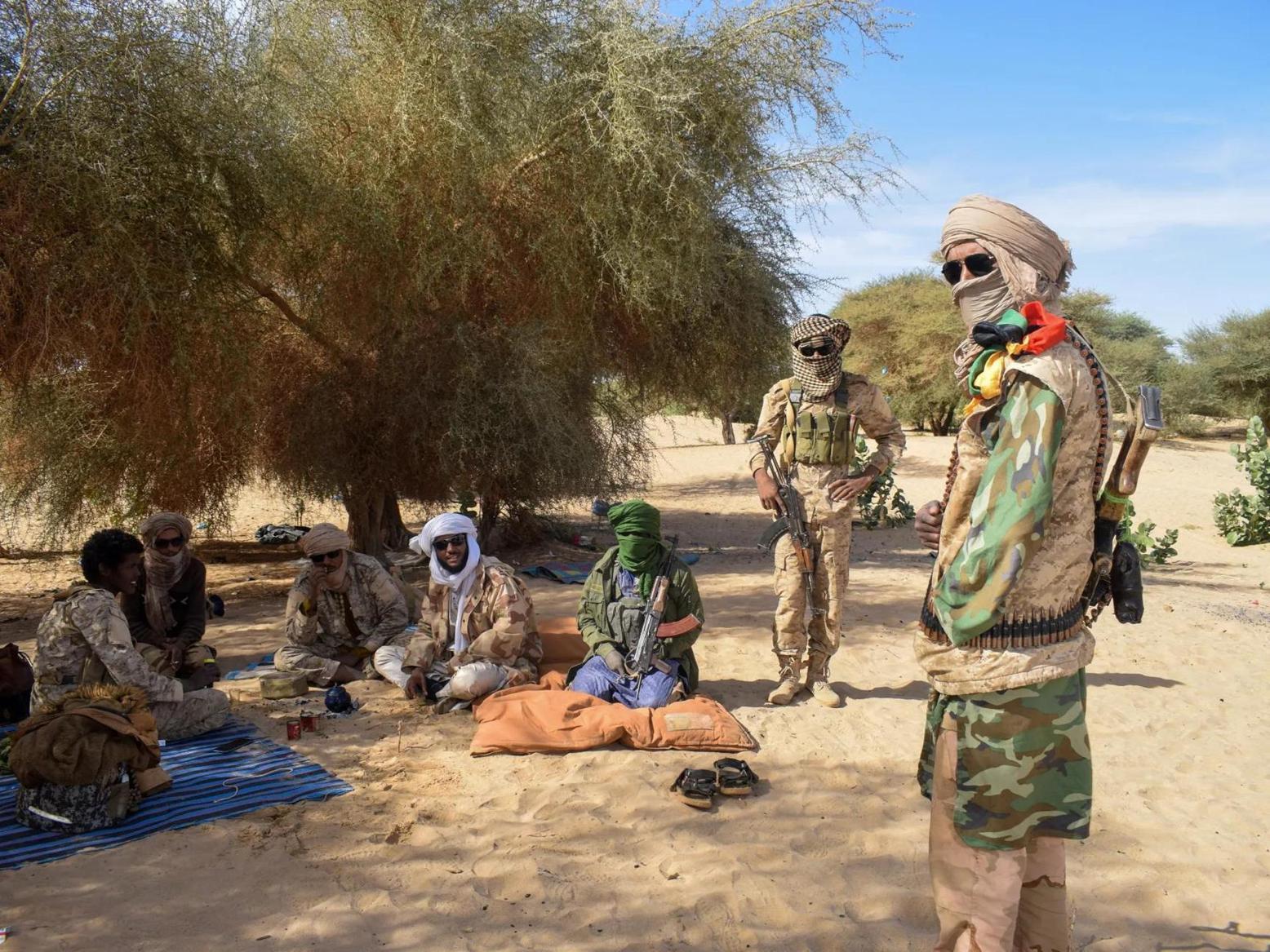
Africa-Press – Gambia. The repercussions of the new wave of violence launched by a local armed group in coordination with another group on April 25 have not remained confined to the internal borders of Mali. Within a few days, the fallout from the attacks has spread from the internal space of the Sahel alliance to its broader regional surroundings, revealing the fragility of the collective security system in West Africa and an escalating division between the alliance and the regional bloc.
Authorities in Burkina Faso have announced the launch of a major security operation in the capital Ouagadougou and other areas, which includes deploying units at strategic intersections and gathering information related to terrorism and crime, according to a local source. The Ministry of Security has urged citizens to report any suspicious behavior, especially near military bases, airports, and sovereign institutions. A military source in Burkina Faso confirmed to the same source that the army is on “high alert because we are at war,” adding that the situation in Mali requires greater strictness and vigilance.
In a significant move since the formation of the Sahel alliance in 2023, the military council in Niger announced the cancellation of traditional May Day celebrations nationwide for security reasons. Observers view this national cancellation as a signal of the difficulty in ensuring security in major public spaces.
Ivory Coast: Between Displacement and Jihadist Corridors
For its part, the Ivorian government has confirmed that its borders are secure but expects a “flow of refugees” due to events in Mali. Abidjan has a recent memory of this issue, as the International Organization for Migration recorded the arrival of over 54,000 newcomers from Burkina Faso and Mali between April 2021 and March 2024. The German Institute for International and Security Affairs estimated that the number reached around 58,000 refugees in the provinces of Tchologo and Boukani alone, noting that the reception of these individuals occurred amid tension, and Ivorian security agencies view them as a potential security threat.
Data from the Africa Center for Strategic Studies revealed that the group has become active or present in several areas in Burkina Faso, with the Burkinabe army effectively controlling only about 30% of the national territory. Armed groups have surrounded approximately 130 towns and have cut off main routes connecting Ouagadougou to Ivory Coast, Togo, Benin, Niger, and Mali. The center warns of a noticeable southward expansion of jihadist groups toward northern Benin, Togo, and Ghana, raising the possibility of forming an unstable corridor linking the desert space to the coastal front of the Gulf of Guinea.
Collapse of Regional Cooperation
A report by a crisis group published in early 2026 observed a widespread paralysis in security cooperation between the Sahel alliance and the regional bloc, with a disintegration of previous arrangements such as the G5 Sahel, the Nouakchott Process, and the Accra Initiative. The report noted that the rift is particularly widening between Burkina Faso and Ivory Coast, and between Niger and Benin, despite the deep economic and social ties between these countries. Conversely, the report indicated limited pragmatism, recently manifested in Ivorian-Malian coordination to resume fuel convoys to Bamako and in talks hosted in Lomé last April between the two regional organizations.
While the regional bloc condemned the recent attacks and urged “all countries in the region, their security forces, and their peoples to unite” in the face of this threat, the fundamental question remains: Do the two regional systems have the political will to restore effective security cooperation before the crisis spiral reaches the coastal front of West Africa?