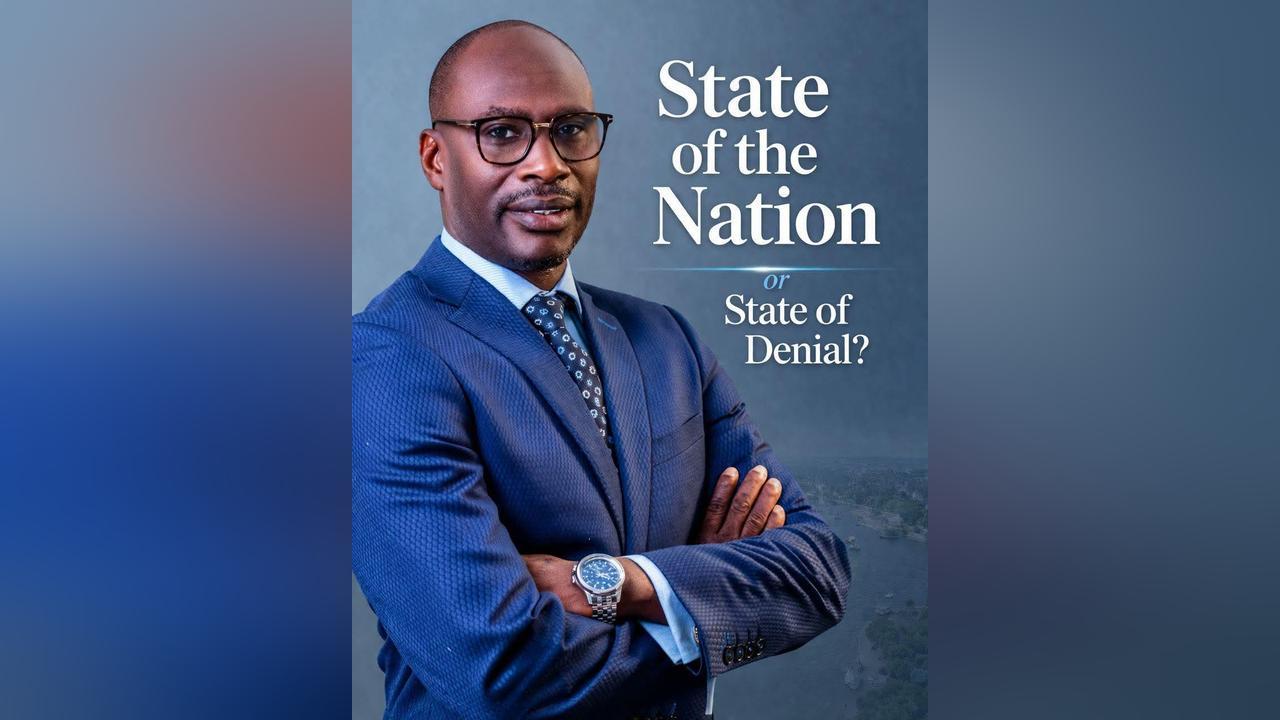
Africa-Press – Gambia. Opposition leader, Essa Mbaye Faal has questioned the accuracy of the State of the Nation Address (SONA) delivered by President Adama Barrow, describing it as a “State of the Nation or State of Denial.”
Reacting to the annual address on Saturday, the leader of APP-Sobeyaa said the speech presented an extensive catalogue of projects, expenditures and policy initiatives in a structured and reassuring manner, but argued that it left a gap when compared with the lived realities of Gambians.
According to him, public policy should be assessed based on outcomes rather than expenditure, noting the absence of independent impact assessments of major infrastructure programmes, data on job creation linked to public investment and clear connections between fiscal spending and poverty reduction.
“Without such evaluation, it becomes difficult to distinguish between activity and progress,” he stated.
Faal further observed that while the government projects stability in public debt and a gradual decline in the debt-to-GDP ratio, the claim does not sufficiently address the structural implications of sustained borrowing in a small, import-dependent economy.
“Debt sustainability is not simply a ratio. It is a function of repayment capacity, currency stability and the productivity of borrowed funds,” he said, adding that continued pressure on the dalasi reflects underlying vulnerabilities.
He noted that currency depreciation directly increases the cost of living in a country heavily reliant on imports, stressing that for ordinary citizens the key concern is whether economic policies are making life more affordable.
On remittances, Faal says the President’s acknowledgement that inflows reached about US$872 million, representing 34 per cent of GDP, highlights a reliance on external private transfers rather than domestic production.
Turning his attention to governance, the opposition leader pointed to findings from the National Audit Office and reviews by National Assembly Select Committees, which he said have consistently identified financial irregularities across public institutions.
“These are not speculative claims. They are formal oversight outputs within the constitutional framework,” he added.
He argued that the main challenge lied not in detecting irregularities but in enforcing accountability, noting that the limited number of prosecutions following audit findings raised concerns about the credibility of the system.
“In any functioning governance structure, audit exposure should trigger investigation, and investigation should lead, where warranted, to prosecution,” he said, warning that any breakdown in this process weakens deterrence, distorts resource allocation and undermines public trust.
Faal emphasised that his remarks should not be interpreted as opposition to progress, but rather as a call for verifiable results. He said a State of the Nation Address should withstand scrutiny not only for what it reports but for what it demonstrates, providing a clear link between policy decisions and outcomes for citizens.
He concludes by saying that the central issue is whether government actions are producing measurable impact, adding that until this is consistently demonstrated with transparency, the gap between official narratives and everyday experiences will persist.