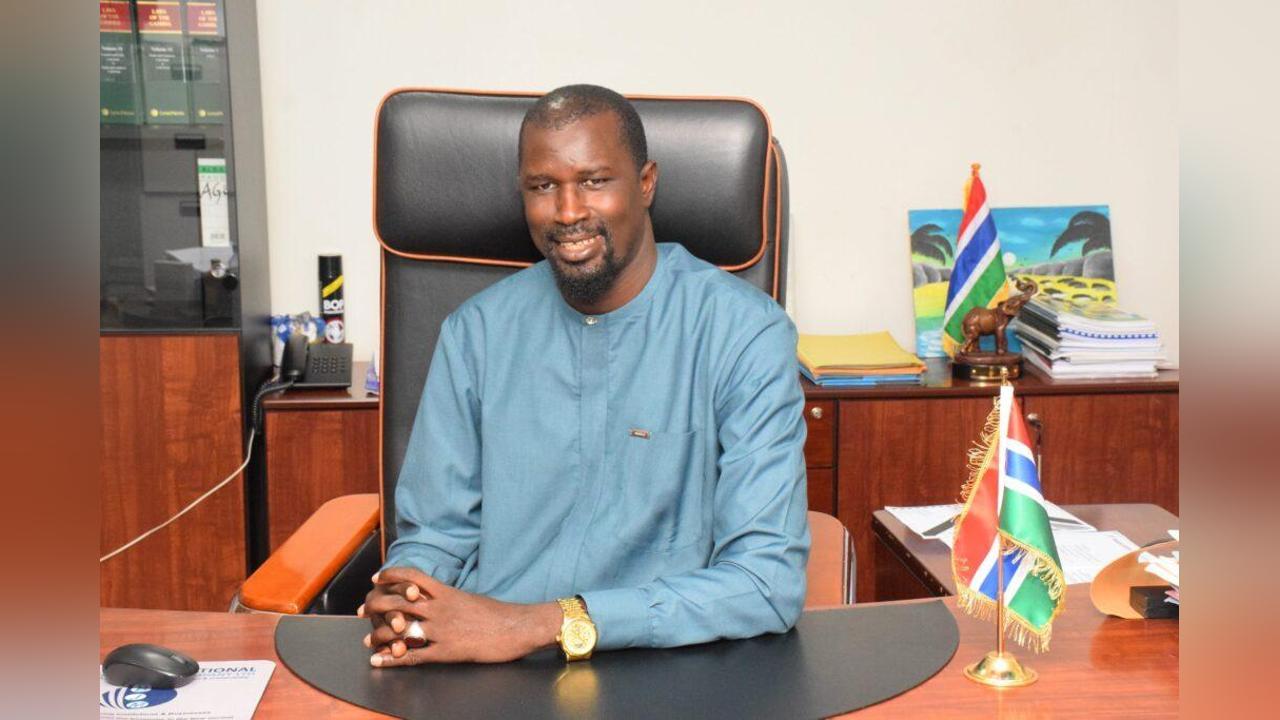
Africa-Press – Gambia. Former Auditor General Modou Ceesay has rejected the Gambian government’s statement of defense in his ongoing Supreme Court case, disputing the state’s account of his removal and alleging that his dismissal stemmed directly from his refusal to accept a ministerial post and to delay audits of key public institutions.
In a formal reply to the Attorney General and the Inspector General of Police — the defendants in the suit — Mr. Ceesay presented a counter-narrative portraying his ouster as unconstitutional and retaliatory. He said he was dismissed shortly after declining a transfer to the Ministry of Trade, Industry, Regional Integration and Employment, insisting that he chose to remain in his constitutionally protected role as Auditor General.
According to court filings, Mr. Ceesay denied the state’s claim that he initially accepted a ministerial appointment before changing his mind. He said that during a meeting with President Adama Barrow on Sept. 10, 2025, he was informed of a cabinet reshuffle and offered the position of Minister of Trade. Mr. Ceesay said he “respectfully declined” the offer during the meeting and formalized his decision in a letter delivered to the Office of the President the following day.
His filing states that his decision followed “careful deliberation and communication” and that he remained consistent in his wish to continue serving as Auditor General.
Mr. Ceesay also defended the independence of the National Audit Office (NAO) and denied any allegations of misconduct or obstruction of audits. He claimed that his office came under pressure to suspend or delay several audits, including those involving the Ministry of Lands, the National Food Security Processing and Marketing Corporation (NSPMC), and the Gambia Revenue Authority (GRA).
He said the GRA audit, in particular, was halted after his office requested backups of the agency’s digital revenue systems, a requirement he described as essential to the audit process.
Mr. Ceesay said that on Sept. 10, 2025, his office initiated the audit of the Government of The Gambia, with plans to submit findings by the end of the month. He reiterated that the Auditor General’s office “must operate without fear or favor and not be subject to the control of any person or authority.”
Recounting the events of his physical removal, Mr. Ceesay described his ouster as “illegal and unconstitutional.” He said that on Sept. 15, 2025, upon arriving at his office, police officers ordered him to vacate the premises and surrender all official materials. Despite protests from NAO staff, he said, the officers forcibly removed him from the building — an incident that was recorded and later broadcast by media outlets.
Mr. Ceesay denied the state’s allegation that he had leaked or circulated confidential information, insisting that he had never held a press conference nor removed or disclosed official documents.
Invoking the Supreme Court’s original jurisdiction, Mr. Ceesay argued that the defendants’ actions violated multiple provisions of the 1997 Constitution and the National Audit Office Act of 2015, both of which protect the independence and tenure of the Auditor General. He cited Sections 158, 159, 160, and 169 of the Constitution, and Sections 3(2), 11, 13, 14, and 16 of the NAO Act, which together outline the terms of appointment, removal procedures, and institutional autonomy of the Auditor General.
He said removal from office is constitutionally restricted to instances of “inability, misbehavior, or incompetence” — and only through due process.
Mr. Ceesay further contended that the state violated these provisions when it authorized police officers to enter the NAO premises and forcibly remove him from his post.
His legal counsel, led by attorney Lamin J. Darboe, described the state’s counterarguments as “frivolous in their utter meaninglessness,” urging the Supreme Court to reaffirm constitutional safeguards protecting oversight institutions from executive interference.
The case is scheduled for a hearing in December before a five-member panel of the Supreme Court, in what is expected to be a landmark test of executive authority against the independence of constitutional institutions.
For More News And Analysis About Gambia Follow Africa-Press