
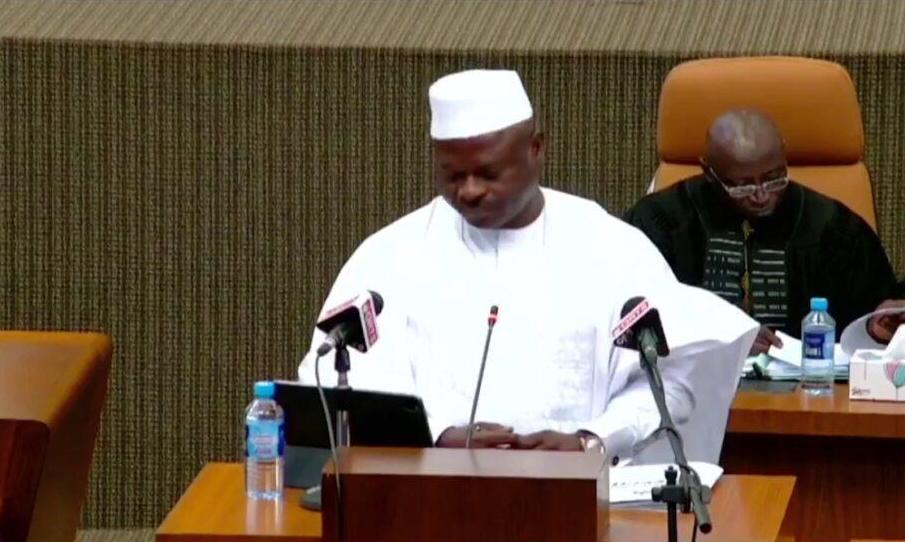
Africa-Press – Gambia. Finance Minister Seedy Keita on Friday projected that The Gambia’s total revenue and grants will rise to D50.3 billion in 2026, citing stronger domestic tax collection, digital reforms, and continued support from development partners.
Delivering his budget address to lawmakers, Mr. Keita said the forecast includes D32.2 billion in domestic revenue, with the remainder expected from external grants.
“Revenue and grants are expected to total D50.3 billion in 2026, with D32.2 billion coming from domestic sources and 18.1% externally,” he told the National Assembly, adding that tax receipts alone are projected to grow by 13 percent to D27 billion, driven largely by digital tax systems and tighter enforcement.
“Tax revenue is anticipated to increase by 13 percent relative to the previous budget, amounting to D27.0 billion in 2026,” he said.
According to the minister, the government anticipates gains from personal and corporate income taxes as new audit measures take hold. Platforms such as ITAS, ASYCUDA, and a forthcoming e-invoicing system are expected to strengthen compliance and reduce underreporting.
“Personal income tax is expected to benefit from enhanced enforcement, the rollout of the rental income solution, and tax audits. While corporate income tax is expected to improve on account of enhanced compliance among donor-funded projects. The ongoing audit of major public works contractors is expected to address long-standing loopholes in tax compliance and underreporting,” he said.
Excise taxes—particularly on the telecommunications sector—are also expected to rise. Mr. Keita said telecom excise collections could grow by 40 percent in 2026, reaching D659 million, once a new revenue-assurance system becomes operational. Value Added Tax is similarly projected to expand under the new electronic invoicing framework designed to curb fraud.
“With the expected rollout of the revenue assurance solution before the end of the year, excise telecom is projected to grow by 40 percent in 2026, reaching D659 million. Value Added Tax (VAT) is expected to grow significantly, driven by the implementation of a new electronic invoicing solution, which is aimed at improving compliance and reducing fraud,” he said.
Non-tax revenue is forecast at D5.2 billion, helped by increased collections from ministries and state-owned enterprises, as well as a planned D1.5 billion disbursement from the Africa50 Asset Recycling Program tied to the Senegambia Bridge.
“Non-tax revenue is projected at D5.2 billion (2.5 percent of GDP) in 2026. This will be supported by the planned and ongoing efforts by the government to increase revenue collection by MDAs, higher dividends from SOEs, and the disbursement of D1.5 billion from the Africa50 Asset Recycling Program for the Senegambia Bridge,” he said.
Still, Mr. Keita acknowledged that geopolitical tensions and shifting donor priorities have made external financing less predictable. Even so, the government expects D14.4 billion in project grants and D3.7 billion in budget support next year, including D2.5 billion from the World Bank, D597 million from the European Union, and D528 million from the African Development Bank.
“The emerging geopolitical tensions and shifting priorities of development partners have raised uncertainties about grants. Despite these, project grants are projected at D14.4 billion, while budget support is at D3.7 billion, of which D2.5 billion is from the World Bank, D597 million from the EU, and D528 million from the AfDB,” he said.
For More News And Analysis About Gambia Follow Africa-Press