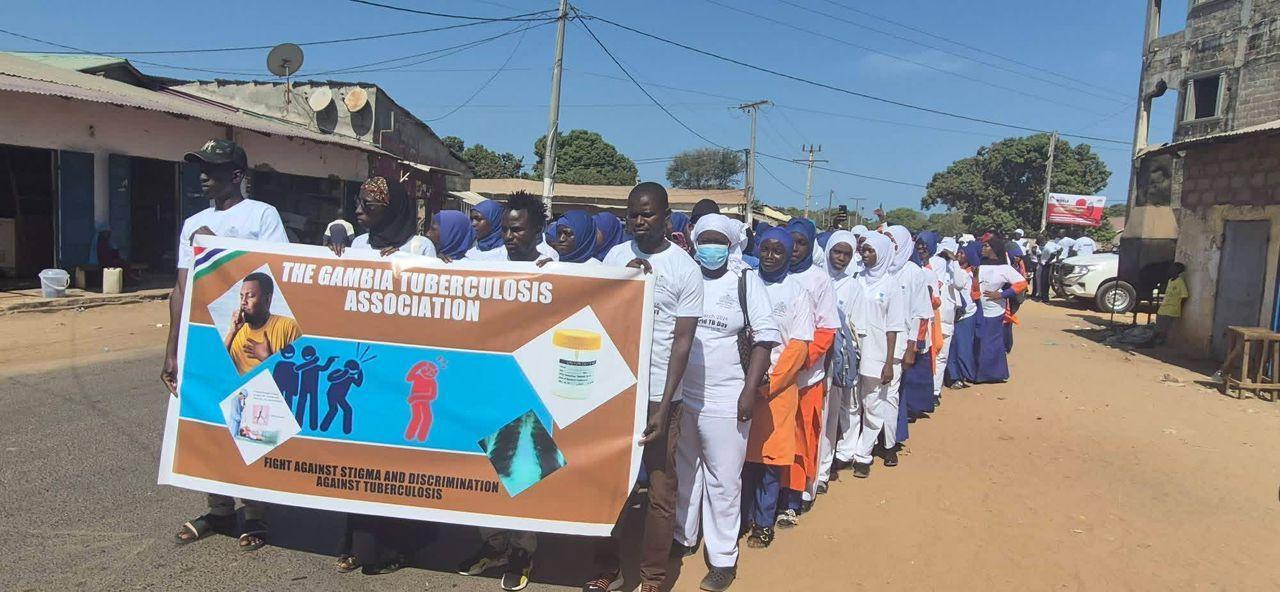
Africa-Press – Gambia. The Ministry of Health, through the National Leprosy and Tuberculosis Control Programme (NLTCP), in collaboration with partners, on Tuesday commemorated World Tuberculosis (TB) Day in Sanyang, West Coast Region.
The event brought together government officials, international partners, health workers, students, religious leaders, and community members. Activities included a march-past and a series of speeches aimed at raising awareness on TB and the importance of early detection and treatment.
Speaking at the event, NLTCP Programme Manager Marie Gomez said The Gambia joins the global community annually to observe World TB Day, highlighting efforts to eliminate the disease as a public health threat.
“This year’s theme, Yes! We Can End TB, is a call for collective action, emphasizing the role of leadership, community engagement, and strong partnerships in combating TB,” Gomez said.
She noted that the Government of The Gambia, through the Ministry of Health, largely funded this year’s commemoration, reflecting the country’s commitment to tackling TB.
“Despite being preventable, treatable, and curable, TB remains a major global public health challenge. Each year, more than 10 million people fall ill, and over one million die from the disease, mostly in developing countries,” she added.
Gomez emphasized that TB remains a serious public health concern in The Gambia, with more than 2,600 cases detected nationwide in 2025.
“These are not just numbers; they represent parents, children, women, workers, and students whose lives have been affected by this disease,” she said.
The NLTCP continues to implement interventions to combat TB, including expanding diagnostic and treatment services, introducing rapid molecular diagnostic tools such as GeneXpert, and providing universal drug susceptibility testing through an efficient sample referral network. Other measures include household contact investigations, preventive treatment for vulnerable groups, health worker training, the Directly Observed Treatment (DOT) strategy, and enhanced TB/HIV collaboration.
Dr. Nathan Nsubuga Bakyaita, World Health Organization (WHO) Representative in The Gambia, described TB as one of the world’s deadliest infectious diseases.
“Globally, more than 10.7 million people fall ill with TB each year, and over 1.2 million die from it,” he said.
Dr. Bakyaita reported that The Gambia’s national TB incidence rate in 2023 was 142 cases per 100,000 population, slightly lower than 145 cases per 100,000 in 2022. He highlighted the importance of community awareness and early detection, citing a 2025 community screening exercise in Brufut, where over 82 percent of people screened showed symptoms requiring further investigation.
“This reminds us that TB continues to spread silently where awareness is low and early diagnosis is delayed,” he said, urging Gambians to seek medical attention for persistent coughs lasting more than two weeks, unexplained weight loss, night sweats, or prolonged fatigue.
“TB is curable, treatment is free, and early action saves lives,” Dr. Bakyaita added.
Dr. Abdou K. Sitlah, Research Clinician at the Medical Research Council Unit, The Gambia at the London School of Hygiene and Tropical Medicine (MRCG@LSHTM), underscored the role of research institutions in advancing knowledge and developing new tools to fight TB.
He said The Gambia has made progress in reducing TB incidence and mortality, but challenges such as delayed diagnosis, limited access to treatment, and the emergence of drug-resistant TB persist. He reaffirmed MRCG’s commitment to supporting TB research, improving diagnostic tools, and strengthening treatment strategies.