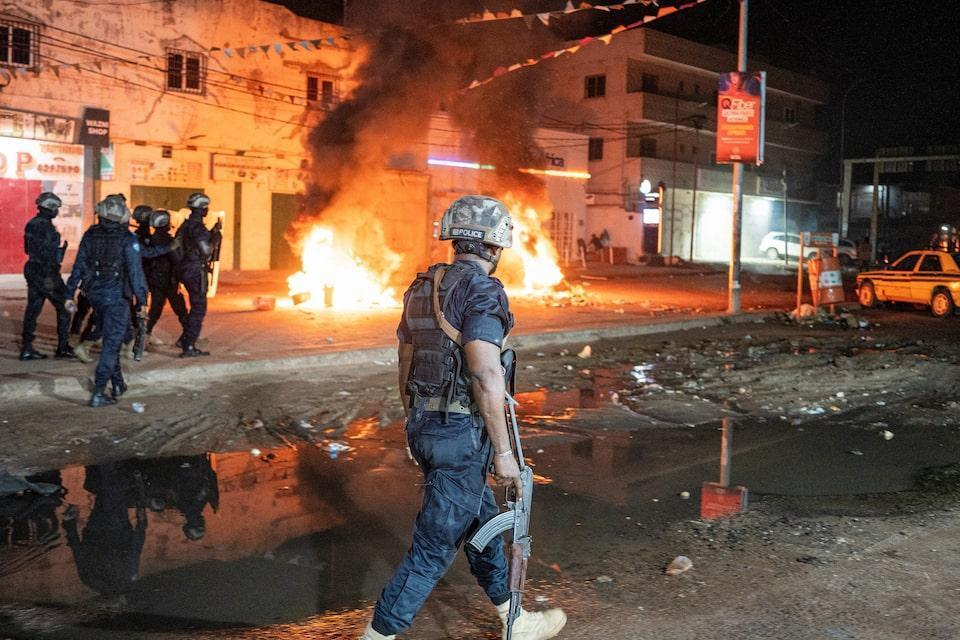
Africa-Press – Gambia. Residents and witnesses reported that police used tear gas to disperse protesters who gathered at multiple locations in Gambia at night, including near the official residence of Adama Barrow, to denounce what they described as prolonged power outages.
A witness stated that protesters in the capital Banjul and its surroundings burned tires in the streets and erected barricades, chanting the slogan “Barrow must go!” as clouds of smoke filled the air.
The electricity crises in this West African nation—where some residents reported power cuts lasting up to 48 hours—come ahead of anticipated presidential elections in December, in which Barrow is seeking a third term.
In a sign of growing discontent with the government, protesters gathered in the town of Farato outside the residence of Vice President Muhammad B.S. Jallow, tearing down banners belonging to the ruling People’s Democratic Organisation for Independence and Socialism.
Barrow, in a televised address to the nation late Tuesday, stated: “I know the fans have stopped spinning, that children are studying in the dark, that mothers are forced to dispose of spoiled food, and that the heat is unbearable day and night.”
He explained that the demand for electricity had reached record levels, coinciding with the breakdown of key generation units and the impact of seasonal conditions on hydroelectric power production.
Earlier, Gambia’s Minister of Information, Ismaila Ceesay, stated that officials “are working tirelessly to restore stability and improve the reliability of electricity supply as soon as possible,” describing the previous night’s events as “extremely concerning.”
Ceesay apologized to those affected by the power outages, saying: “As a government, we understand the feelings of frustration, anger, and hardship that many Gambians are facing.”
Barrow visited facilities belonging to the National Water and Electricity Company on Tuesday morning, promising that Gambia would receive new generators this week and that electricity would be restored by the end of October. The official noted that the government is in the final stages of installing an additional 24-megawatt generation unit and has awarded a contract to establish a 50-megawatt solar power plant.
NAWEC announced in a statement on August 15 that it is experiencing “unexpectedly high demand for electricity during peak hours,” attributing this to rising temperatures. It also reported a “technical fault affecting one of the main generation units linked to imported sources,” without providing further details.
The company indicated that the situation would require the implementation of a “load shedding” system affecting “several areas in the country,” but did not specify dates for this.