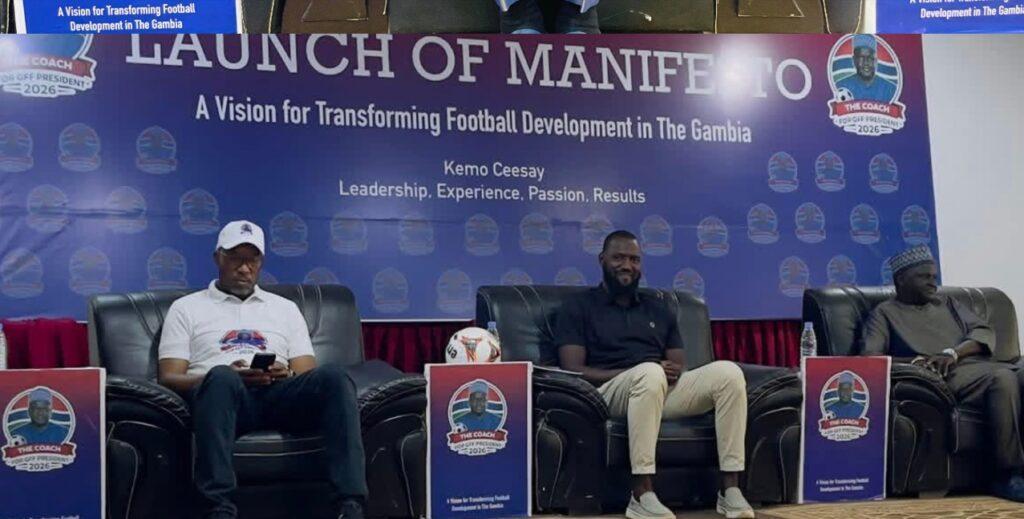
Africa-Press – Gambia. Kemo Ceesay, a candidate for president of the Gambia Football Federation, unveiled an ambitious policy platform on Saturday that promises to decentralize the sport’s governance and unify a federation he says has long been divided by competing regional and political interests.
The announcement, delivered before football officials, former national team players, and club representatives at the Paradise Suite Hotel, immediately reshaped the race for the federation’s top office. Within hours, a rival candidate, Amadou Jaiteh, withdrew his own bid and threw his support behind Mr. Ceesay. Soon after, leaders of all seven Regional Football Associations issued a joint endorsement of his candidacy.
“Today is not just another day in Gambian football,” Mr. Ceesay told the gathering. “Today marks the beginning of a movement. Today marks the beginning of a new conversation about the future of our beautiful game.”
The platform, built around the themes of transparency, accountability and development, calls for annual audited financial reports, governance rules aligned with FIFA and the Confederation of African Football, and a new regional headquarters in Soma intended to shift decision-making away from the capital. Mr. Ceesay also pledged to professionalize the federation’s administration through performance-based hiring, digitization, and new revenue streams.
On football matters, he proposed establishing a semi-professional league with licensing requirements and player welfare standards, upgrading infrastructure — including regional training centers and facilities in Yundum — and strengthening youth development through mandatory youth leagues, integration with school football, a new federation academy and mental health support for players. He also announced a program he called “President La Katcha,” under which the federation’s president would meet with club and regional leaders every six months.
Mr. Ceesay told the crowd that their presence reflected something larger than support for a single candidacy. “Your attendance is not simply support for a candidate,” he said. “It is a demonstration of your commitment to the future of Gambian football.”
He framed football as inseparable from national identity, describing it as “hope,” “opportunity,” and “the dream of every young boy and girl who kicks a ball on the streets of Banjul, Brikama, Farafenni, Soma, Janjanbureh, Basse, Kerewan, and every community across our beloved nation.” The sport, he added, has historically united Gambians even as politics divided them.
“I stand before you today not merely to launch a manifesto, but to launch a vision,” he said. “A vision of a united football family. A vision of all-inclusive development. A vision of excellence. A vision of accountability. A vision of transformation.”
He distilled that vision into two words. “My mission is simple: unification and transformation,” he said. “These are not just words. They are the pillars upon which I intend to build the next chapter of Gambian football.” Transformation, he argued, can only follow unity, and progress demands collective effort and mutual respect among stakeholders.
Mr. Ceesay was careful to credit his predecessors rather than present himself as a clean break from the federation’s past. He praised Seedy Kinteh for delivering infrastructure projects, Mustapha Kebbeh for advancing professionalism and governance, and Lamin Kabba Bajo for back-to-back Africa Cup of Nations qualifications and the growth of the women’s game.Asked why he believed he was best positioned to lead, Mr. Ceesay pointed to relationships he has cultivated across the sport. “I am the candidate who can unite all stakeholders,” he said. “I have maintained positive relationships across clubs, regions, allied associations, and with fellow aspiring candidates. I firmly believe that elections should never create enemies. Elections should strengthen democracy, encourage healthy competition of ideas, and ultimately bring us together for the common good of football.”
He also committed to reconnecting the federation with some of the country’s most prominent former players, naming Jatto Ceesay, Seffo Solley, Aziz Corr Senior and Pa Dembo Touray among those whose experience, he said, should help guide the sport’s future. “Every region deserves an opportunity,” he added. “Every community deserves investment. Every talented young footballer deserves a pathway to success, regardless of where they come from.”
He closed his remarks with a direct appeal. “Today, I invite you to join this movement,” he said. “A movement for unity. A movement for accountability. A movement for development. A movement for inclusion. A movement for transformation. The future of Gambian football will not be built by one person. It will be built by all of us working together.”
The most immediate consequence of the launch came from Mr. Jaiteh, who had been mounting his own campaign for the federation presidency before announcing his withdrawal in support of Mr. Ceesay.
“At this important moment, I believe that the greater interest of Gambian football must come first, before personal ambition,” Mr. Jaiteh said. “I, together with my team, have chosen to throw my full support behind Mr. Kemo Ceesay, the Coach. No other candidate knows the problems of our football better than him.”
He said his decision had not been made lightly, describing his own motivation to serve the sport as rooted in a longstanding commitment to its growth, unity and transparency. But he said that commitment now meant stepping aside. “I can assure Gambians and the football family, Kemo has the diary of Gambian football, and he can write multiple books about Gambian football,” he said.
Mr. Jaiteh characterized the coming election as a decision with consequences well beyond who holds the federation’s top post. “Today, we are choosing more than a president,” he said. “We are choosing the direction of our football. We are choosing the future of our clubs, our players, our referees, our coaches, our academies, and the generations yet to come. That is why I proudly stand in support of Kemo Ceesay.”
The endorsement from the country’s regional football bodies followed shortly after. Speaking on behalf of the Kanifing Municipal, West Coast, Banjul, Lower River, North Bank, Central River and Upper River associations, along with allied bodies, Ismaila Ceesay, head of the School Football Association, said the moment marked a shift in how the regions related to the national federation.
“Today marks more than the launch of a manifesto,” he said. “It marks a moment where the regions of The Gambia, for too long spoken about rather than spoken with, stand together, with one voice, to declare the direction we believe Gambian football must take.”
He said the gathering represented a turning point in how the country approaches the development of the sport. “This is the day the regions said, clearly and without hesitation, that the future of the Gambia Football Federation must be built from the ground up — from our school pitches, our regional leagues, our community pyramids — and not imposed from the top down.”
Mr. Ceesay, the regional official, said the endorsement reflected more than personal trust in the candidate; it reflected confidence in specific commitments around decentralization. “We saw a genuine plan for resource decentralization, ensuring regional associations are not merely implementers of federation decisions but partners in shaping them,” he said, citing what he described as a pledge to respect “regional autonomy and voice, recognizing that the seven regions of this country are not satellites of the center, but the very heartbeat of Gambian football.”
He argued that the country’s football identity has always run through its regions rather than its capital. “There is no Gambian football without the regions,” he said. “Every Scorpion who has ever worn the national colors first played barefoot on a regional pitch, in a school compound, or on a dusty community ground. Our regions are not the periphery of this nation’s football story — we are its origin and its engine.”
“On this significant day,” he added, “we, the Regional Football Associations and Allied Associations of The Gambia, pledge our full support to Team COACH and the candidacy of Kemo Ceesay.”
For More News And Analysis About Gambia Follow Africa-Press