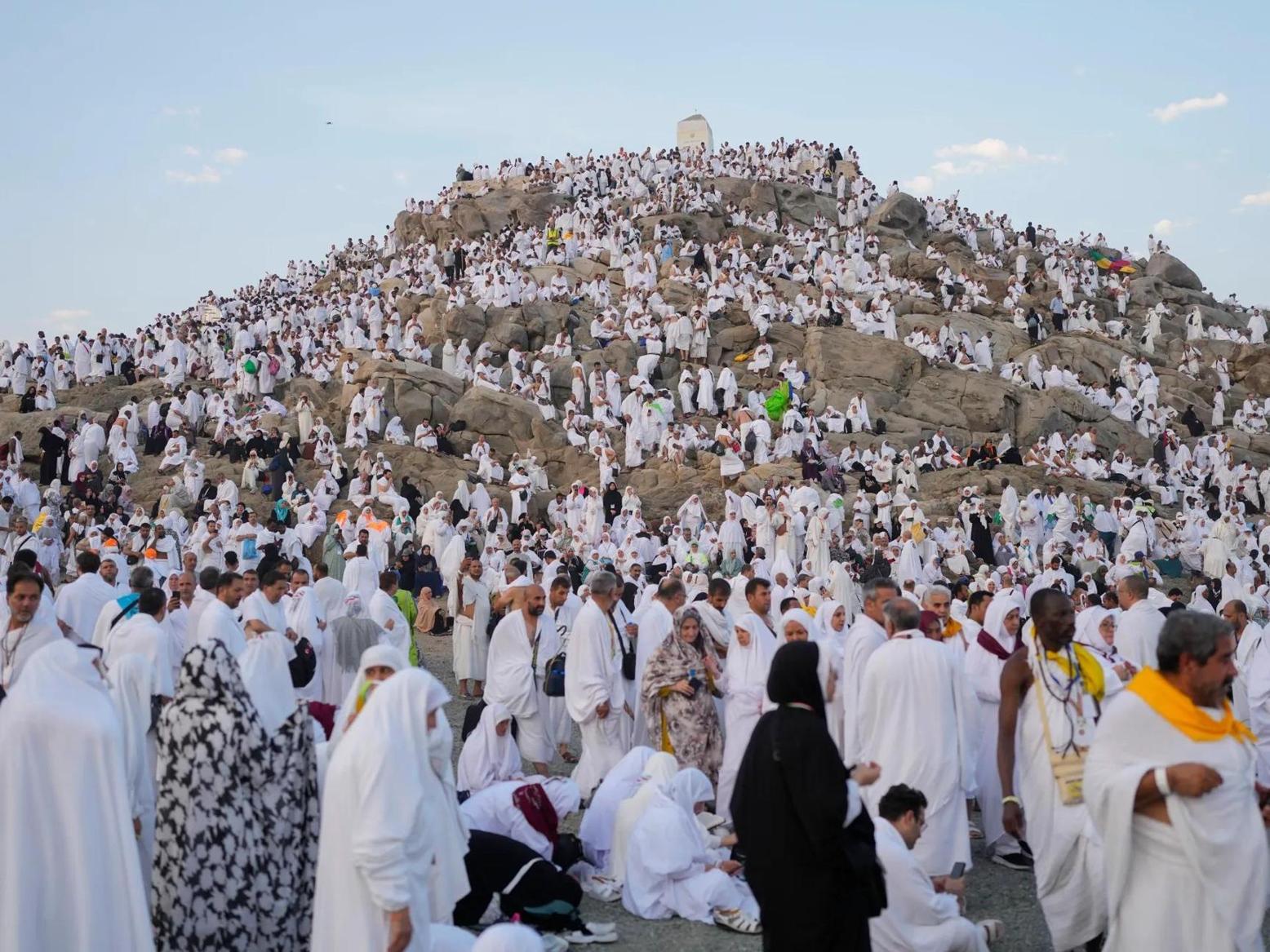
Africa-Press – Gambia. Mount Arafat, located in the heart of Mecca, is associated with moments that recur every year when thousands of pilgrims stand upon it in a scene of faith that stirs the hearts. However, behind this scene lies a story older than human history itself, concerning the formation of this mountain.
Although the events of this story date back millions of years, their effects are still preserved in the rocks of the mountain today, which have transformed into a living archive silently recording the history of the region.
In a study published in a scientific journal, a group of scientists from a radiation physics laboratory at a technology institute in Pakistan attempted to unlock these files, uncovering a series of surprises, the most notable being that the formation of the mountain was part of a larger tectonic story related to the emergence of the Red Sea.
The beginning was at the mountain’s surface, where pilgrims stand on rocks that appear still and simple. However, what scientists revealed through collected samples is that they belong to a type known as “granodiorite,” which is a deep igneous rock formed when magma cools slowly within the earth, resulting in a solid rock filled with mineral crystals.
Researchers found that within these rocks, familiar minerals such as quartz, feldspar, and mica appear.
Dating by Fission Track
The next step the scientists sought was to understand the age of Mount Arafat, for which they used a precise technique known as “fission track dating.”
This technique relies on the fact that within the tiny mineral crystals hidden in the rocks, there are minute quantities of uranium, an unstable element. Over time, some of its atoms spontaneously split, releasing minuscule atomic fragments that move at high speeds within the crystal.
These fragments do not pass without leaving a trace; they leave behind “scratches” or extremely fine microscopic tracks that cannot be seen with the naked eye, but remain preserved within the mineral for millions of years.
To observe these effects, scientists polish the mineral samples and chemically treat them, then examine them under a microscope, revealing a network of fine lines resembling engravings in glass. Each of these tracks represents a radioactive event that occurred in the distant past, and the older the rock, the greater the number of these accumulated effects within it. By counting them and measuring the amount of uranium in the mineral, researchers can calculate the time that has passed since the rock cooled and stabilized geologically.
What is remarkable about this technique is that it does not reveal the moment of the magma’s birth itself, but rather determines the moment when the rocks cooled sufficiently to preserve those fine traces. For this reason, it is an important tool for documenting the history of mountains, volcanic activity, and the movement of the earth’s crust.
In the case of Mount Arafat, scientists applied this technique to minerals found within granodiorite rocks, discovering that these rocks formed over a period extending back millions of years, within the late Miocene epoch. This means that the mountain is not merely a relatively recent formation, but part of a deep history of the earth dating back about 9 million years.
In that ancient time, the earth was entirely different, and tectonic forces were reshaping the region with the opening of the Red Sea and changing the continent’s features. Thus, the rocks of the mountain bear the traces of that tectonic phase, which witnessed the separation of the Arabian Peninsula from Africa and the opening of the Red Sea, making it part of the geological record of the formation of one of the world’s most important seas.
From History to the Present
From this tectonic history inscribed in the rocks and decoded by scientists, the study transitioned to the present by addressing a much simpler question: whether the rocks of this mountain pose any danger to humans.
Like many mountains around the world, Mount Arafat contains natural elements such as uranium, thorium, and radioactive potassium. However, researchers have proven through rock analysis and measurement of natural radioactive element levels, then comparing the results with international standards, that the radiation in the mountain is completely safe and poses no health risk to humans.
This result is not surprising to a geological expert, as the presence of natural radiation within the rocks of Mount Arafat is not unusual.
He states, “The presence of natural radiation does not necessarily indicate a health risk, as most igneous rocks on earth already contain small amounts of radioactive elements such as uranium, thorium, and potassium. Scientifically, the important factor is the actual radiation dose level.”
He adds that “what the researchers observed reflects the geological nature of the deep rocks associated with the Arabian Shield, which are igneous rocks formed deep within the earth’s crust and contain natural radioactive activity within their minerals. This is a natural geological phenomenon and not an indicator of exceptional radiological danger.”