
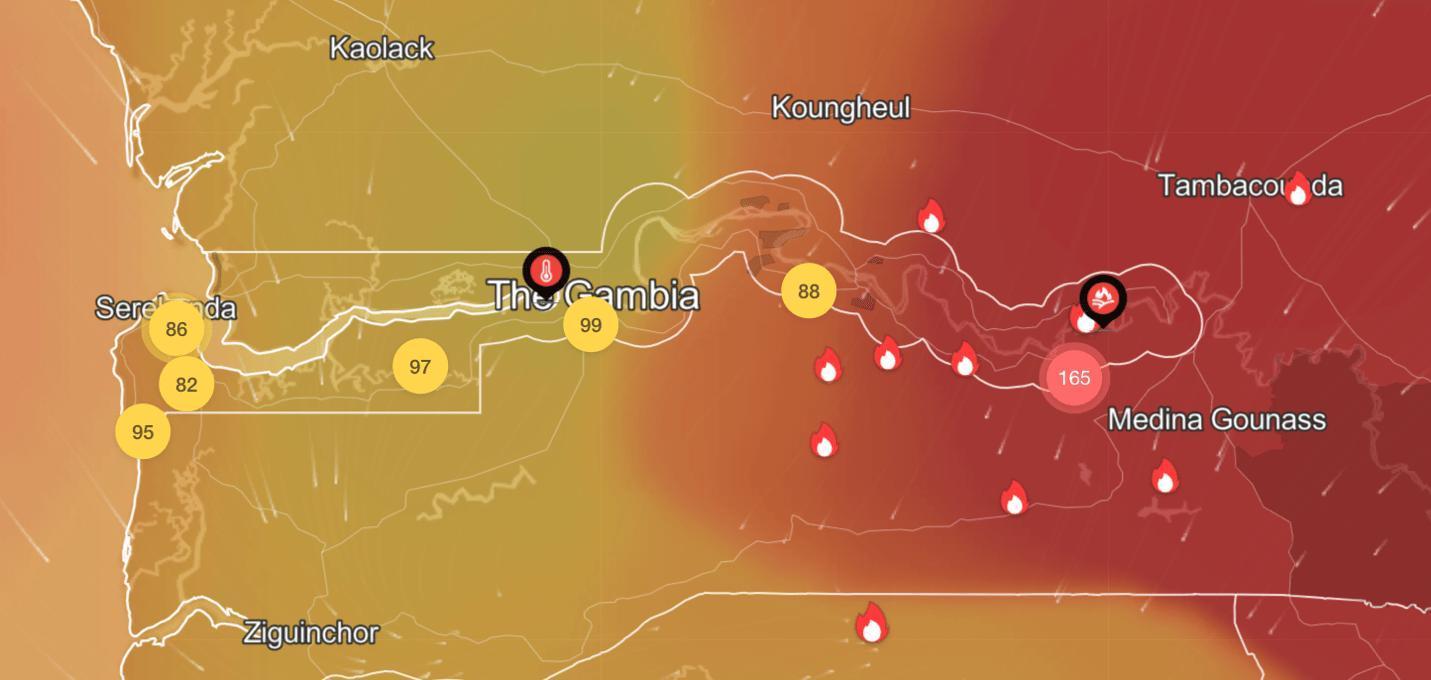
Africa-Press – Gambia. In recent days, The Gambia has been in the grip of a severe heatwave, as reported by the Permian Health Air Quality Monitoring Network. This network operates 13 monitoring stations throughout The Gambia, tracking climate data like temperature, humidity, and air quality. The data reveals extremely high temperatures, exceeding 40 degrees, posing a significant risk to public health. Coupled with frequent power outages, this extreme weather presents a notable threat to public well-being. There have been reports of wildfires, triggered by heat waves in Kombo South, and other parts of Gambia, resulting in air pollution.
Figure 1: Air Quality Map of The Gambia indicates that the heatwave is more pronounced in the inland areas of the country compared to the coast.
On a global scale, there’s growing recognition that climate change and greenhouse gas emissions are pushing temperatures to unprecedented levels. Experts predict that we will see more frequent and intense heatwaves in the coming years, resulting in significant health and economic impacts. In The Gambia, it’s important to raise awareness about this issue and improve our collective understanding of health and environmental issues to better cope with such events.
Understanding the health impacts of heatwaves is crucial, as they can cause a range of health problems, from mild to life-threatening conditions. Our bodies usually maintain a temperature of 36 to 37.2 degrees Celsius, despite changes in the environment. We do this through behavior adjustments, like staying indoors, keeping hydrated, wearing suitable clothing, and taking cool baths. Physiological processes such as sweating and changes in our blood vessels also help us cope with excessive heat. However, under extreme conditions like those currently seen in The Gambia, where temperatures surpass 40 degrees Celsius, our body’s internal control systems can be overwhelmed, leading to various heat-related illnesses.
Heatwaves can have serious health consequences, especially without proper precautions. Here are the health effects of heatwaves:
To protect against these heat-related health illnesses, consider taking these precautions:
It is imperative that we are intentional about how we urbanize the country. Many urban areas in The Gambia lack green spaces and trees, leading to increased temperatures due to the urban heat island effect– a phenomenon that occurs in urban areas where concrete, asphalt, and buildings absorb heat during the day and release it at night, causing temperatures to be higher. This is exacerbated by human activities such as energy consumption and lack of vegetation, leading to health risks and environmental challenges in cities.
By strategically planting trees in urban areas in The Gambia such as the OIC road network an in real estate developments, not only can we create more pleasant and livable environments for residents, but we can also mitigate some of the negative effects of rapid urbanization while enhancing the aesthetic appeal of our cities and towns. Trees also play a vital role in improving air quality because they absorb pollutants such as carbon dioxide, sulfur dioxide, and nitrogen oxides, and release oxygen into the atmosphere which cleans the air we breathe and contributes to combating climate change by reducing greenhouse gas emissions. This responsibility should not fall only on national and local government authorities, as each of us can contribute by committing to planting and maintaining at least one tree on in our compounds where feasible.
** Dr. Sunkaru Touray, MD, FACP, FCCP, is a board-certified specialist in Pulmonary Diseases and Critical Care Medicine, and co-founder of the Permian Health Lung Institute, an organization dedicated to promoting health and advocating for communities in The Gambia through education, research, and providing high-quality care to patients with respiratory illnesses.
For More News And Analysis About Gambia Follow Africa-Press