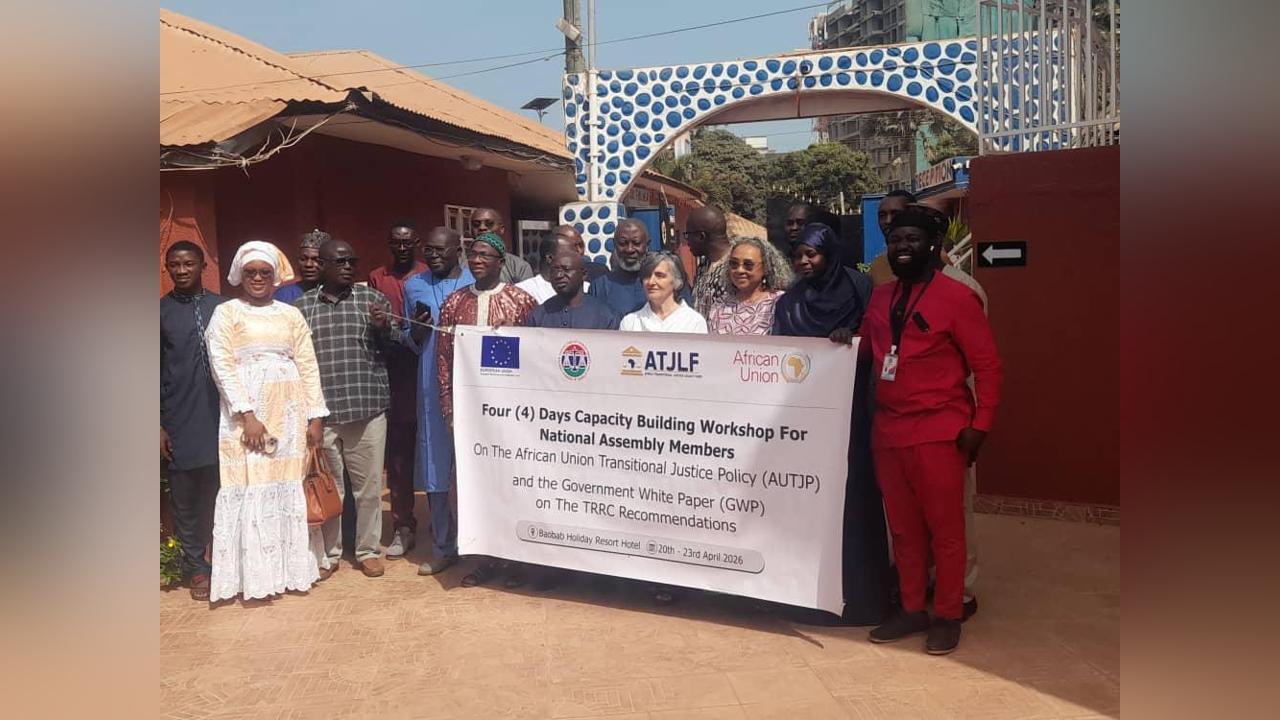
Africa-Press – Gambia. The Victims Centre for Human Rights has begun a four-day capacity building workshop for National Assembly Members (NAMs).
The training focuses on the African Union Transitional Justice Policy (AUTJP) and The Gambia Government’s White Paper on the Truth, Reconciliation and Reparations Commission (TRRC) recommendations.
The training which opened Monday at Boabab Residents Hotel, is aimed at strengthening lawmakers’ understanding of transitional justice frameworks and their role in ensuring effective implementation of key reforms.
Delivering the welcoming remarks, Muhammed Sandeng, Acting Board Chairman of the Victims Centre, described the training as a critical step in popularising both the AU policy and the government’s White Paper. He says the initiative is part of broader efforts to deepen public awareness and institutional engagement with transitional justice processes.
Sandeng reminded participants that the Victims Centre was established in 2017 by a small group of victims of the former regime of Yahya Jammeh, but has since grown to more than 1,500 registered members. He noted that the centre continues to document human rights violations, conduct outreach, and support on-going transitional justice efforts.
He added that the organisation provides key services to victims and their families, including medical, educational and psychosocial support.
Highlighting on-going activities, Sandeng said the centre has translated and recorded the AU Transitional Justice Policy into four local languages: Mandinka, Wolof, Fula and Jola conducted trainings for staff and civil society organisations, and carried out a musical caravan tour across regions including West Coast, Lower River, North Bank, Central River and Upper River.
He used the occasion to call on government to adequately fund the Reparations Commission and expedite forensic identification of remains from the 1994 coup currently at the Edward Francis Small Teaching Hospital.
In her opening statement, the European Union Ambassador to The Gambia, Immaculada Roca I Cortes, described the workshop as timely, noting that while The Gambia has made progress in addressing past abuses, the real challenge lies in implementing recommendations.
She said the TRRC process marked a significant milestone in giving victims a voice and uncovering the truth, but stressed that meaningful change depends on translating those findings into concrete action.
“The discussions here are not only about the past, but about the kind of future The Gambia wants to build,” she said, reaffirming the EU’s support for justice, accountability and the rule of law.
Chairperson of TANGO, Yadicon Heribo Njie, in her keynote address, underscored the critical role of parliament in ensuring oversight and accountability in the implementation of the White Paper.
She warned that delays risk undermining public trust, noting that many victims continue to suffer the consequences of past abuses, with some dying without seeing justice.
“Reparations are not acts of charity; they are obligations of the state,” she said, urging lawmakers to accelerate the process with clear timelines and sustained political will.
The workshop continues as stakeholders push for stronger legislative engagement to advance The Gambia’s transitional justice agenda.
For More News And Analysis About Gambia Follow Africa-Press