

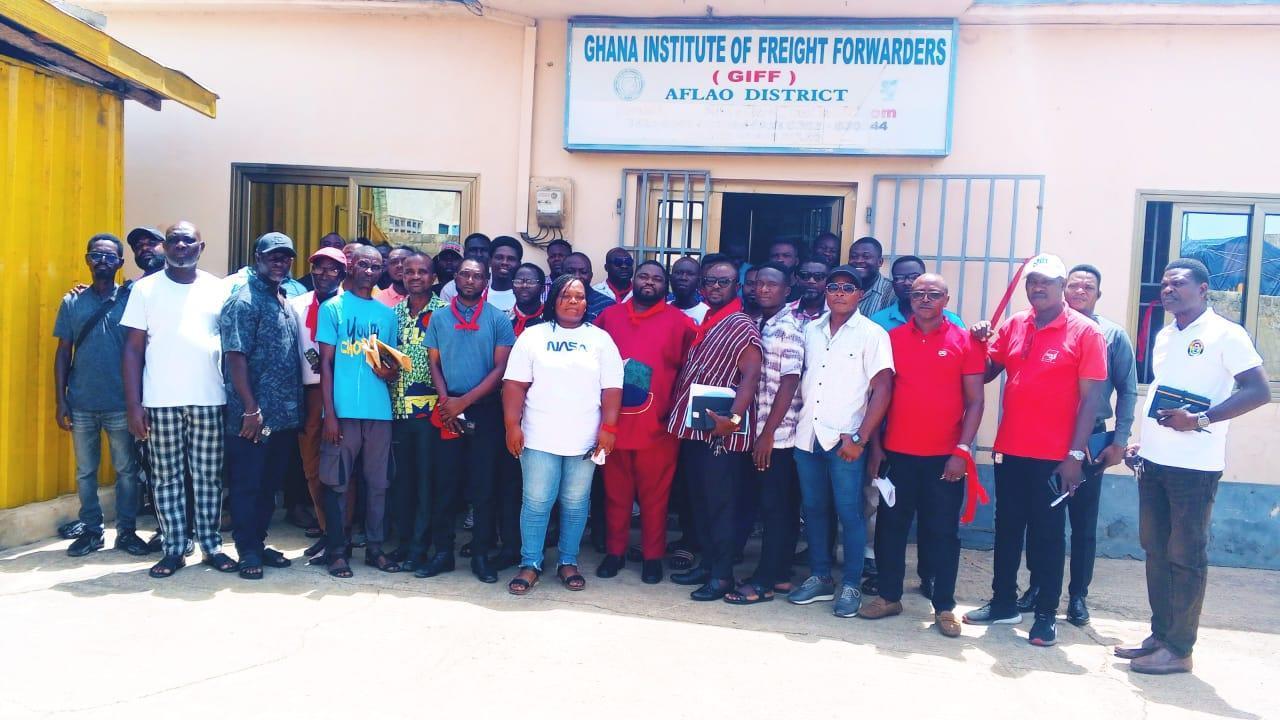
Africa-Press – Ghana. The Ghana Institute of Freight Forwarders (GIIF), Aflao District, has issued a strong ultimatum to the Ministry of Finance to address concerns over recent trade and customs measures.
It warned that it would take lawful action if no response is received by Tuesday, April 7, 2026.
Mr Abijah Osabutey-Ayor, the Chairman of the GIIF Aflao District, said the Association could no longer tolerate what it described as burdensome and unjustifiable policies affecting freight forwarders and customs house agents operating within the Ketu South and Ketu North Municipalities.
In a press statement, he noted that the trade corridors in the area played a critical role in revenue mobilisation, cross-border trade, and employment creation, particularly for border communities.
However, he said freight forwarders, who serve as key partners to the Ghana Revenue Authority (GRA), have in the past month been subjected to measures that are negatively impacting their operations and livelihoods.
“These challenges do not only affect our businesses but also have broader implications for trade facilitation, the cost of doing business, and the efficiency of Ghana’s import and export ecosystem,” he said.
Mr Osabutey-Ayor highlighted concerns over the Publican Digital Inspection Solution, an Artificial Intelligence (AI)-powered system introduced to enhance customs inspection and valuation processes.
He explained that although the system was designed to detect undervaluation, misclassification, and fraudulent declarations, its implementation had resulted in inflated and unrealistic customs values, often disregarding internationally accepted valuation principles such as the transaction value method.
He said this had led to frequent disputes, arbitrary duty assessments, and excessive financial burdens on traders.
He further raised concerns about the centralisation of the Customs Technical Services Bureau (CTSB) valuation functions in Accra, which he said had caused significant delays in the classification and valuation of goods.
He noted that such delays had resulted in high demurrage and rent charges at seaports, airports, and land borders, thereby increasing the cost of doing business.
Mr Osabutey-Ayor also pointed out the absence of an effective appeals system, stating that freight forwarders were unable to challenge valuation decisions, as the proposed “Publican Secretariat,” has not been operationalised.
Questioning the efficiency of the system, he asked, “How does AI determine the value of used cargo?”
The association is therefore demanding the decentralisation of classification and valuation processes, a review and recalibration of the AI system to align with international standards, and the establishment of a transparent and accessible dispute resolution mechanism.
On the issue of the ban on selected commodities through land borders, Mr Osabutey-Ayor criticised what he described as a blanket prohibition on items such as rice, sugar, flour, cooking oil, spaghetti, canned tomatoes, textiles, frozen products, and pharmaceuticals.
He argued that the directive contravened the Customs Act, 2015 (Act 891), which provides mechanisms for regulating imports, transit goods, and enforcement, without granting unilateral authority for such bans.
He described the decision as administratively ultra vires, legally unsustainable, and a violation of Article 23 of the 1992 Constitution, which requires public officials to act fairly and reasonably within the law.
Mr Osabutey-Ayor noted that the ban was inconsistent with AfCFTA and ECOWAS trade facilitation principles, warning of potential economic and employment consequences if the policy remains unchanged.
He called for the immediate suspension and review of the directive, as well as stakeholder engagement with the GIIF Aflao District leadership.
While reaffirming the association’s openness to dialogue, Mr Osabutey-Ayor stressed that failure by the Ministry of Finance to respond to their concerns within the stipulated period would compel them to take all lawful and appropriate measures to protect the interests of their members.