
Africa-Press – Ghana. Women in Ghana have been urged to engage actively in partisan politics to amplify their voices in decision making, strengthen accountability and thereby tackle societal norms inimical to the holistic growth of women and girls.
Mr Thomas Benarkuu, the Deputy Chief Executive Officer of the MIHOSO International Foundation (MIHISO), a Non-Governmental Organisation, gave the advice at a Social Accountability Forum (SAF) at Odomase in the Sunyani West Municipality.
He noted that women formed majority of the nation’s population, urging them to bold, formidable, defied stereotypes and contest in the District Level and Parliamentary Elections.
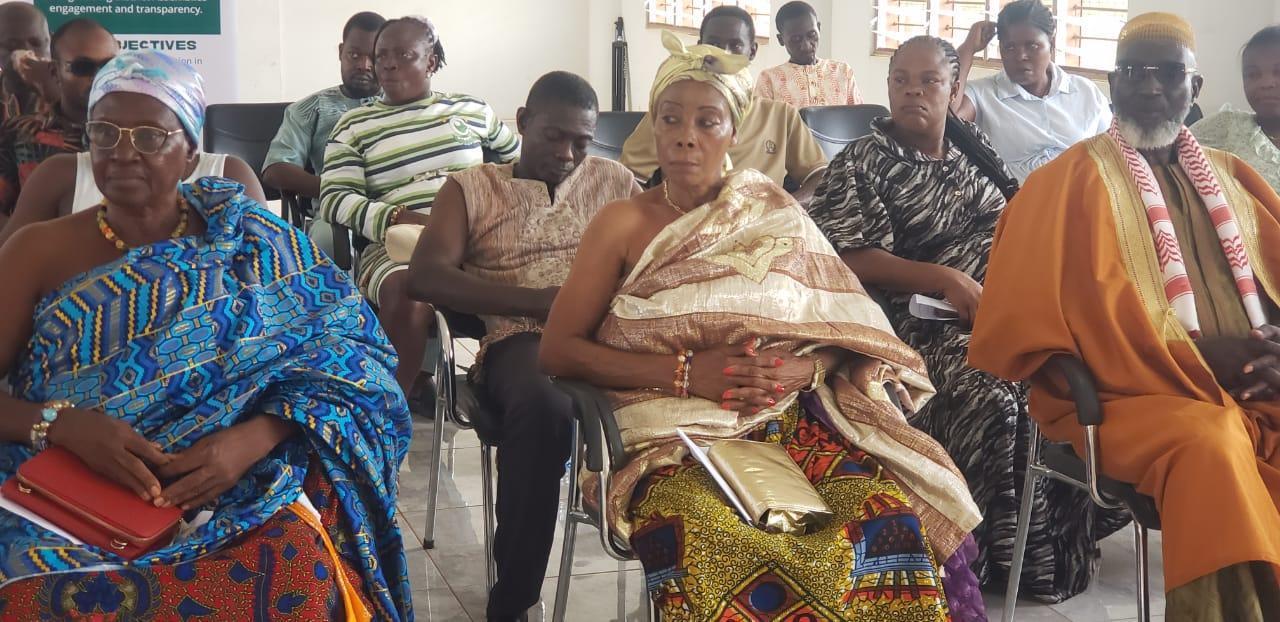
MIHOSO, an NGO working to improve the welfare of the vulnerable, organised the day’s forum, attended by representatives from faith-based organisations, government agencies and departments, market women and women groups, and traders and traditional authorities.
The event aligned with the execution of “Social Accountability for Resilient Democracy” (SARD) project being implemented by the NGO under the GIZ’s Participation, Accountability, And Integrity for a Resilient Democracy (PAIReD) programme.
It is commissioned by the German Federal Ministry for Economic Cooperation and Development and co-funded by the European Union and the Swiss State Secretariat for Economic Cooperation.
The project sought to strengthen the capacities of public institutions in Ghana to effectively implement citizen-oriented, trustworthy and accountable governance at national and local levels.
Mr Benarkuu expressed regret that despite their immeasurable contributions in shaping society and economic growth, the voices of women were silent in the decision making process at the local and national levels.
He said the voices and concerns of women and other vulnerable groups like Persons living with HIV and AIDS as well as People with Disabilities (PwDs) ought to be heard and captured in the fee fixing and medium-term development plans of the various Municipal and District Assemblies.
Mr Benarkuu said that could be done if women barred odds and resolve to participate actively in politics both at the local and national levels, saying that would greatly deepen the decentralization concept, and thereby strengthen transparency and accountability.
“In fact, it’s against this background that MIHOSO wishes to address these bottlenecks by seeking funds from the PAIRed to strengthen and empower citizens in selected districts to engage in local governance and also demand accountability from state and public actors at the local level,” he explained.
Mr Benarkuu emphasised MIHOSO dedication to leverage the 1992 Constitution, which afforded various opportunities to demand transparency and accountability in local governance.
“For accountability to work, the citizenry must be able to engage duty-bearers on interests and have relevant information, contact, and other capacity to track performance and financial malpractices,” he stated.
The SARD project seeks to build the capacity of public institutions to deliver citizen-oriented and trustworthy governance mainly at the local levels.
The project will also empower citizens with increased knowledge to actively participate in local governance and demand accountability from local state officials.
So, the SARD project sought to increase accountability and transparency of local government institutions and other key public institutions in the discharge of their duties in the five Municipal and District Assemblies in Bono, and Ahafo Regions.
The Assemblies comprised Sunyani West Municipal and Dormaa West District in Bono region as well as Tano North Municipal, Asutifi North and Asunafo South District of the Ahafo region.
Alhaji Ibrahim Habila, the Sunyani West Municipal Coordinating Director, advised the local communities to own and contribute to the decision making process of the various Metropolitan, Municipal and District Assemblies (MDAs).
He emphasised that the MDAs were established for the people, saying that their active contributions in decision making would not only strengthen the decentralization concept, but also push forward the holistic development of the local communities.
For More News And Analysis About Ghana Follow Africa-Press