
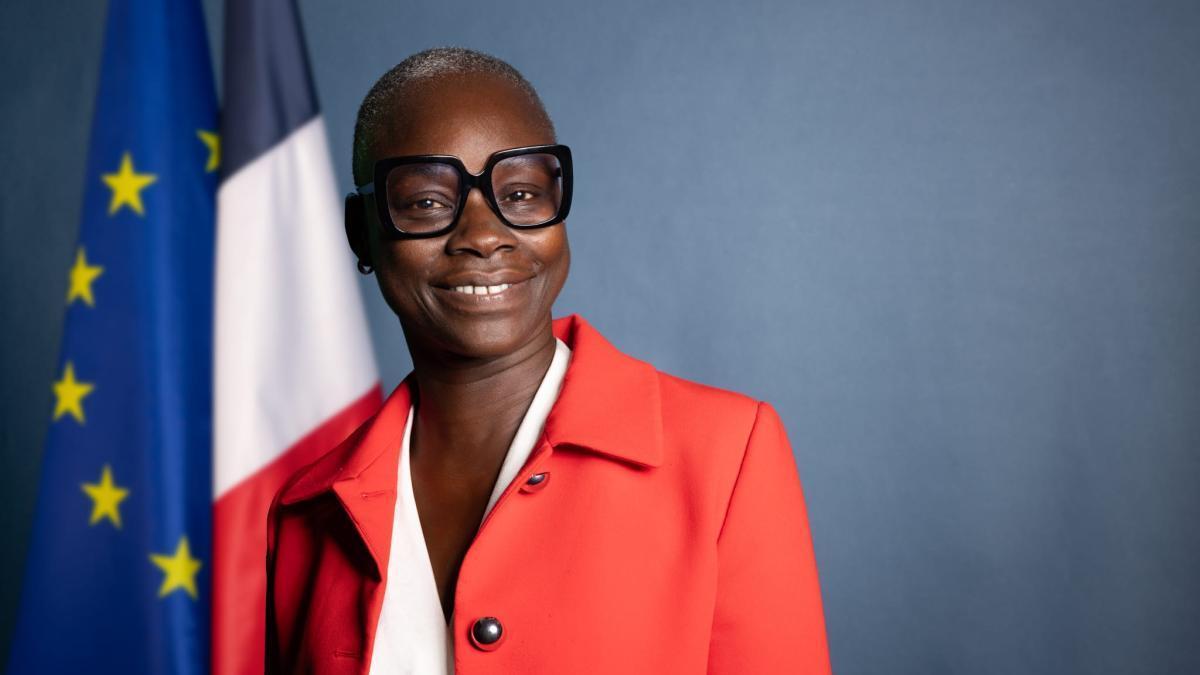
Africa-Press – Ghana. When Madam Diarra Dimé-Labille speaks about Ghana, it is not in the distant tone of a foreign envoy newly posted to unfamiliar territory.
Instead, her words carry a sense of familiarity, even affection, shaped by years of professional engagement with Ghanaian diplomats and a personal connection to West Africa.
“I was born and raised in Senegal… and when I was younger, Kwame Nkrumah was someone we studied,” she recalled during her first media engagement in Accra.
Now, as France’s Ambassador to Ghana, Madam Dimé-Labille brings not only decades of experience in international law and diplomacy, but also a worldview deeply rooted in Africa’s historical, political and cultural evolution.
Her appointment in September 2025 marked another chapter in a career defined by legal precision, multilateral engagement and a strong commitment to human rights and international cooperation.
But beyond the credentials and career milestones, it is her personal connection to Ghana that stands out most strongly in her early days in office.
“I feel very comfortable and welcomed in Ghana. From the moment I arrived, I have been overwhelmed by the warmth and hospitality extended to me, and I now fully understand why Ghana is often described in that way. I have truly felt at home,” she said.
“Ghanaians are very open, warm and willing to help. There is a genuine readiness to support me and relate to me almost like a sister, which has been wonderful to experience.”
That sense of belonging, she suggested, has already begun to shape both her personal experience and diplomatic approach.
“I am thoroughly enjoying my time here, both personally and professionally, and I see no reason for that to change. I will continue to build strong relationships and networks with Ghanaians, as I am here to work with and alongside them.”
Born on August 28, 1973, Madam Dimé-Labille is a trained lawyer whose career trajectory reflects a steady rise through some of the most critical institutions in global diplomacy.
She began her professional journey in 2002 as a trainee lawyer at the International Criminal Tribunal for Rwanda, an experience that exposed her early to the complexities of justice, accountability and post-conflict reconciliation.
That foundation would shape much of her career.
After a stint in the private sector as a consultant, she joined the Legal Affairs Directorate of France’s Ministry for Europe and Foreign Affairs in 2008, marking her formal entry into diplomacy.
From there, she steadily built a reputation as a specialist in international law, human rights and humanitarian affairs.
Her early diplomatic assignments took her to Rwanda, where she served as political adviser at the French Embassy, and later to roles within the Ministry’s Sub-Directorate for International Economic Affairs.
But it was her subsequent postings in global diplomatic hubs that broadened her perspective and deepened her expertise.
Between 2014 and 2018, she served as legal adviser at the French Embassy in The Hague, engaging directly with institutions at the heart of international justice.
She later moved to Geneva, where she worked with France’s Permanent Mission to the United Nations, focusing on humanitarian organisations and legal advisory roles.
Her work in Geneva placed her at the intersection of law and global humanitarian policy, dealing with issues that affect millions across continents.
In 2020, she was appointed Legal Adviser and Head of Human Rights and Humanitarian Affairs at France’s Permanent Mission to the United Nations in New York, a role that required both technical legal expertise and diplomatic finesse.
Reflecting on that period, she highlighted the value of collaboration, particularly her interactions with Ghanaian diplomats during Ghana’s tenure on the UN Security Council.
“I had this amazing chance to work with Ghanaian diplomats… and the way they were talking about their country was really very charming,” she said.
That experience, she noted, played a role in her decision to choose Ghana when the opportunity arose to serve as ambassador.
Her career took another significant turn in August 2024 when she joined the Office of the President of the French Republic as Adviser on Africa and Diasporas, contributing to policy on political, security and broader France-Africa relations.
It is perhaps this blend of legal expertise, diplomatic experience and historical awareness that defines Madam Dimé-Labille’s approach to her current assignment in Ghana.
At her core, she is a lawyer-diplomat – someone who sees international relations not just through the lens of policy, but also through the frameworks of law, justice and shared responsibility.
“I am a diplomat, but a lawyer by training,” she said, underscoring the foundation that continues to guide her work.
As Ambassador, she is stepping into a relationship that is both longstanding and evolving.
France and Ghana have maintained diplomatic ties for decades, but recent years have seen renewed efforts to redefine that partnership in response to changing global dynamics and African priorities.
For Madam Dimé-Labille, this means moving beyond traditional models of cooperation towards a more balanced and forward-looking partnership.
Her emphasis is clear: investment over aid, partnership over dependency, and collaboration over prescription.
“President Mahama is not seeking for help, he is seeking for investment,” she noted, capturing what she sees as a fundamental shift in how African countries engage with international partners.
This philosophy aligns with France’s broader strategy of engaging key African countries, including Ghana, Nigeria, Kenya and South Africa, as strategic partners in development and innovation.
In practical terms, her mission will focus on sectors such as infrastructure, youth employment, education, security and cultural exchange.
She has already highlighted initiatives aimed at increasing student mobility between Ghana and France, including programmes under Campus France and other academic exchange platforms.
Interestingly, she points out that language is no longer a barrier.
While encouraging Ghanaians to learn French, she notes that many French institutions now offer programmes in English, opening new opportunities for Ghanaian students.
Beyond education, security cooperation is another key area of focus.
Ghana’s location within a volatile sub-region makes it a critical partner in efforts to address threats such as violent extremism and cross-border instability.
Madam Dimé-Labille emphasises that France’s approach is now guided by the needs and priorities of partner countries.
“We are really listening… what Ghana is asking from us,” she said, signalling a shift from past approaches that have sometimes drawn criticism in parts of Africa.
Her tenure also coincides with growing global conversations around historical justice, including reparations for slavery and colonialism.
Here too, her legal background shapes her perspective, as she navigates the complexities of international law while acknowledging the importance of dialogue and consensus.
At a personal level, her experience in Ghana continues to reinforce her sense of connection to the country and its people.
“I recall when President Mahama was in Paris and, as he stepped off the aircraft, he referred to me as his sister – ‘She is my sister’. I was very proud of that moment,” she said.
“I am thoroughly enjoying my time here, both personally and professionally, and I see no reason for that to change. I will continue to build strong relationships and networks with Ghanaians, as I am here to work with and alongside them.”
Those reflections offer insight into a diplomat who sees her role not only in formal terms, but also in human and relational dimensions.
She describes her posting as a “win-win situation,” reflecting both her admiration for Ghana’s democratic stability and her desire to contribute to its continued progress.
Ghana, in her view, stands out as a beacon of hope and stability in a region often marked by political and security challenges – a country that combines historical significance with contemporary relevance.
From its Pan-African legacy to its current position as a hub for investment and innovation, Ghana presents both opportunity and inspiration.
Leading the French Embassy in Accra, Madam Dimé-Labille is supported by a team tasked with advancing diplomatic relations, development cooperation and economic partnerships.
Her leadership style, by her own account, is collaborative and inclusive, grounded in mutual respect and shared goals.
“I am going to dedicate myself, my time, and everything I can to make this a success,” she said.
As she settles into her role, expectations are high.
Her extensive experience, combined with her regional roots and legal expertise, positions her to navigate the complexities of modern diplomacy at a time when Ghana-France relations are poised for renewal.
In many ways, Madam Diarra Dimé-Labille represents a new generation of diplomats; globally experienced, legally grounded, and attuned to the shifting dynamics of geopolitics and international relations.
For Ghana, her tenure offers an opportunity to deepen engagement with France in ways that reflect shared priorities and mutual respect.
And for the Ambassador herself, it is a chance to serve not just as a representative of her country, but as a bridge that links histories, cultures and futures.
For More News And Analysis About Ghana Follow Africa-Press