
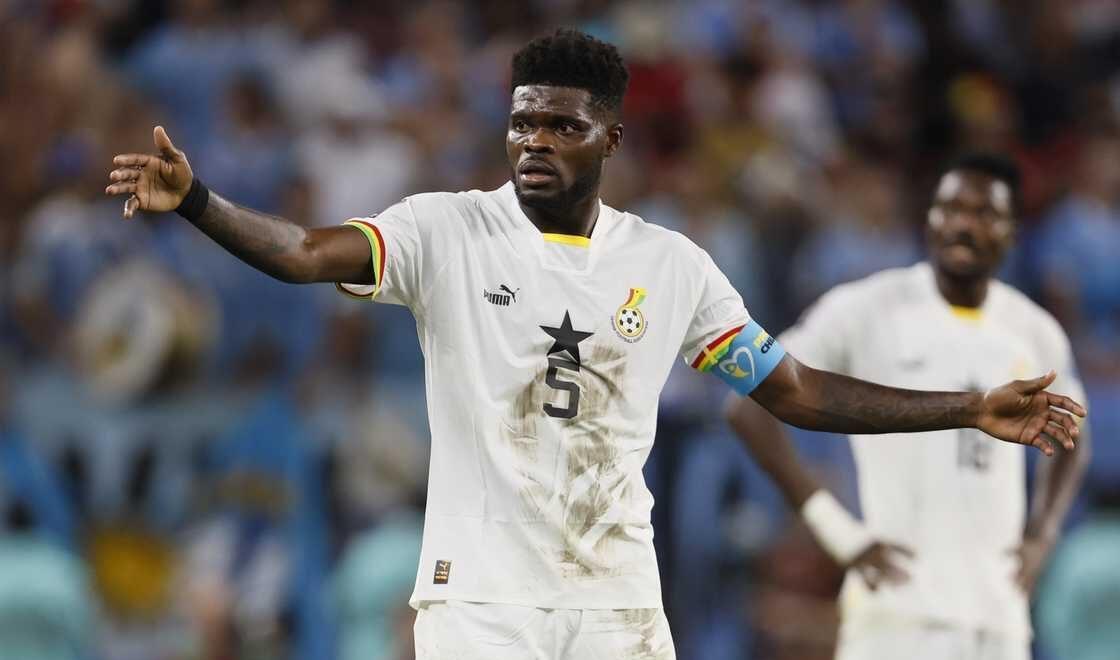
Africa-Press – Ghana. The government of Ghana has lodged an official protest with Canada regarding the refusal to grant Ghanaian national team player Thomas Partey a visa to participate in the 2026 World Cup. This comes as the player faces trial in the UK on allegations of “sexual assault,” while he maintains his innocence against all charges.
Ghana’s Foreign Minister Samuel Okudzeto Ablakwa stated that the country objects to the “arbitrary and extremely unfair” decision concerning Partey’s visa application, noting that the player is a key member of the Ghanaian national team.
The minister explained that the Ghanaian government has sent an official protest note to Canadian authorities, urging Ottawa to reconsider its decision.
He added that while Ghana respects Canada’s sovereign right to enforce its immigration laws, relying on unproven allegations raises questions about principles of justice and proportionality.
Thomas Partey, 33, currently plays for Villarreal in Spain, having previously represented Arsenal in England.
His absence will be felt in Ghana’s opening match against Panama, scheduled for the 17th of this month in Toronto, due to the lack of a visa.
The Ghanaian team has set up its training camp in the United States, specifically at Bryant University in Boston, in preparation for the World Cup.
Despite his expected absence from the Panama match, Partey will be eligible to participate in the next two matches for Ghana in Group 12 against England and Croatia, which will take place on American soil.
The Ghanaian player faces seven charges of “sexual assault” stemming from allegations made by four women regarding incidents purportedly occurring between 2020 and 2022. Partey has pleaded not guilty to all charges and is set to appear in a British court next year.
In this context, FIFA has confirmed that the player will not be able to travel from the Ghanaian team’s base in Boston to Canada for the match against Panama, stating that it does not engage in immigration policy procedures or visa issuance decisions of host countries.
FIFA emphasized that its authority does not extend to intervening in government decisions regarding entry permissions or visa grants for participants in the tournament.
Meanwhile, the Ghanaian government has pledged to explore all available diplomatic and legal avenues under Canadian and international law to ensure a fair and thorough examination of the case.
It has also urged Canadian authorities to reverse their decision in line with principles of justice and the rule of law.
In response, the Canadian immigration department stated that it cannot comment on individual cases, affirming that the protection and safety of citizens is its top priority.
The Canadian Ministry of Immigration, Refugees and Citizenship noted that its officials apply immigration rules consistently and without exceptions, regardless of an individual’s nationality, status, or role in the tournament.
In the United States, authorities confirmed they are aware of the case pending in British courts but noted that Partey has not been convicted of any crime and has obtained a visa allowing him to enter the U.S. and participate in the Ghanaian team’s camp.
Partey’s case is the latest in a series of controversies related to immigration policies during the 2026 World Cup, which will be hosted by the United States, Canada, and Mexico.
Previously, Somali referee Omar Abdulkadir Artan, one of about fifty referees selected by FIFA to officiate World Cup matches, faced issues related to U.S. immigration procedures, raising questions about the impact of these policies on the world’s largest sporting event.
Additionally, the International Sports Press Association revealed that several African and Iranian journalists were unable to obtain the necessary visas to cover the World Cup in the United States.
The travel restrictions have also affected some African fans, as a group of ticket holders from the Democratic Republic of the Congo were barred from traveling to the U.S. due to an Ebola outbreak in their country, with reports indicating they are unable to recover the cost of the World Cup tickets they had previously purchased.