
Africa-Press – Ghana. The Agortime-Ziope District takes centre-stage at the Seventh Volta Trade and Investment Fair by profiling is major features and resources including the district’s economic potential and cultural strengths.
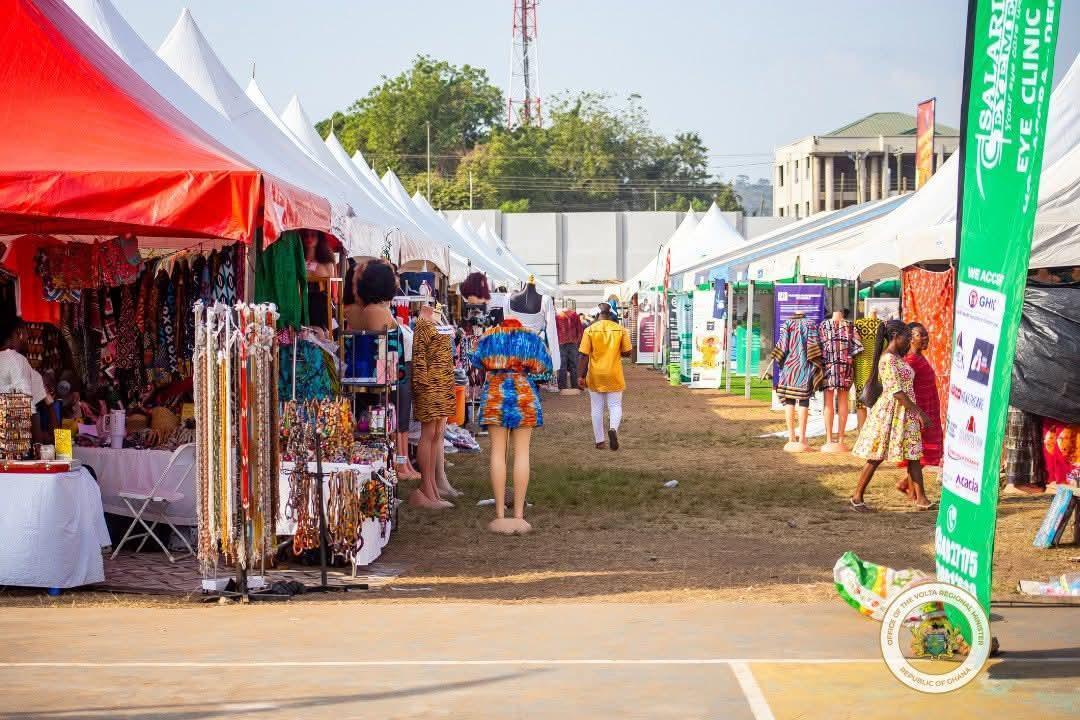
The fair, Ghana’s first-ever 24-hour trade exhibition, opened on November 26 and continues until December 8, hosting exhibitors, investors and visitors around the clock.
Presenting its profile at the District Days, Mr Reuben Akuffo, District Coordinating Director, highlighted the district’s origins, noting that it “was carved out of the former Adaklu-Anyigbe District and established by Legislative Instrument 2080 in 2012,” with Kpetoe as its capital.
He described Agortime-Ziope as a district renowned for its cultural heritage, particularly traditional kente weaving, which remains “a major economic activity and a source of local pride.” Agriculture, he added, is the backbone of the local economy, with farmers engaged mainly in maize, cassava, and vegetable production.
The district, he said, combines a strong cultural identity with steady development initiatives, making it “an important contributor to the Volta Region’s social and economic landscape.” He also outlined the district’s strategic location, bordered by the Republic of Togo to the east, which positions it as a significant point for cross-border trade.
Mr. Akuffo reported that Agortime-Ziope covers 315.65 square kilometres, making it one of the smallest districts in Ghana by land size. Its projected 2025 population of 39,553 represents a density of 88.75 persons per square kilometre, with females constituting 52 per cent.
He named major communities within the district, including Agortime-Kpetoe, Afegame, Abenyinase, Ziope, Adedome and Wudzedeke, and listed key institutions such as the District Court, Police Station, Fire Service, NHIS office, Immigration Service, GRA and NGOs including World Vision International.
The district’s traditional structure, he noted, comprises the Agortime and Ziope Traditional Areas, each celebrating unique festivals —Agbamevorza, a colourful kente festival, and Agbleza, a farm festival expressing gratitude for harvests and heralding the next farming season.
On natural and economic resources, he identified Bismarckia clay and the River Tordze as key endowments, with agriculture, craftwork and trade dominating livelihoods.
He emphasised the district’s strong agricultural potential, particularly tomato production, saying farmers “have the experience and capacity to supply a future processing factory.”
Mr Akuffo added that livestock rearing, including pigs, sheep, goats and poultry, is also prominent, with dedicated grazing areas around Agortime-Afegame.
He highlighted the district’s tourism strength, driven largely by its cultural festivals and renowned kente weaving tradition. “Agortime is the home of kente,” he said, adding that the weaving craft is a natural skill among the people, making the district a unique cultural and economic attraction.
For More News And Analysis About Ghana Follow Africa-Press