
Africa-Press – Ghana. Mr. Philip Duah, a local accountability officer, was left surprised when he visited the Suame Roundabout to verify the installation of streetlights at the site, which is being redeveloped into an interchange in the Ashanti Region.
The project was intended to improve visibility for motorists at night.
However, the interchange, still under construction, had no streetlights installed.
Data published by the Ministry of Finance indicated that GH¢963,188 had been paid to a company on June 14, 2023, to install the streetlights at the Suame Interchange area, but nearly three years later, not a single streetlight had been installed.
“When I probed, the local Assembly said they had no information on the project. This made it difficult to probe further,” Duah said.
Tracking petroleum-funded projects
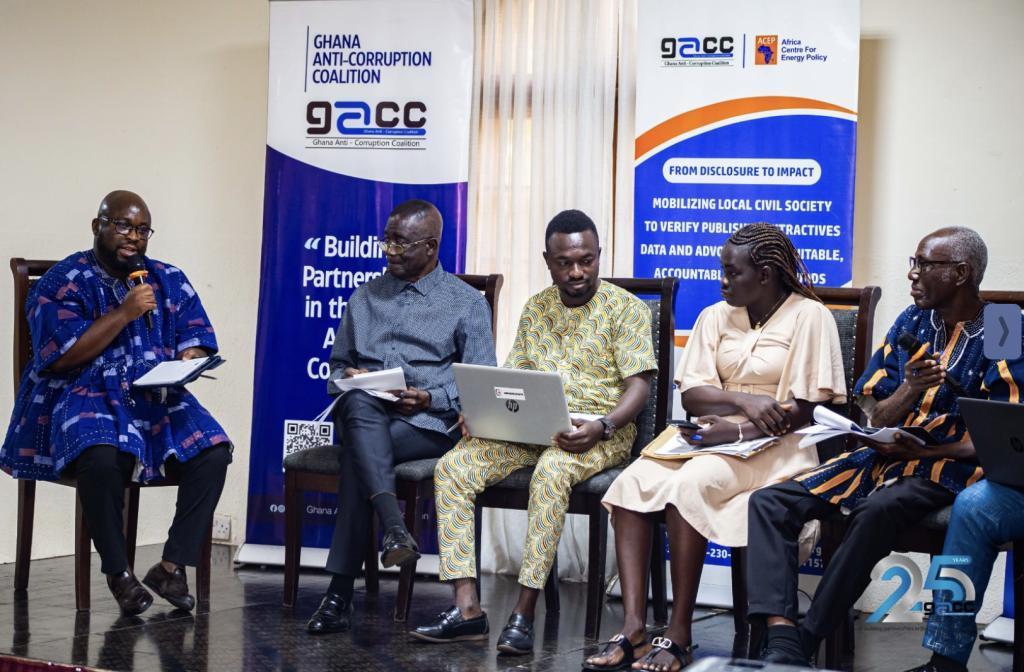
The case is one of several findings from a three-year project by the Ghana Anti-Corruption Coalition, with support from the Africa Centre for Energy Policy, to track the use of petroleum revenue in selected districts.
The project, titled From Disclosures to Impact – Mobilising Local Civil Society to Verify Published Extractive Data and Advocate for Equitable and Accountable Spending of Funds, focused on monitoring projects funded through the Annual Budget Funding Amount (ABFA).
The ABFA is a portion of Ghana’s petroleum revenue allocated annually to support development projects.
Under the project, the GACC deployed Local Accountability Network (LANet) members to verify projects listed in official data from the Ministry of Finance.
Over the three-year period, the Coalition monitored 68 projects across five districts – Asante Akyem, Ho, Sekondi-Takoradi Metropolis, Nzema East, and Tamale.
Out of the total, 33 projects were tracked in the first year and 35 in the second year.
Mr Samuel Harrison-Cudjoe, Programmes Officer at GACC, said the exercise was to confirm whether projects listed in official records existed and identify risks linked to their implementation.
“All that we did was to pick the list of oil-funded projects that the Ministry of Finance put out and we went to verify, to see if indeed those projects exist and also to look at any of the corruption risks and governance issues around those projects,” he said.
Findings point to systemic gaps
Findings from the monitoring point to systemic challenges, including lack of citizen participation, weak oversight, and limited access to information.
Mr Harrison-Cudjoe said one of the key issues identified was the absence of local involvement in project planning.
“The projects are planned in Accra and then sent to the district. People living within the district don’t have any say,” he said.
He added that many projects were not aligned with the medium-term development plans of the assemblies, limiting local ownership.
Another issue identified was lack of transparency in the contracting process.
“There is no transparency when it comes to contracting around some of these projects,” he said.
He explained that contracts were awarded in Accra, with little or no information shared with local assemblies, making it difficult for them to monitor or enforce compliance.
The report also identified weak oversight systems, allowing contractors to operate without adequate checks.
In some cases, projects listed in official records could not be found on the ground.
“There were some projects that even though we have them on paper, you go to the ground, you can’t find the project. It’s not there,” Mr Harrison-Cudjoe said.
Information gap fuels risks
The GACC expressed concern about what it described as “information asymmetry,” where government agencies hold information that is not accessible to citizens.
“Once a certain group of people have the information and others do not, those who have the information are able to manipulate it,” Mr Harrison-Cudjoe said.
Mr Duah, who monitored projects in the Asante Akyem area, described the situation as a major challenge for accountability.
He said many projects were introduced at the local level without prior notice or engagement with communities.
“The project is designed in Accra and dumped at the local level,” he said.
He cited instances where projects listed in official records could not be traced.
“For example, they indicated construction of roads from Konongo to Kumasi, but when you check, you cannot see any project ongoing there,” he said.
Mr Hudu Hafiz, a LANet member in Tamale, also reported challenges in accessing information during the monitoring process.
He said some institutions declined to provide data unless additional approvals were obtained, while contractors were often unwilling to engage with monitors.
“Information was not forthcoming,” he said.
Billions in oil revenue spending
According to the Public Interest and Accountability Committee, Ghana earned about US$6.55 billion in petroleum revenue between 2011 and 2020, out of which about US$2.6 billion (over GH¢9.4 billion) was allocated to the ABFA.
PIAC reports have consistently raised concerns about inefficiencies in the use of these funds, including project delays, poor quality work, and weak monitoring systems.
Big Push raises stakes
The GACC’s findings come at a time when government is preparing to scale up infrastructure investment under its “Big Push” agenda.
The initiative is expected to be financed partly through the ABFA, with about GH¢13.85 billion earmarked in 2026 for projects in roads, energy, digital infrastructure, and rural development, according to the Ministry of Finance.
Mr Harrison-Cudjoe said the findings from the GACC project provide important lessons for the implementation of the Big Push agenda.
“If we do not resolve these problems, then the Big Push is going to suffer the same fate,” he said.
He called for full disclosure of project information, including contract details, timelines, and funding allocations.
As Ghana prepares to invest heavily in infrastructure through the Big Push initiative, the GACC report highlights the need for reforms in project planning, contracting, and monitoring.
The report underscores that without transparency, local participation, and effective oversight, the impact of petroleum-funded projects may remain limited.
It also points to the importance of aligning national projects with local needs to ensure that public funds deliver value to citizens.
The lessons from the citizens’ audit suggest that strengthening accountability systems will be key to achieving the intended outcomes of the Big Push agenda.
Source: Ghana News Agency
For More News And Analysis About Ghana Follow Africa-Press