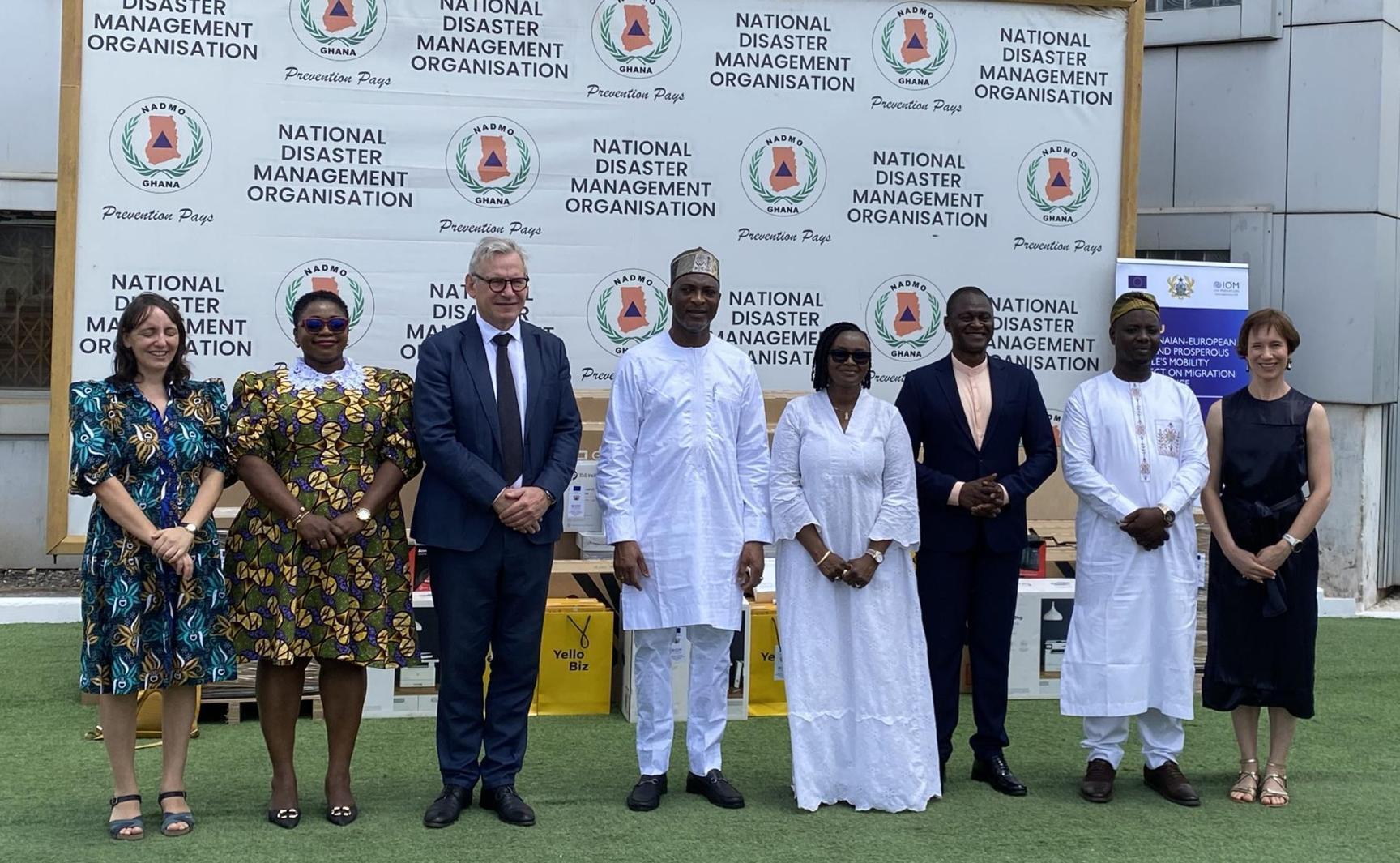
Africa-Press – Ghana. The International Organisation for Migration (IOM) has donated emergency response equipment to the National Disaster Management Organisation (NADMO) to strengthen Ghana’s disaster preparedness, crisis coordination and response systems.
The items, comprising 30 desktop computers, six laptops, three drones, printers, mobile phones, television sets, and routers, were funded by the European Union to enhance operations at NADMO’s Emergency Centres at the national level, as well as the Upper East and Upper West regions.
The donation was made on Friday in Accra during the first quarter meeting of the National Coordination Mechanism for Migration (NCM), under the Ghana-European Safe and Prosperous People Mobility Project (ATUU).
The event brought together government officials, migration stakeholders and development partners to review migration governance efforts and strengthen inter-agency collaboration on migration and emergency response.
Mr Muntaka Mohammed-Mubarak, the Minister of the Interior, who received the items on behalf of the Government, commended the IOM and the European Union for their continued support to Ghana’s security and humanitarian institutions.
The donation, he said, would improve NADMO’s ability to manage displacement, disasters and migration-related emergencies, especially in vulnerable communities in northern Ghana.
The Minister described NADMO as a critical national institution whose preventive work could help the country to avoid major financial and human losses during emergencies.
He, however, appealed for more support for the organisation, citing persistent funding constraints.
“Sometimes because resources are scarce, attention is focused on immediate daily needs, but NADMO helps us prevent many unnecessary expenditures if it is properly structured,”he said.
Mr Rune Skinnebach, the Head of Delegation of the European Union in Ghana, said the handover was a renewed investment in the long-standing partnership between Ghana and the EU.
The EU remained committed to supporting Ghana in migration governance, protection, reintegration, anti-human trafficking efforts, border management and safe migration pathways, he noted.
Mr Skinnebach said the European Union had invested more than 40 million euros in Ghana to support institutions and communities, adding that the bloc remained Ghana’s largest donor, export market and investor.
He disclosed that more than 34,000 asylum seekers fleeing conflict in Burkina Faso had crossed into Ghana, including many women and children, making preparedness and coordinated humanitarian response more urgent.
The EU envoy commended NADMO for its role in responding to displacement caused by conflict, environmental shocks and climate-related emergencies.
Ms Fatou Diallo Ndiaye, the Chief of Mission of IOM for Ghana, Togo and Benin, said the donation was more than a transfer of equipment, describing it as a practical investment in Ghana’s capacity to prepare for displacement and respond to emergencies in a timely and coordinated manner.
Over the years, IOM and NADMO had strengthened coordination systems, promoted data-driven decision-making and improved preparedness for crises linked to climate shocks, mass movement, cross-border displacement and regional insecurity.
Ms Ndiaye said the partnership had already delivered concrete results, including the development of Ghana’s National Cross-Border Humanitarian Crisis Response Plan to guide action within the first 24 to 72 hours of emergencies.
She said the institutions had also conducted simulation exercises and jointly responded to recent emergencies such as the Akosombo Dam spillage and conflict-related displacement through assessments and life-saving interventions.
The equipment donated would improve real-time data management, coordination, continuity of operations and accountability during crises, she said.
Major (Rtd) Dr Joseph Bikanyi Kuyon, Director-General of NADMO, expressed gratitude to the IOM and the European Union for the “significant support to a sensitive and strategic area of Ghana’s disaster management system.”
He said the Emergency Operations Centres served as the nerve centre of NADMO’s work and the equipment would directly strengthen the organisation’s ability to save lives and protect property during disasters.
He said the support also demonstrated the value of partnership in building resilient national response systems.
The National Coordination Mechanism for Migration was established on November 28, 2024, under Ghana’s National Migration Policy to promote coordinated implementation and reporting of migration-related initiatives, including the Global Compact for Safe, Orderly and Regular Migration.
For More News And Analysis About Ghana Follow Africa-Press