

Africa-Press – Ghana. Across laboratories worldwide, the process of discovering and developing new medicines has long been characterised by time-consuming experiments, high costs, and complex procedures that often take years to yield results.
In Ghana, where the burden of diseases such as malaria, hypertension, diabetes and infectious outbreaks remain significant, the need for faster and more efficient approaches to drug development has become increasingly urgent.
It is within this context that emerging technologies, particularly Artificial Intelligence (AI) and lab-on-a-chip systems, are gaining attention as potential game-changers in the global health landscape.
At the centre of this shift is Dr Ofosua Adi-Dako, a Schmidt Global Faculty Fellow at Imperial College London and a Senior Lecturer at the University of Ghana School of Pharmacy, whose work is contributing to a new frontier in pharmaceutical research.
Her work combines advanced microfluidic systems with AI-driven data analysis to transform how drugs are tested, refined, and prepared for clinical use.
Rethinking traditional drug development
Traditionally, drug discovery follows a linear and often slow process. Scientists typically conduct experiments one at a time, carefully observing outcomes and repeating procedures to validate results.
This approach requires extensive human resources, sophisticated laboratory infrastructure, and significant financial investment.
In many cases, researchers must rely on animal testing to generate sufficient data before proceeding to clinical trials, further increasing costs and ethical considerations.
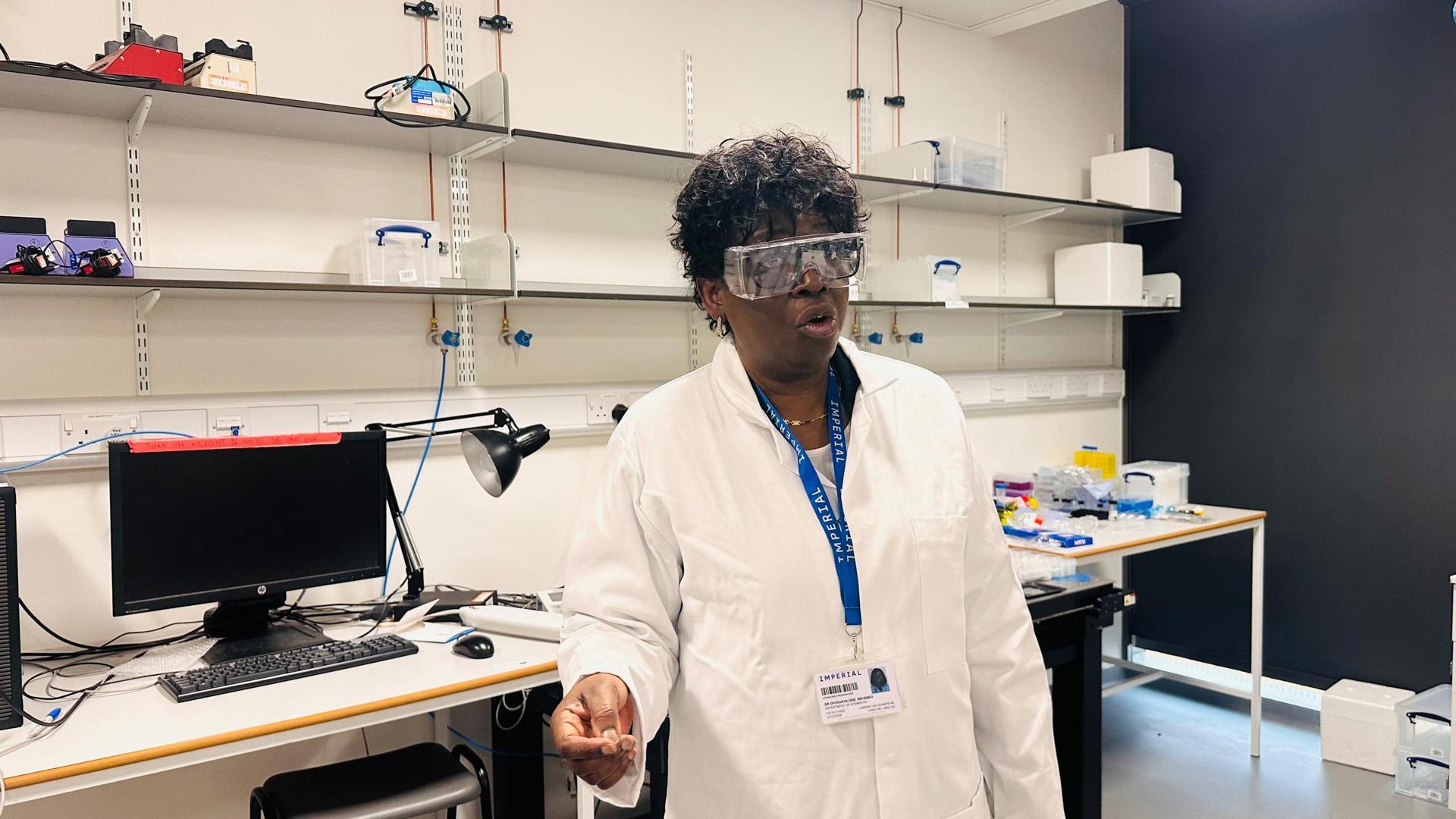
Dr Ofosua Adi-Dako demonstrates microscopic imaging of a lab-on-a-chip device Dr Adi-Dako explains that this conventional method can delay the availability of life-saving treatments, especially in regions where resources are limited.
“Sometimes, experiments have to be repeated multiple times, and researchers may spend long hours or even nights to monitor results,” she told journalists during a week-long study tour at the laboratory of Imperial College London, where precision, patience and persistence define the pace of scientific discovery.
Such limitations reflect the importance of adopting more efficient and scalable technologies.
The promise of Lab-on-a-Chip technology
Lab-on-a-chip technology marks a decisive shift from conventional laboratory methods, introducing a more compact, efficient and data-driven approach to scientific research.
At its core, the technology uses miniaturised, engineered chips embedded with intricate microchannels capable of handling extremely small volumes of fluids, often measured in nanolitres or picolitres.
Within these tiny platforms, complex biological processes can be recreated with remarkable precision, allowing scientists to simulate how drugs interact with human tissues under controlled conditions.
By mimicking biological barriers, particularly intestinal membranes, the technology enables researchers to observe how drug compounds permeate, diffuse and are absorbed into the body.
This is a critical stage in drug development, as ineffective absorption can render even the most promising compounds useless in clinical application.
“What we are doing is creating systems that replicate what happens in the human body, allowing us to observe how drugs behave before they are tested in more advanced stages,” said Dr Ofosua Adi-Dako.
Beyond simulation, the strength of lab-on-a-chip systems lies in their ability to generate high-throughput data. Unlike traditional laboratory setups that focus on a single experiment over an extended period, these chips can run dozens, sometimes hundreds, of parallel experiments simultaneously.
This dramatically accelerates the pace of research while maintaining a high degree of accuracy and consistency, said Dr Ignacio Gispert Contamina, a Fellow in the Department of Chemistry at Imperial College London, who co-directs the Membrane Biophysics Group and serves on the executive team of FabriCELL.
The technology also reduces reliance on large sample volumes and expensive reagents, making it more cost-effective and sustainable.
A lab-on-a-chip device showing microfluidic channels for rapid testing.In addition, it minimises the need for repeated trials and lowers dependence on animal testing by providing early-stage insights into drug behaviour.
Crucially, the large datasets produced can be integrated with advanced analytical tools, including artificial intelligence, to uncover patterns and predict outcomes with greater confidence.
This combination of speed, precision and scalability positions lab-on-a-chip technology as a powerful tool in modern drug discovery, with the potential to shorten development timelines and bring effective and timely treatments to patients.
AI as catalyst for scientific discovery
While lab-on-a-chip technology accelerates experimentation, artificial intelligence enhances the analysis of the data generated.
AI models are capable of processing vast datasets quickly and identifying patterns that may not be easily detected through conventional analysis.
This allows researchers to make more informed decisions about which drug compounds are likely to succeed and which should be modified or discarded.
According to Dr Adi-Dako, AI provides an added advantage by uncovering hidden relationships within data, improving accuracy and reducing uncertainty in drug development.
The integration of AI with lab-on-a-chip systems represents a shift towards what scientists describe as “smart science”, a more efficient, predictive, and data-driven approach to research.
Implications for Ghana’s healthcare delivery
For Ghana, the adoption of these technologies could have far-reaching implications.
The country’s healthcare system continues to face challenges, including delays in access to effective treatments, dependence on imported medicines, and limited local capacity for advanced pharmaceutical research.
By leveraging lab-on-a-chip and AI technologies, Ghanaian researchers could accelerate the development of treatments tailored to local health needs.
For instance, scientists could rapidly test drug candidates for diseases such as malaria, which remains a leading cause of morbidity and mortality in the country.
Glimpse into a modern laboratory workspace at Imperial College equipped with advanced research toolsSimilarly, the technology could be applied to improve medications for non-communicable diseases such as hypertension and diabetes, which are on the rise.
One particularly promising area is the study of Ghana’s rich natural resources.
The country is home to a wide range of medicinal plants traditionally used for treatment. However, scientific validation and optimisation of these compounds have often been slow.
With lab-on-a-chip systems, researchers could test multiple plant-based compounds simultaneously, analysing their effectiveness and refining their formulations more efficiently.
This could pave the way for the development of locally produced, evidence-based herbal medicines that meet international standards.
Enhancing drug formulation and patient outcomes
Beyond discovery, the technology also plays a crucial role in drug formulation.
Drugs are not administered in their raw form; they must be carefully formulated to ensure they are absorbed effectively by the body.
If a drug fails to permeate biological membranes or does so inconsistently, it may not deliver the desired therapeutic effect.
Lab-on-a-chip systems allow scientists to study these processes in detail, ensuring that drugs are optimised for maximum effectiveness.
This has direct implications for patient care, particularly in rural and underserved areas where access to healthcare is limited and treatment failures can have serious consequences.
Improved drug formulations could lead to better health outcomes, reduced treatment costs, and increased confidence in locally produced medicines.
Building local capacity through collaboration
A key aspect of Dr Adi-Dako’s work is the emphasis on collaboration and knowledge transfer.
GNA Correspondent, James Amoh Jnr (right), poses with Ghanaian scientist, Dr Adi-Dako, during a visit to a laboratory facilityThrough her fellowship and partnerships with international institutions, she is gaining exposure to cutting-edge technologies and methodologies that can be adapted for use in Ghana.
Plans are underway to replicate elements of this research approach locally, enabling Ghanaian institutions to benefit from high-throughput experimentation and AI-driven analysis.
“This is about building capacity and ensuring that we are able to apply these innovations to solve our own healthcare challenges,” she said.
Such initiatives are expected to strengthen research institutions, enhance training opportunities for young scientists, and promote innovation within the pharmaceutical sector.
Despite the potential benefits, several challenges must be addressed to ensure successful adoption of these technologies in Ghana.
These include the need for investment in advanced laboratory infrastructure, access to funding, and the development of specialised skills in AI and microfluidics.
There is also a need for supportive policies and regulatory frameworks to encourage research and innovation.
Experts say that collaboration between government, academia, and industry will be critical in overcoming these barriers.
Looking ahead
As the global scientific community continues to embrace digital and micro-scale technologies, Ghana stands at a crossroads.
The integration of AI and lab-on-a-chip systems into the country’s research ecosystem offers an opportunity to transform healthcare delivery, making it more responsive, efficient, and locally driven.
Science, Technology and Innovation (STI) journalists pose for a group photograph during a working visit to a laboratory at Imperial College, LondonFor Dr Adi-Dako, the goal is clear, to translate advanced scientific knowledge into practical solutions that improve lives.
Her work reflects a broader vision of a future where Ghana is not only a consumer of medical innovations but also a contributor to global scientific progress.
With sustained investment and strategic collaboration, that future may be closer than it seems.30 March 2026
Source: Ghana News Agency