

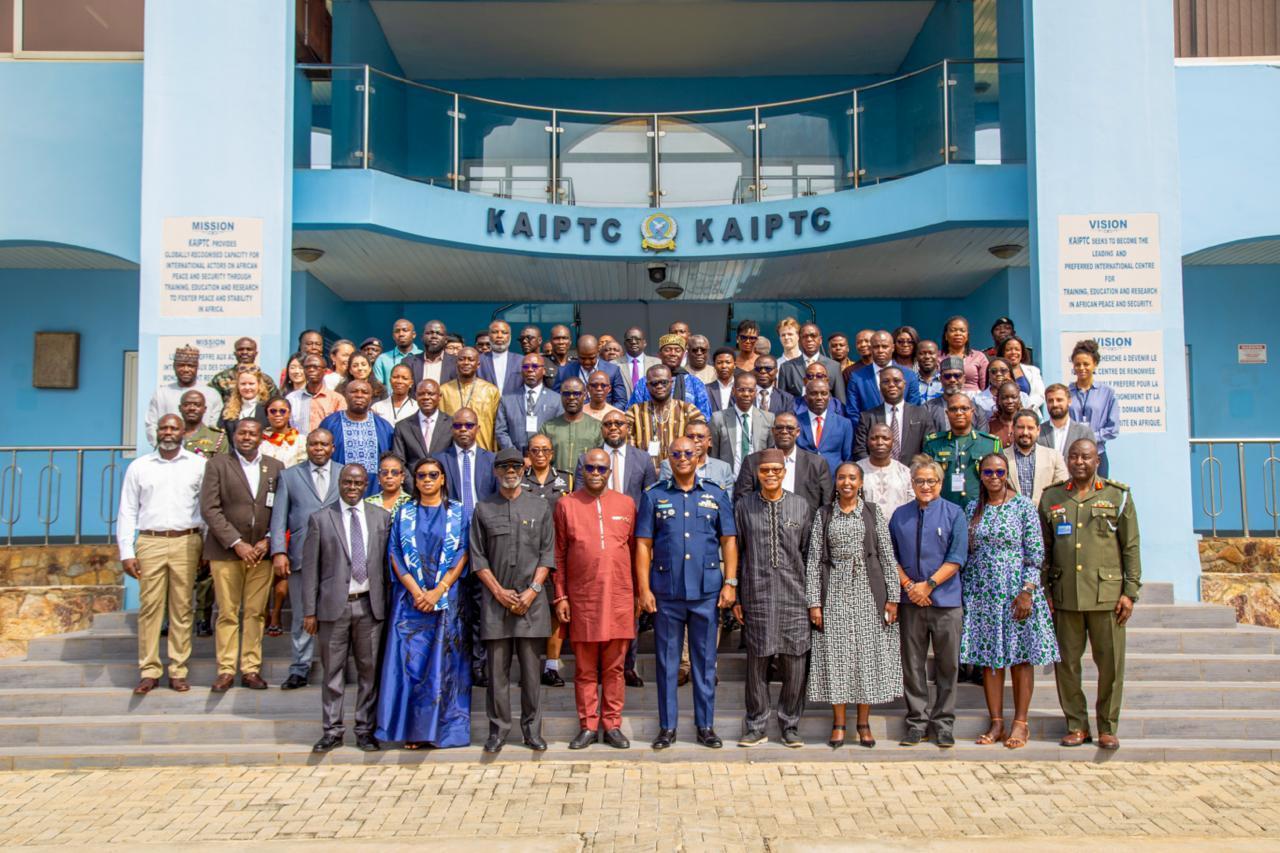
Africa-Press – Ghana. Mr. Ebenezer Okletey Terlabi, the Deputy Minister for the Interior, has urged countries in the Gulf of Guinea and West and Central Africa to adopt integrated, politically driven approaches to weapons and ammunition management to prevent violent conflict and extremism.
He said the persistent proliferation of small arms and light weapons and their associated ammunition continued to fuel armed violence, organised crime and insecurity, undermining governance, development and social cohesion across the region.
Mr. Terlabi made the call at the opening of a high-level regional dialogue on weapons and ammunition management in the context of conflict prevention, held in Accra.
The two-day dialogue is expected to produce practical recommendations aimed at aligning weapons and ammunition management with broader conflict prevention and peacebuilding strategies, strengthening cross-border cooperation, and promoting inclusive approaches involving governments, civil society, women and youth across the Gulf of Guinea sub-region.
It brought together security experts, policymakers, regional bodies and development partners.
He noted that Africa was estimated to host about 40 million small arms and light weapons, with diversion from legal production to illicit markets remaining a major concern, especially in a sub-region characterised by porous borders and cross-border criminal networks.
The Deputy Minister stressed that arms remained legitimate tools for states in enforcing the rule of law and asserting state authority.
However, he noted that weak national control systems, uneven legal harmonisation among countries, and fragmented regulatory approaches continued to undermine effective arms control.
He explained that the continued separation of firearms regulation from ammunition management had created significant loopholes, which were being exploited for the illicit circulation of weapons across borders.
The Deputy Minister said Ghana, mindful of growing security pressures in its neighbourhood, had begun addressing legislative gaps in arms control and recently concluded a nationwide gun amnesty programme aimed at recovering illicit weapons and strengthening conflict prevention measures.
Mr. Terlabi emphasised that no single country could resolve the problem alone, urging stronger political leadership, regional cooperation and frameworks that linked state policies with community engagement to address the demand and misuse of weapons.
Dr. Mohammed Ibn Chambas, the African Union High Representative for Silencing the Guns, said the dialogue was timely, given the rising threat posed by the proliferation of weapons and ammunition in the Gulf of Guinea, a sub-region that served as both a major trade corridor and a strategic security pillar for Africa.
He said despite progress made through continental and regional initiatives, significant gaps remained in enforcement and technical capacity.
This, he added, allowed illicit arms flows to continue fuelling insurgency, organised crime, piracy and communal conflicts.
He outlined ongoing efforts under the African Union’s Silencing the Guns initiative, including collaboration with regional economic communities, civil society, women and youth groups to curb illicit arms flows and strengthen weapons and ammunition management systems.
Dr. Ibn Chambas cited initiatives such as Africa Amnesty Month and regional training programmes on marking, tracing and record-keeping of small arms and ammunition as important steps, but cautioned that uneven implementation continued to undermine their impact.
He urged participants to move beyond fragmented interventions and adopt coherent control architectures that treated weapons and ammunition as inseparable components of conflict prevention, while empowering communities and strengthening regional cooperation mechanisms.
Air Vice Marshal David A. Akrong, the Commandant of the KAIPTC, said the dialogue sought to reposition weapons and ammunition management as a frontline preventive tool against violent conflict and extremism in the Gulf of Guinea and beyond.
He observed that while international efforts had historically focused more on small arms control, the regulation of ammunition was only recently gaining attention, despite its central role in sustaining armed violence.
Air Vice Marshal Akrong said addressing weapons and ammunition through separate frameworks had created policy and operational gaps, weakening regional efforts to curb illicit trafficking and reduce violence.
He reaffirmed KAIPTC’s commitment to supporting national and regional initiatives through technical assistance, research, training and capacity-building, including its role in supporting Ghana’s national action plans on small arms and light weapons.
The Commandant said the Centre would continue to leverage its convening power to promote dialogue, innovation and partnerships that translated policy frameworks into practical, preventive action across West and Central Africa.
Mr. Niloy Banerjee, the United Nations Development Programme (UNDP) Resident Representative in Ghana, said the dialogue reflected a growing recognition at global and regional levels that peace and security challenges were increasingly intertwined with development outcomes.
He noted that Africa was estimated to have about 40 million small arms, with West Africa accounting for roughly 11 million, while Ghana alone had about 2.3 million weapons, nearly half of which were unregistered or untraceable.
Mr. Banerjee said although countries had developed strong regulatory frameworks, including global and regional conventions, the challenge remained translating these commitments into concrete action through harmonised policies, interoperable systems and strengthened multilateral cooperation.
He said UNDP’s prevention strategy focused on reducing demand for weapons, improving stockpile management and traceability, and building institutional and community capacities, while addressing the deeper development drivers of insecurity.
According to him, inclusive growth, job creation and community resilience were essential to reducing the perceived need for private arms and preventing the conditions that fuel violence and extremism.