

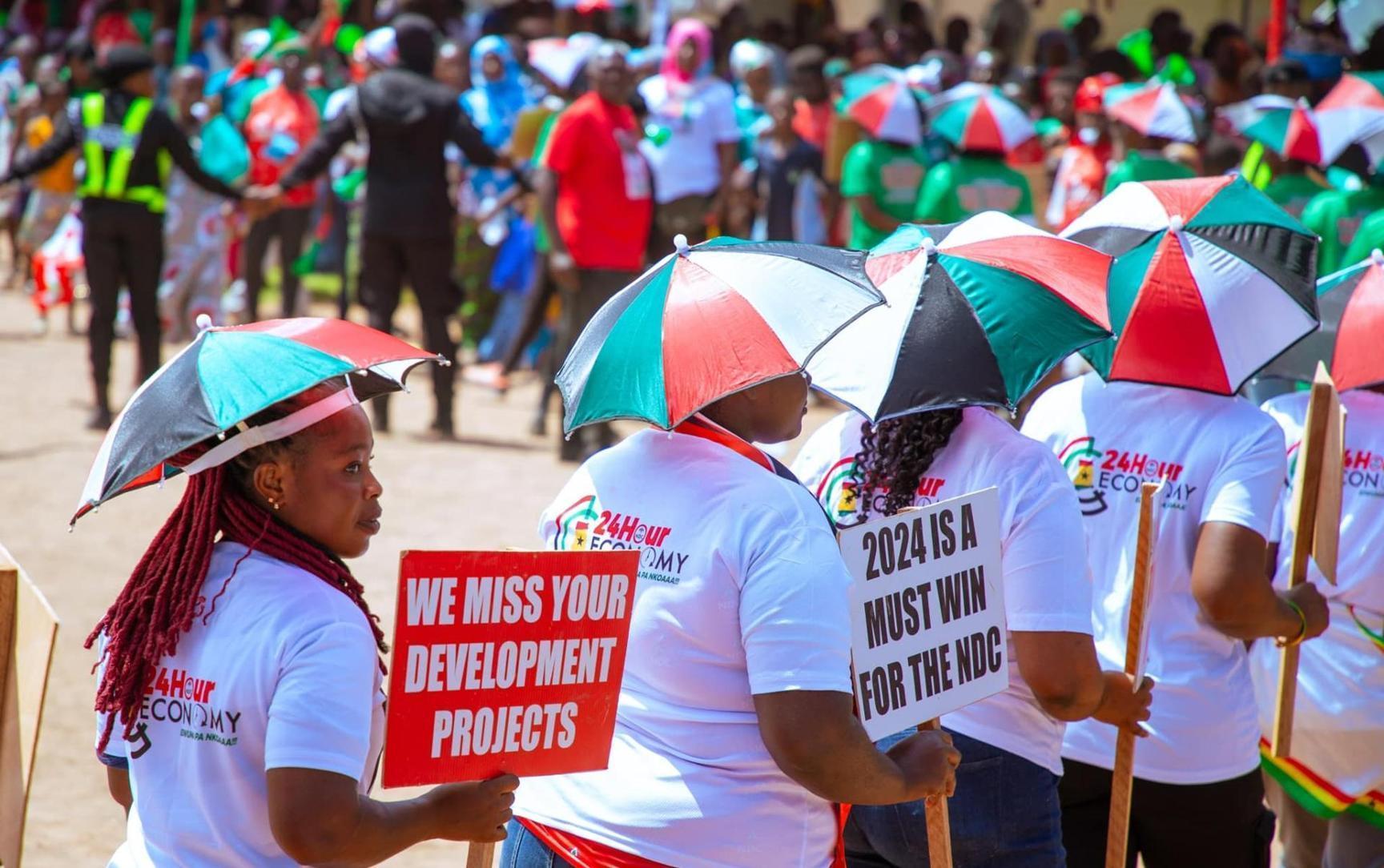
Africa-Press – Ghana. The return of the National Democratic Congress (NDC) to power under President John Dramani Mahama raises important questions regarding governance strategy and party sustainability in Ghana’s Fourth Republic.
Specifically, the case presents a tension between personalized presidential governance and party-centred policy institutionalization.
While presidential leadership remains central to executive authority, Ghana’s electoral and constitutional architecture are fundamentally party-centred. Presidential tenure is strictly time-bound, whereas political parties are structured for continuity.
Given that President Mahama is serving a single non-renewable four-year term, the strategic implications of governance personalization become particularly salient.
This article argues that the NDC’s optimal governance and electoral strategy lie in prioritising party-aligned, institutionalised policies over presidentially personalised initiatives.
Drawing on theories of party institutionalisation and comparative evidence from African democracies, this article posits that party-centred policy alignment offers superior long-term benefits, including electoral resilience, organisational stability, and democratic consolidation.
The analysis suggests that governance strategies anchored in party ideology and institutional identity are more likely to service leadership transitions and sustain political legitimacy beyond Mahama’s presidential tenure and for strengthening democratic consolidation in Ghana.
In constitutional democracies, political leadership is inherently time-bound, whereas political parties are designed for institutional continuity. Ghana’s Fourth Republic reflects this principle through firm presidential term limits and competitive multiparty elections in which parties, rather than individuals, serve as the primary vehicles for political contestation.
The National Democratic Congress (NDC), currently in government under President John Dramani Mahama, operates within this institutional framework.
As President Mahama serves a single, non-renewable term, the party faces a strategic governance choice: Whether to personalise policy leadership around the presidency or to institutionalise governance outcomes within party ideology and organisational identity.
Drawing on comparative African political experience, this article argues that the latter approach is more conducive to long-term political sustainability and democratic consolidation.
Personalisation of Power and Its Strategic LimitationsThe personalisation of public policy, where flagship programmes are closely associated with the identity of a sitting president, is a recurrent feature across African presidential systems.
While such strategies may enhance short-term legitimacy, they often undermine long-term party sustainability and institutional continuity.
Evidence from Southern Africa illustrates this dynamic. In Zambia, the governance under President Frederick Chiluba became increasingly personalised, contributing to the erosion of internal cohesion within the Movemement for Multi-Party Democracy (MMD). Following Chiluba’s exit, the MMD struggled to maintain electoral relevance and eventually collapsed as a competitive force.
Policy success did not translate into party continuity.
Similarly, Malawi’s Democratic Progressive Party (DPP) under President Bingu wa Mutharika relied heavily on presidential authority and individualised development narratives. After Mutharika’s death, the party faced internal fragmentation and declining electoral performance, highlighting the risks of leadership-centred governance.
These cases demonstrate that personalisation creates succession vulnerabilities, weakens party ownership of governance outcomes, and limits policy transferability to successor leadership.
Party Institutionalisation and Electoral Competition: Comparative InsightsBy contrast, African political parties that have prioritised institutionalisation over personalisation have demonstrated greater electoral resilience across leadership transitions.
Comparative evidence from South Africa and Tanzania illustrates the advantages of party-centred governance frameworks.
In South Africa, The African National Congress (ANC), has maintained electoral dominance across leadership transitions including transitions from Mandela to Mbeki, Zuma, and Ramaphosa.
Despite ongoing governance challenges, major policy frameworks such as the Reconstruction and Development Programme and later the National Development Plan have been consistently framed as party-owned initiatives rather than presidentially branded initiatives.
This institutional framing has enabled leadership turnover without precipitating immediate electoral collapse.
Similarly, Tanzania’s Chama Cha Mapinduzi (CCM) has sustained political dominance by anchoring governance outcomes within party ideology and organisational discipline. While individual presidents retain significant influence, the party remains the central locus of political authority.
These cases contrast sharply with parties overly dependent on charismatic presidents, underscoring the strategic value of institutionalised party governance for long-term political sustainability.
Electoral Implications for the NDCGhana’s electoral system reinforces party primacy. While voters assess presidential performance, electoral accountability is ultimately exercised through party competition.
With President Mahama constitutionally barred from contesting subsequent elections, the NDC’s future electoral prospects depend on whether governance achievements are perceived by voters as party-owned rather than leader-specific.
Mahama-centred policy branding like “Mahama Cares” risks anchoring voter evaluation in retrospective leadership rather than future party competence.
Comparative evidence from Kenya further illustrates this danger. The Jubilee Party’s heavy reliance on the personal alliance between Uhuru Kenyatta and William Ruto led to rapid organisational fragmentation following the dissolution of the alliance, weakening the party’s institutional coherence.
A party-centred policy strategy, in contrast, enhances the NDC’s capacity to present itself as a programmatic organisation capable of sustaining governance beyond a single presidential tenure.
Strategic Advantages of Party-Centred Policy AlignmentDrawing from both theory and comparative experience, party-centred policy alignment offers four principal advantages:
Leadership Transition Stability: Institutionalised policies survive leadership change without symbolic or electoral rupture.
Electoral Transferability: Governance successes become assets for future candidates, not liabilities tied to a predecessor.
Organisational Mobilisation: Party members and activists mobilise more effectively when policies are framed as collective achievements.
Democratic Consolidation: Reduced reliance on charismatic authority strengthens programmatic competition and accountability.
These advantages are consistently observed across African parties that have endured leadership transitions successfully.
Reinterpreting Presidential LegacyA shift toward party-centred governance does not marginalise presidential leadership; rather, it redefines presidential legacy. Comparative cases such as Mandela in South Africa and Nyerere in Tanzania demonstrate that leaders who prioritise institution-building exert enduring influence long after leaving office.
In this context, President Mahama’s most enduring contribution may lie in the consolidation of the NDC as a programmatic, institutionalised governing party capable of surviving leadership transition without electoral decline.
ConclusionAs the NDC navigates the remaining years of President Mahama’s tenure, the importance of strategic discipline becomes increasingly pronounced. Comparative African experience demonstrates that political parties which personalise governance struggle with succession, while those that institutionalise policy enjoy electoral resilience.
This article has argued that aligning governance outcomes with party identity rather than presidential personality is both electorally advantageous and democratically responsible.
For the NDC, party-centred policy alignment is not merely a strategic preference but a structural necessity for long-term political survival and democratic maturity.
The writer is a Political Marketing Researcher and Strategist, Accra Technical University.