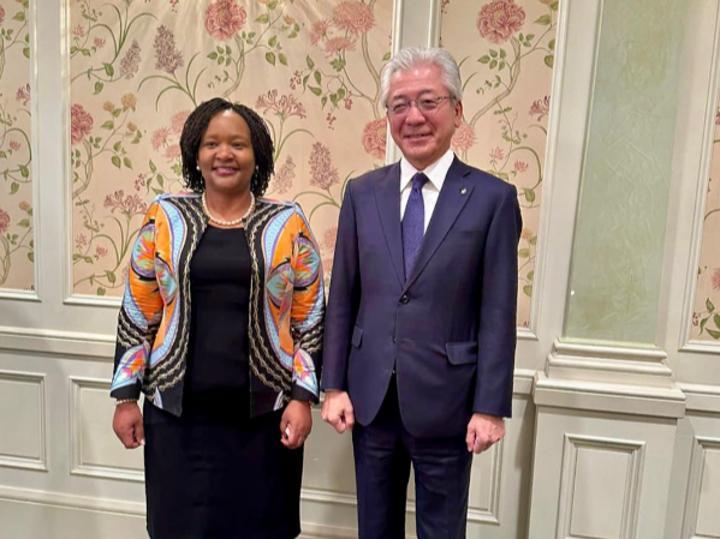
Africa-Press – Kenya. Trade and Investment Cabinet Secretary Rebecca Miano has urged investors from the Japan-based Toyota Tsusho corporation to scale up manufaturing of spare parts in Kenya.
This as the CS signed far-reaching agreements with Japenese vehicle manufacture that will see the firms expand local markets.
The CS challenged the firm to leverate on Kenya’s strategic partnerships to ramp up local manufacturing of components forr the company’assembling facility in Kenya.
“It is an optune time that the Japanese conglomerate worked with Kenyan counterparts to develop the requisite capacity for the Kenyan-based facility’s enhanced operations, targeting the greater African Market under the Africa Continental Free Trade Agreement (AfCFTA), among other markets.,” the CS said.
The CS made the remarks during a meeting with top management of the Toyota Tsusho Corporation, which was held on the sidelines of the G7 Session of Trade Ministers meeting held, in Sakai, Osaka, Japan.
During the meeting, a National Automotive policy was agreed on between the Government of Kenya and the automotive industry stakeholders to provide for making Kenya the destination of choice for the Industry.
However, in the light of emerging industry trends, as highlighted by the Toyota Tshusho management, it was agreed that the ongoing development of the automotive bill and regulations therein also be done in close consultation with the Industry stakeholders.
The meeting noted with encouragement that Kenya has made milestones as an automotive assembly hub for the African region, supported by well skilled man power and the availability of assembling facilities.
It was resolved that the Corporation continue to work with Ministry of Investments, Trade and Industry to further its business interests in the African region and for the mutual benefit of the people of Kenya and Japan.
The meeting resolved that the finalisation of the automotive bill and automotive regulations will be expedited in collaboration with the Industry stakeholders.
The bill and regulations will provide for End of Life Vehicle (ELV)recycling for both used cars and batteries, thus helping to raid the country of an otherwise growing menace of wastes.
Currently it is estimated that over 70,000 vehicles are laying in junk yards after coming to the end of their useful life.
The meeting resolved End of Life Vehicle (ELV)recycling should go hand in hand with reduction in the age of second hand vehicles to be allowed into Kenya, which in turn is anticipated to drive up demand for new vehicles and hence support local assembling with attendant increase in job creation.
“The growth of the industry has not been in tandem with capacity development for the local manufacture of parts and components thus occasioning falling out of some of the players and thus slowing down the projected scaling up of the number of locally produced parts and components in the locally assemblied vehicles,” Miano said.
The meeting advocated for a deliberate capacity building of the local manufacturers of parts and components to ensure that they can keep pace with the industry’s demands, with regards to the level of technology and volumes.
This in turn calls for deliberate support by the original equipment manufacturers (OEM) to make this happen, the meeting observed.
Increasing Local content will enable the automotive industry feature favorably in market access of the region, on the criteria of rules of origin.
“To support the transition into new and environmentally friendly technology which requires new type and more efficient batteries, the Kenya Bureau of Standards (KEBS) will expedite the development of standards for the new type of batteries and electric motors,” Miano told the meeting.
On electric vehicles development, it was agreed that the industry considers developing an appropriate supportive infrastructure such as local manufacture of energy efficient batteries and charging systems to aid swooping and making the vehicles convenient for use and hence making them popular.
It was agreed that there was need to provide for incentives by way of reduced duty on electric and hybrid vehicles in order to make them affordable to many.
Noting that the Kenya vehicle manufacturers (KVM)-one of the local automotive assembling facilities in Kenya- is experiencing financial difficulties, it was agreed that Toyota Tshusho, as one of the stakeholders in the industry, steps in to save the facility from eminent collapse.
The Toyota academy will consider the possibilities of broadening the scope of training and capacity development to enable many Kenyan youth engage in meaningful and viable businesses in tandem with emerging industry trends, it was resolved.
The meetingnoted the great concern the messy situation and deplorable behaviour of the boda boda operators in Kenya, which has left many dead, injured or maimed.
It was recommended that under the company’s Corporate Social Responsibility (CSR) that the conglomerate considers intervening to impart organisation into the bodaboda sector to make it safe for the Kenyan consumers.
For More News And Analysis About Kenya Follow Africa-Press