
Africa-Press – Kenya. President William Ruto has affirmed his commitment to ending plastic pollution.
Ruto said dealing with plastic pollution is central to making progress on climate change.
Plastics account for up to 19 per cent of greenhouse gas emissions allowed under 1.5 °C by 2040.
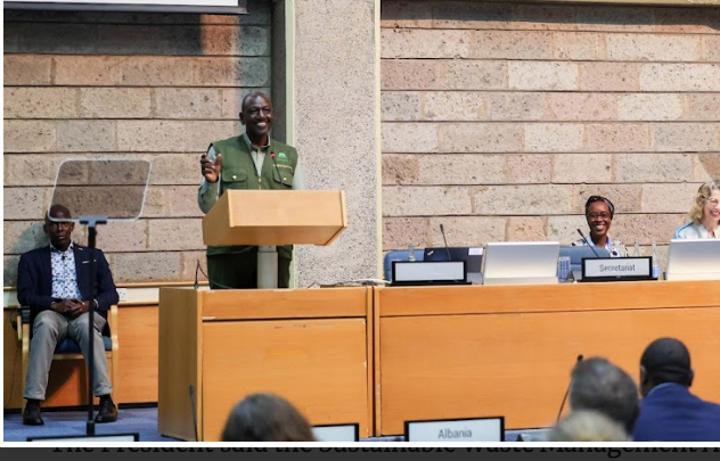
The president, who spoke during the opening of the third session of the Inter-Governmental Negotiating Committee said Kenya has already done a lot.
“I would like to affirm Kenya’s commitment to ending plastic pollution. We demonstrated this commitment with the ban on the manufacture and use of polythene bags in 2017, followed closely in 2020 with a ban on single-use plastics in protected areas such as national parks, forests, and beaches,” he said.
Ruto said the Sustainable Waste Management Act enacted in July last year, made Kenya the first in the world to subject all products, including plastics, to Extended Producer Responsibility.
“We know this is not enough, and we are ready to play our part in the elimination of plastic pollution. Nobel Laureate Wangari Maathai, a daughter of our own soil, taught us the principle of the hummingbird, which is essentially beginning to do the work, bit by bit until it is done,” he said.
In March 2022, the fifth session of the UN Environment Assembly (UNEA-5.2) adopted a plan to develop an internationally legally binding instrument on plastic pollution.
The instrument will also consider the marine environment.
An intergovernmental committee is in the process of developing an instrument based on a comprehensive approach that addresses the full life cycle of plastic, including its production, design, and disposal.
The committee has held two sessions to develop the plastic treaty, with the third session scheduled for November 13 to 19 this year at the UNEP Headquarters in Nairobi.
An international legally binding agreement should be ready by 2024.
“It is now time for investors, multinational corporations, and technology companies to shift strategic investments to reduce their plastic waste footprint,” Ruto said.
He urged producers and innovators to rethink plastic products and packaging to reflect the principles of reuse, refill, repair, and repurpose.
The president said they should also explore alternative options such as non-plastic substitutes, alternative plastics, and plastic products that do not have negative environmental, health, or social impacts.
“I invite innovators to come and invest in Africa because the continent has natural resources that can be used for planet-friendly alternatives,” Ruto said.
This is an opportunity for African plastic alternative industries to become market leaders and drive economic growth and transformation.”
He said that in order to deal with plastic pollution, humanity must change.
“Change is inevitable. This treaty, this instrument that we are working on, is the first domino in this change. Let us bring it home. Let the change begin,” Ruto said.
The president said it is not common for the globe to speak in unison or act in urgency on an environmental issue.
However, the threat of plastics to the planet, health, and future is of such magnitude that it requires everyone to develop and execute a global instrument that will help to neutralise the threat of plastic pollution.
Some countries are already seeking to derail the process.
Iran has announced plans to form a Global Coalition for Plastic Sustainability with other countries.
This Coalition’s proposed solution to the global plastic crisis is to only address unsustainable patterns of consumption.
The patterns include, addressing leakage of plastic waste into the environment, calling for improvements in waste management, and reducing uncontrolled hazardous plastic pollution.
However, the Coalition has demands that if accepted, will severely undermine global efforts to end plastic pollution.
These demands include excluding plastic production from the regulatory scope of the treaty, ultimately shifting the burden of this global crisis entirely onto consumers, and doing nothing to address the skyrocketing rate of plastic.
Further, the Coalition seeks a strictly voluntary, nationally determined approach rather than binding global rules that level the playing field.
This casts doubt the sincerity of the Coalition’s efforts to end plastic pollution.
Iran has identified Saudi Arabia, the Russian Federation, and Bahrain—all with large petrochemical interests—as key members of its coalition.
Iran has said it will disclose more members soon.
The US is trying to agree with the rest of the world, while China remains a bit cautious.
For More News And Analysis About Kenya Follow Africa-Press