
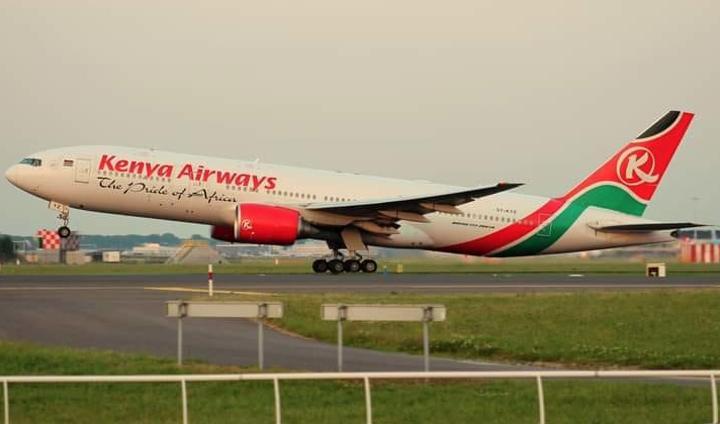
Africa-Press – Kenya. Kenya Airways is losing at least Sh2.6 million per flight every time it has to use an alternative route to Europe, Asia, or America following a massive air closure in the Middle East due to the ongoing war between Israel/US and Iran.
The national carrier’s acting CEO, Captain George Kamal, revealed this at a media briefing in Nairobi, indicating that most flights are forced to use alternative routes to various destinations across the world, with an extra hour in the air, costing the airline at least $10,000 (Sh1.3 million) per single trip and $20,000 (Sh2.6 million) for a return trip.
Large parts of the Middle East airspace have remained closed, including Iran, Iraq, Kuwait, and Syria, for over 20 days now, since Israel and the US fired the first missile to Iran, sparking retaliatory attacks by the Islamic nation, targeting neighbouring nations allied to Washington DC.
Israel, Bahrain, UAE, and Qatar airspace remains heavily restricted, with short-notice full closures possible, as missile and drone strikes continue across the region, creating a high-risk environment for aviation.
For flights between Europe and Asia, the normal Gulf corridor is effectively unavailable. Overflying traffic is rerouting either north via the Caucasus-Afghanistan, or south via Egypt, Saudi Arabia, and Oman.
Although the airline is yet to ascertain actual losses emanating from the ongoing crisis, Kamal indicated that it is both a curse and a blessing in disguise.
Apart from making losses from longer routes, the airline is incurring heavy fuel prices, even as various analysts warn of a possible jet fuel shortage in Kenya, Madagascar, and South Africa, considering that 70 per cent of the imported Jet A-1 fuel passes through the Strait of Hormuz.
Last week, CITAC- a consultancy that provides expert analysis, data, and strategic advice on the African energy sector warned that Kenya is among nations at high risk of jet fuel shortages due to heavy reliance on imported refined products.
“Africa remains highly exposed to supply shocks and price fluctuations, with about 70 per cent of Africa’s jet fuel and kerosene imports moving through the Strait of Hormuz,” the firm said.
It added that African carriers are particularly exposed, as jet fuel represents between 30 per cent and more than 40 per cent of their operating expenses, far above the global average of 20 to 25 per cent.
Kenya Airways boss, while acknowledging that the cost of Jet A-1 fuel has more than doubled since the war broke out, said that the airline has enough stock to take it up to 50 days, with extra fuel expected from India this week.
Fuel indeed takes up to 40 per cent of our total operational costs. While global prices have soared past $83.7 per barrel, at KQ, we have enough stock to take us up to 56 days,” Kamal said.