What You Need to Know
Prime Cabinet Secretary Musalia Mudavadi has urged African nations to prepare for a changing global order that is reshaping the continent’s security landscape. Speaking at the Mashariki Cooperation Conference, he emphasized the need for intelligence-driven decision-making and stronger cross-border cooperation to address emerging threats and challenges facing Africa.
Africa-Press – Kenya. Prime Cabinet Secretary Musalia Mudavadi has called on African nations to urgently prepare for a shifting global order, warning that emerging geopolitical dynamics are reshaping the continent’s security landscape.
Speaking at the 3rd Mashariki Cooperation Conference held in Diani, Mudavadi said Africa must confront “hard truths” about the changing international system and its implications on security architecture.
He noted that multilateralism is increasingly under strain as unilateralism resurges globally, undermining established diplomatic norms.
“The fundamental principles of diplomacy are being eroded, with militarism re-emerging as a common instrument of foreign policy,” Mudavadi said.
The Prime Cabinet Secretary warned that clarity of national interests is often blurred in the current environment, underscoring the need for intelligence-driven geoeconomic and geopolitical decision-making.
“We must begin to strategically prepare for the world beyond the current global order,” he stated.
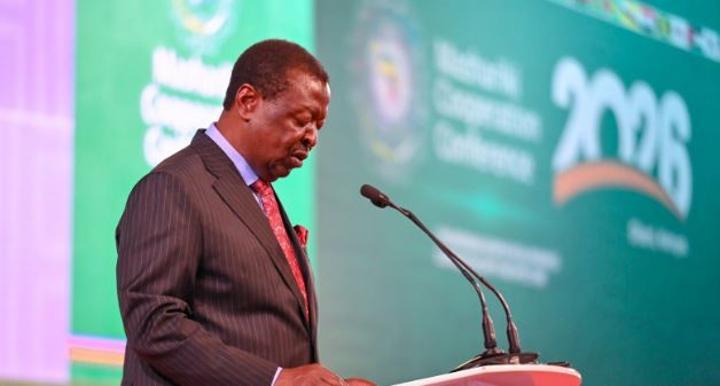
Prime Cabinet Secretary Musalia Mudavadi and other delegates during the 3rd Mashariki Cooperation Conference in Kwale county on April 9, 2026./HANDOUTThe conference, themed “Emerging Geopolitical Dynamics and Africa’s Security Architecture,” has attracted participants from 76 countries across Africa and beyond. Mudavadi emphasised that no single country can effectively address the complex challenges facing the continent alone, calling for stronger cross-border cooperation and institutional partnerships.
“As leaders and practitioners, we are called upon to strengthen coordination across borders, institutions, and partnerships,” he said, adding that teamwork remains critical in building stable and resilient societies.
He urged African states to move beyond dialogue and prioritise actionable intelligence-sharing and policy coordination through forums like the Mashariki Cooperation Conference.
The Cabinet Secretary outlined a range of emerging threats, including high-intensity conflicts, misuse of artificial intelligence, unconstitutional changes of government, environmental degradation, terrorism, demographic pressures, migration, and geopolitical competition over Africa’s natural resources.
Mudavadi also highlighted what he described as the “privatisation of peace”, warning that transactional approaches to diplomacy and security are gaining ground amid the weakening of multilateral systems.
“In some quarters, foreign policy increasingly treats diplomacy as a transaction and sovereignty as a negotiable property,” he said.
He pointed to the growing role of private military and security companies and mercenaries across the continent, raising concerns about the outsourcing of security interventions.
“There is a growing trend towards outsourcing of security interventions as demonstrated by the proliferation of Private Military and Security Companies,” he noted.
Mudavadi stressed that Africa’s security must remain collective, proactive, and preventive, anchored in justice and human dignity.
The high-level forum brought together key leaders and policymakers, including Interior Cabinet Secretary Kipchumba Murkomen, former Nigerian President Olusegun Obasanjo, Attorney General Dorcas Oduor, and National Assembly Defence Committee Chairperson Nelson Koech.
Others in attendance included Senate Security Committee Chair Fatuma Dullo, Supreme Court Judge William Ouko, and National Intelligence Service Director General Noordin Haji, alongside ambassadors and senior government officials.
The geopolitical landscape has been shifting significantly in recent years, with emerging powers challenging traditional global dynamics. This has led to a reevaluation of security strategies among nations, particularly in Africa, where the implications of these changes are profound. The rise of unilateralism and the erosion of multilateral diplomatic norms have prompted leaders like Mudavadi to call for a proactive approach to security and cooperation across the continent. As Africa faces complex challenges, the need for collective action and strategic partnerships becomes increasingly critical.