What You Need to Know
Interior Cabinet Secretary Kipchumba Murkomen highlighted the interconnectedness of Africa’s security challenges at the 3rd Mashariki Cooperation Conference. He urged for coordinated responses among African nations to enhance their role in global geopolitics, moving from being a passive player to an active one. The conference gathered 76 countries to discuss strategic security architecture.
Africa-Press – Kenya. Interior Cabinet Secretary Kipchumba Murkomen said Thursday Africa’s security challenges are deeply interconnected and require coordinated responses to effectively address them.
He said it was on this understanding that Kenya mooted the Mashariki Cooperation Conference—an annual forum that convenes security and intelligence chiefs from East Africa and beyond to discuss and forge collaboration on strategic regional and global security architecture.
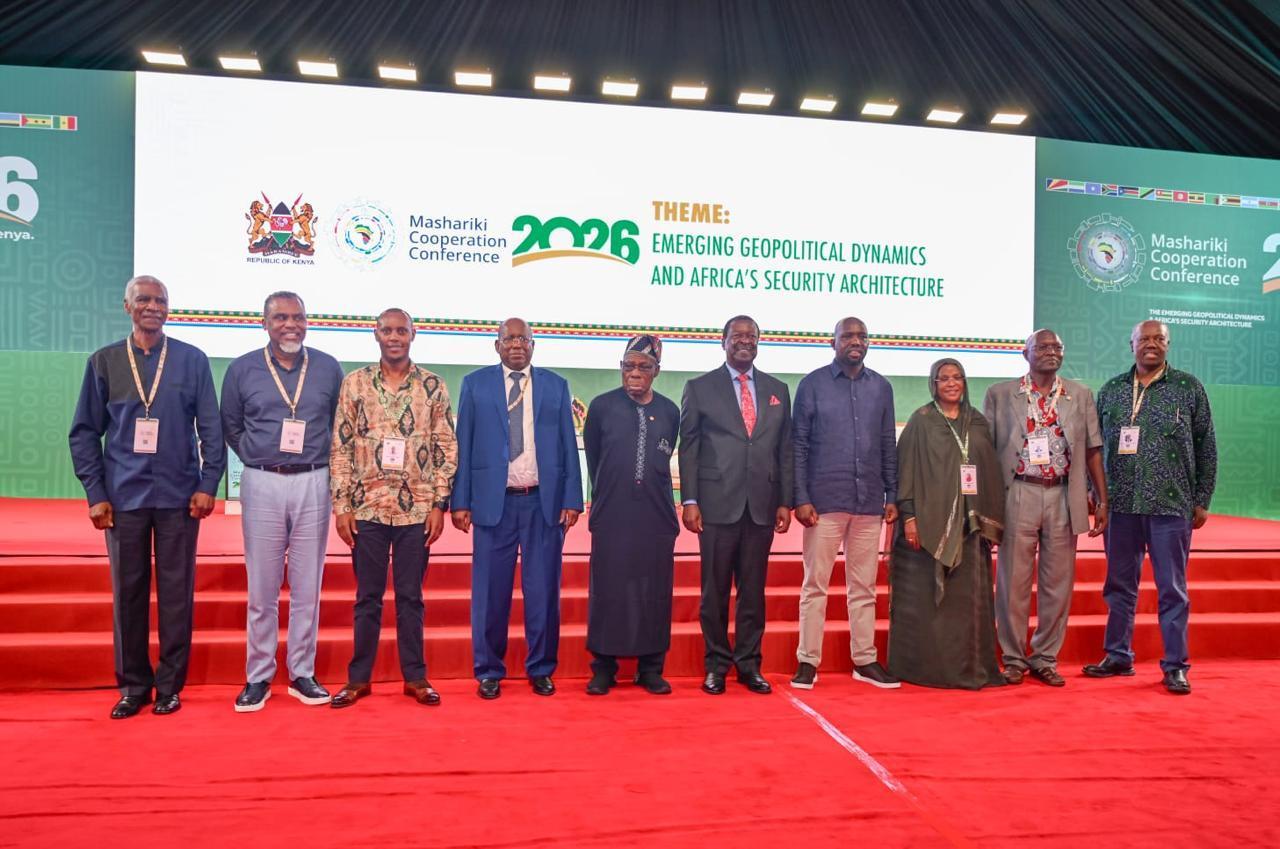
He spoke at the 3rd Mashariki Cooperation Conference in Diani, Kwale County. Prime Cabinet Secretary Musalia Mudavadi was the chief guest.
Former Nigerian President Olusegun Obasanjo speaks during the 3rd Mashariki Cooperation in Diani, Kwale County, on April 9, 2026./HANDOUT
Murkomen called on the participants to fashion solutions that will position Africa as a player in the world’s geopolitics, as opposed to the current scenario where it is largely used as a playground.
This year’s conference, whose theme is “Emerging Geopolitical Dynamics and Africa’s Security Architecture”, has drawn participation from 76 countries from Africa and other continents.
Officials said the meeting underscored the growing urgency for coordinated responses to Africa’s complex security challenges.
Senate Security Committee Chair Fatuma Dullo, National Assembly Defence Committee Chairperson Nelson Koech and other delegates follow proceedings during the 3rd Mashariki Cooperation in Diani, Kwale County, on April 9, 2026./HANDOUT
The annual forum, an initiative of the Government of Kenya, brings together security leaders from East Africa and beyond to deliberate on regional and global security architecture.
Mudavadi too emphasised the need for Africa to reposition itself within global geopolitics by developing homegrown solutions to security threats.
He challenged delegates to move the continent from being a passive arena for external interests to an active and influential player on the world stage.
National Intelligence Service Director General Noordin Haji speaking during the 3rd Mashariki Cooperation in Diani, Kwale County, on April 9, 2026./HANDOUT
The conference has drawn an array of prominent leaders and policymakers, including former Nigerian President Olusegun Obasanjo, Attorney General Dorcas Oduor, and National Assembly Defence Committee Chairperson Nelson Koech.
Also in attendance are Senate Security Committee Chair Fatuma Dullo, Supreme Court Judge William Ouko, and National Intelligence Service Director General Noordin Haji, alongside ambassadors, principal secretaries, and heads of regional and international agencies.
Haji, who was the host of the event, said unity is key in the fight against many challenges in the region.
The Mashariki Cooperation Conference has steadily grown into a key platform for fostering intelligence sharing and strengthening partnerships aimed at addressing cross-border threats such as terrorism, cybercrime, and transnational organised crime.
Officials say the outcomes of this year’s discussions are expected to shape future collaboration frameworks and enhance Africa’s role in global security governance.
The Mashariki Cooperation Conference, initiated by Kenya, aims to address the complex security challenges facing Africa by fostering collaboration among nations. This annual forum has become essential for security leaders to share intelligence and develop strategies against threats like terrorism and cybercrime. The growing participation from various countries underscores the urgency for Africa to unify its approach to security and assert its influence in global affairs. Historically, Africa has often been viewed as a passive participant in global geopolitics, but initiatives like this conference aim to change that narrative.