Africa-Press – Kenya. The Kenyan Interior Minister announced that four people were killed in protests that erupted in several Kenyan cities against rising fuel prices, following a general strike in public transport that halted public transportation.
The transport sector alliance stated that vehicles belonging to its member associations would stop operating starting at midnight in protest against the price increases, while police confirmed they would intervene to address any disturbances.
The Interior Minister, Kithure Kindiki, said in a televised press conference: “We have lost four Kenyans in the violence that occurred in the country today, which also resulted in injuries to more than 30 people.”
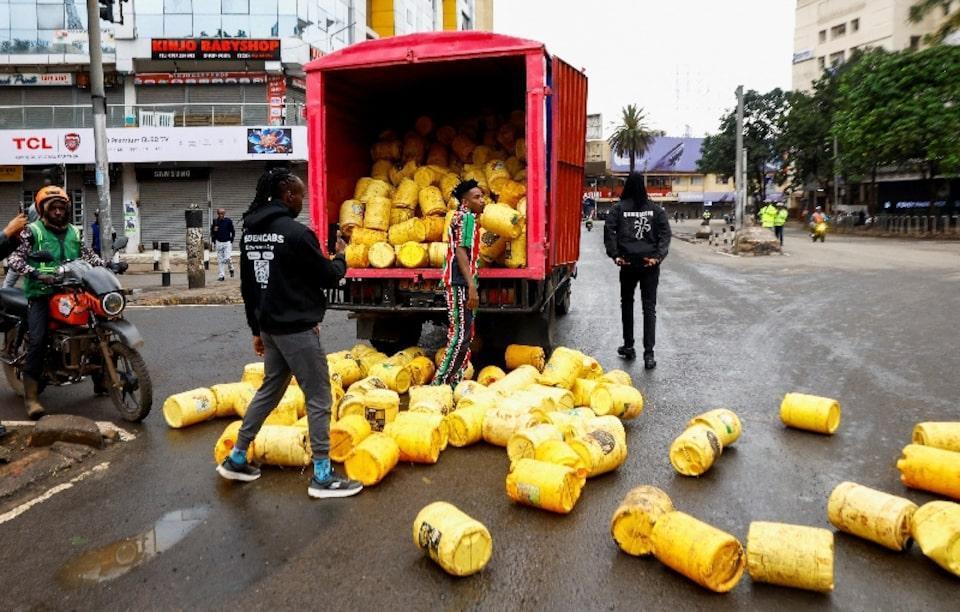
So far, the Kenyan government has not provided further details about the location or circumstances of these events, but it has pointed to those fueling the violence in the country. The Interior Ministry listed a series of incidents that occurred in the country on Monday, including the looting of several major stores, the burning of an office belonging to the Democratic Labor Union in Machakos County, south of the capital Nairobi, and the destruction of two trucks on the Rironi-Mau Summit road.
While the statement did not clarify the reasons for these attacks or the circumstances surrounding the escalation of violence that led to the deaths of four people, the Interior Ministry believes that “a segment of the political class is making inflammatory statements to encourage intolerance and ethnic sectarianism, and that gangs are organizing themselves to spread terror.”
The Kenyan Energy and Petroleum Regulatory Authority raised retail fuel prices by up to 23.5% last week, after increasing them by 24.2% the previous month, amid the impact of the conflict in the Middle East on global oil and gas supplies. Earlier on Monday, Finance Minister Njuguna Ndung’u stated that current prices are already supported.
A meeting between the Ministers of Transport and Energy with public transport operators, held late Monday to discuss a solution to the problem, did not yield any significant progress, as the association agreed to a government proposal to narrow the gap between diesel and kerosene prices to prevent fraud. However, they disagreed on how much prices could be reduced, as associations demanded a reduction of 46 shillings per liter.
Albert Karakacha, head of the Public Transport Owners Association, said at a press conference: “We did not agree on anything… what we urge the president to do is to take action because the strike will continue. The strike is still ongoing.”
On Monday morning, striking transport drivers and scattered groups of protesters blocked roads leading to the capital Nairobi. Police fired tear gas in some areas, while some protesters set tires on fire to block access to main roads, increasing traffic congestion and stranding many passengers.
In Mombasa, Kenya’s main port city, the strike raised concerns about supply chain disruptions. Kenya imports nearly all of its fuel products from the Middle East through government agreements with Gulf suppliers. The rise in fuel prices has led to a sharp increase in transportation costs and higher prices for essential goods, putting additional pressure on families already struggling with the cost of living.
Gabriel Odhiambo, 24, a public relations worker, stated that transportation costs have doubled, and food prices have risen. The price of four tomatoes is now 60 shillings (50 cents), which is a threefold increase.
Kenya raised the price of premium gasoline in Nairobi to 214.25 Kenyan shillings ($1.66) per liter from 206.97, and diesel to 242.92 shillings from 196.63 for the period of May 15 – June 14, while the price of kerosene remained unchanged at 152.78 shillings.
Like many other African countries, Kenya relies heavily on fuel imports from the Gulf, a supply line disrupted by the American-Israeli-Iranian conflict that began on February 28. Despite the announcement of a ceasefire, fuel prices remain high due to the continued closure of the Strait of Hormuz, through which one-fifth of the world’s oil passes.