
FREDRICK OKANGO
Africa-Press – Kenya. a position that was firmly confirmed by the Supreme Court, ending a contentious legal debate and offering rare clarity in a political system often marked by strategic ambiguity. Yet while the date is settled, a more consequential question remains unresolved: whether Kenya’s institutions are capable of delivering an election that meets the threshold of credibility.
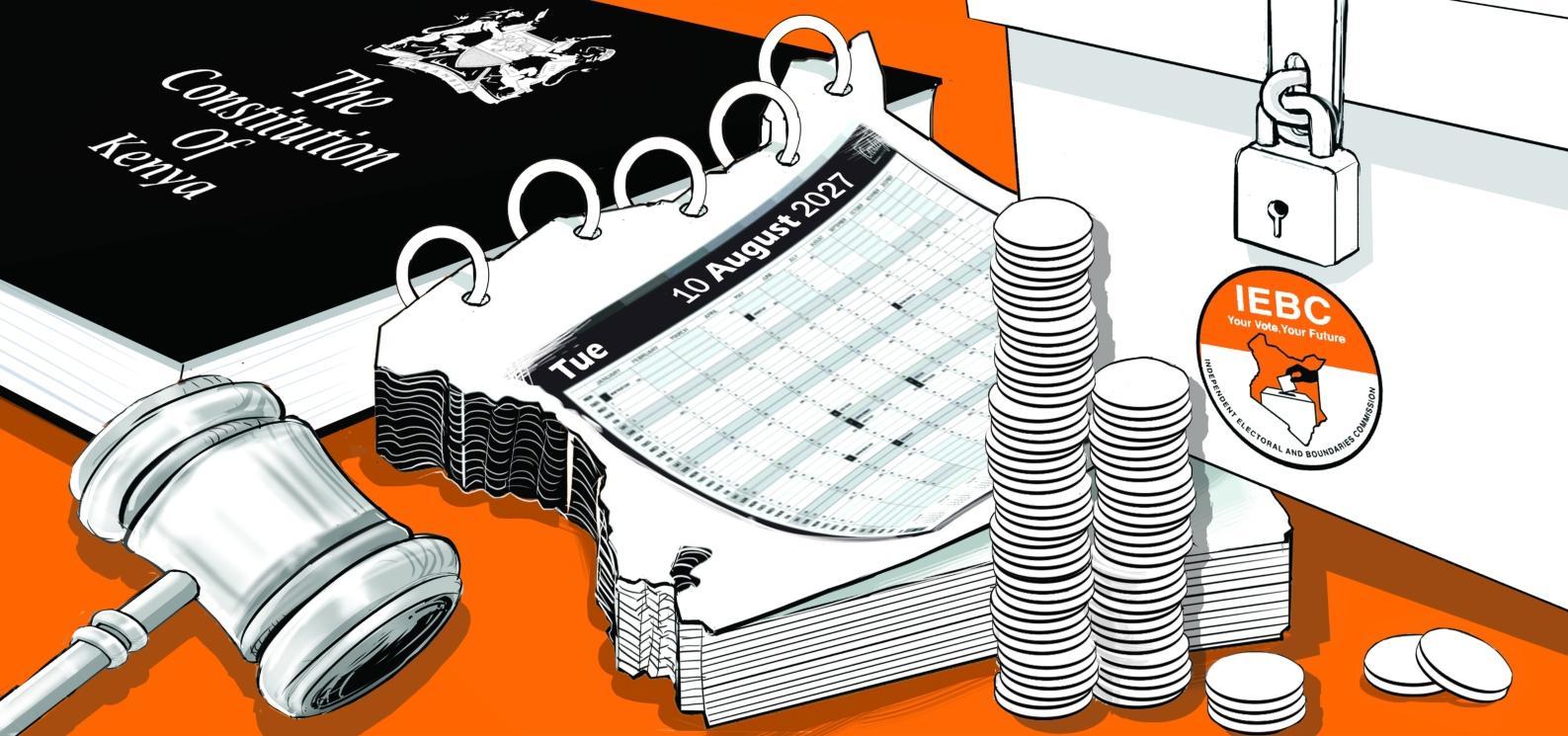
This certainty has merely shifted national anxiety from when Kenyans will vote to how that vote will be administered. At the centre of this concern is the Independent Electoral and Boundaries Commission (IEBC), constitutionally mandated to transform legal certainty into democratic legitimacy. On this front, warning signs are no longer subtle. They reveal an institution struggling to convert constitutional authority into public trust.
The IEBC is confronting four interlinked crises that threaten to undermine the integrity of the 2027 polls long before a single ballot is cast. Chief among them is the failure to conduct a boundaries review. The constitution requires constituency and ward boundaries to be reviewed every eight to 12 years to preserve the principle of one person, one vote, one value.
The last review was concluded in 2012, and the constitutional window lapsed in March 2024. The commission has since acknowledged that no substantive delimitation will occur before 2027, opting instead for a “phased approach” whose outcomes will only materialise after the election.
This is not a technical oversight but a structural failure. Prolonged vacancies within the commission have paralysed decision-making at critical moments, while the High Court’s nullification of the 2019 census data for parts of northern Kenya stripped the IEBC of the demographic foundation required for lawful boundary calculations.
The consequence is stark: Kenyans will vote in 2027 using population data more than a decade old, despite dramatic demographic shifts, especially in urban and peri-urban areas. Such distortions weaken electoral equity and create fertile ground for post-election disputes.
These structural weaknesses are compounded by financial asphyxiation. The IEBC faces an estimated Sh20 billion shortfall in order to deliver the 2027 election cycle. Elections are not single-day events; they are complex, multi-year undertakings that require early procurement, technology testing, voter education, staff training and robust dispute-prevention systems. Chronic underfunding forces last-minute improvisation, a pattern that has historically produced contested outcomes rather than public confidence.
Litigation further constrains the commission’s capacity. The IEBC remains entangled in multiple court cases that have stalled core functions and entrenched legal uncertainty. While judicial oversight is indispensable in a constitutional democracy, unresolved injunctions—particularly those touching on boundaries and census data—have had the practical effect of grounding a core constitutional mandate at the worst possible time.
Hovering above all these challenges is the most unforgiving constraint of all: time. Budgets can be revised and laws amended, but time lost cannot be recovered. With less than two years to the election, delay is no longer a bureaucratic inconvenience; it is an institutional risk.
Conscious that credibility cannot be self-declared, the IEBC has increasingly turned to stakeholder engagement as a survival strategy. Chairperson Erastus Ethekon’s recent appearance before Parliament outlined four prerequisites for a credible election: institutional readiness, inter-agency coordination, timely resourcing and sustained public confidence. Crucially, he framed Parliament not merely as an overseer but as a strategic partner in safeguarding electoral integrity.
That appeal now rests with the National Assembly’s Justice and Legal Affairs Committee, the Budget and Appropriations Committee and the Senate’s Standing Committee on Justice, Legal Affairs and Human Rights. These bodies hold the legislative, financial and oversight levers that will determine whether the IEBC remains constrained or becomes functional.
Kenya is certain about when it will vote, but dangerously unclear about how. While the constitution fixes the date and confers legitimacy in principle, an underfunded and legally constrained IEBC cannot deliver an election that earns national confidence. August 10, 2027, is fixed. Credibility is not.
Source: The Star