
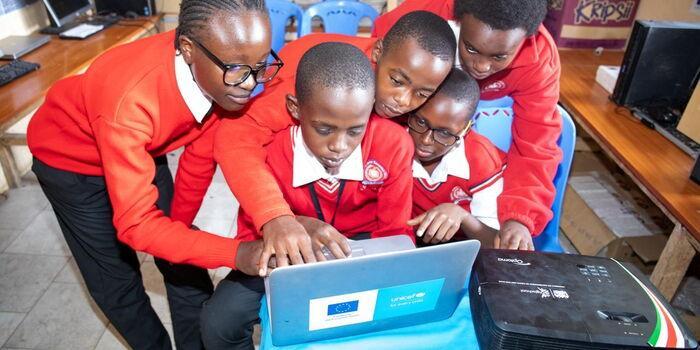
At least 363 public primary schools across Kenya have been connected to internet services under the European Union-funded ‘Last Mile Connectivity of Schools’ Project, significantly boosting digital learning in rural and underserved areas.
The initiative, launched in October 2023, targets 1,000 public primary schools across 14 counties, aiming to support digital learning aligned with Kenya’s Competency-Based Curriculum (CBC).
Remote schools in Kenya’s marginalised regions are beginning to see tangible gains. Enkasiti Primary School in Kajiado County, which previously lacked access to digital resources, now has stable and sustainable internet connectivity, significantly enhancing teaching and learning.
According to project data, more than 277,000 learners have so far accessed online learning platforms and digital educational content through the programme.
The project has also strengthened inclusive education, benefiting about 2,800 learners with disabilities through the provision of assistive and adaptive digital tools tailored to support diverse learning needs.
According to teachers, the connectivity has opened new teaching possibilities. Joseph Kamau, a teacher at Enkasiti Primary School, said internet access allows learners to participate in virtual experiments and simulations.
“With the help of the internet, we can stream classes and use lab exchange programmes where learners conduct experiments virtually, changing factors like temperature and pressure without needing physical apparatus,” Kamau explained.
Beyond learners, educators have also benefited. The programme has enabled over 4,400 teachers to integrate digital technology into their classrooms, while hundreds have received formal ICT training.
The project forms part of the European Union’s Digital Economy Package for Kenya, implemented under the Global Gateway Strategy, which seeks to strengthen digital infrastructure and skills.
EU Deputy Director-General Myriam Ferran said the initiative is already delivering tangible impact, noting that more than 400 teachers have received targeted ICT training in the first phase alone.
“Our aim is to reach 1,000 schools by the end of the year, tripling the impact we have seen so far,” Ferran said, adding that learners consistently report improved engagement and learning outcomes.
With steady progress underway, the project is expected to play a critical role in narrowing Kenya’s digital divide, ensuring learners in remote areas are not left behind in the country’s education transformation.