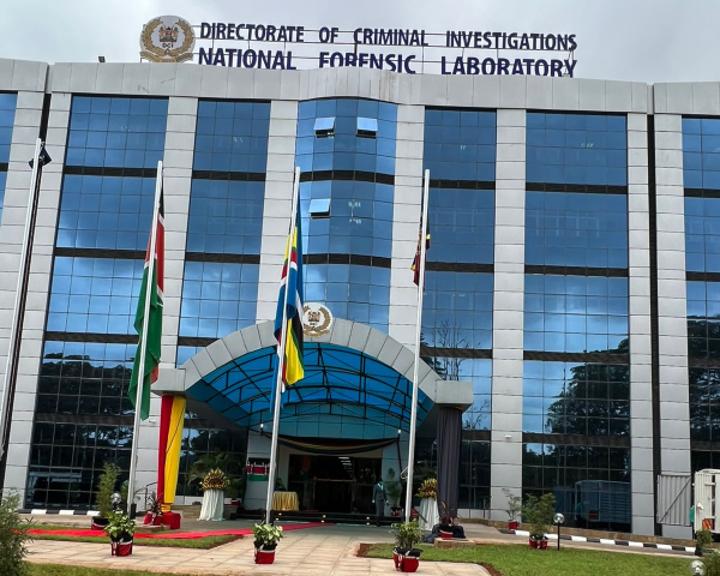
Africa-Press – Kenya. The commissioning of the National Forensic Laboratory marked a milestone in the war against crime. This has so far prompted Kenya to among others market the facility to regional countries for use.
The construction of the laboratory had stalled for years. Former President Uhuru Kenyatta commissioned the facility and ordered the revamping of the cybercrime war.
More than 1,000 detectives in various fields have since been trained and deployed there. Apart from South Africa, the laboratory is one of its kind and will come in handy for many countries.
The commissioning of the facility at the Directorate of Criminal Investigations was termed historic and a major milestone in the fight against crime in the country and regionally.
Former DCI boss George Kinoti said the experts will now be available for use in any part of the country and region. “Any country is now ready to seek help here. We have experts who can fly to any part of the world to investigate and pick evidence for analysis and use,” he said.
“The facility will be open for use by any country.” So far, more than 1,000 detectives have received various forensic investigations disciplines. The group focused on Crime Scene Investigations, which form the foundation upon which every successful investigation is built.
This has led to improved service delivery as the efficiency and effectiveness of our officers in forensic investigations, especially in crime scene reconstruction and evidence management has led to the successful resolution of many crime puzzles.
Officials said the completion and opening of the new laboratory will be a game-changer in the fight against crime, which had taken a new trend in terms of technology and sophistication.
“The laboratory will help us to back up what we have been doing with scientific proof. The success rate in the prosecution of cases will go up,” they said.
The government and other development partners have also equipped detectives with the contemporary tools and equipment required in modern-day investigations.
The service has been relying on foreign laboratories to conduct tests for evidence on issues under probe. For instance, toxicological tests are at times done either in South Africa or in Europe. In the laboratory, there are different sections.
They include fingerprints, ballistics, cybercrime, document examination, economic crimes, toxicology, computer forensics, mobile device forensics, malware analysis, computer incidents response team, network forensics, research and training and biological and chemistry sections.
There will be a Digital Forensic Laboratory, whose overall function will be to identify, seize, acquire and analyse all electronic devices related to all cyber-enabled offences reported.
This is to collect digital evidence that will be presented in a court of law for prosecution. The DFL is divided into subunits, each outlining specific roles and responsibilities of the Digital Forensics Analysts.
Apart from the laboratory, crime scene simulation rooms have been developed at the National Police Service Training College, main campus in Kiganjo, at the DCI Academy and another one at DCI headquarters, Kiambu Road.
The Germans are also buying thousands of laptops for the police to be used in reporting crimes. This follows a move by the police to digitise the Occurrence Book.
The OB is the one that contains all crimes reported daily in the country and will now be monitored and followed up by supervisors at various levels. Many crimes go unsolved because police lack a laboratory to help them address the cases.
Officials said the facility will boost detectives’ effectiveness in solving crime as investigations will be concluded faster since the country will no longer have to send samples to South Africa for forensic analysis.
Crimes such as terrorism, robbery with violence, murder, cyber fraud, espionage, kidnappings, rape and defilement will now be solved using modern scientific methods that limit human interaction with evidence and allow for proper documentation for successful convictions.
The facility hosting 10 laboratories is expected to aid detectives in combating organised transnational crime, trafficking of drugs, illicit arms and wildlife trophies using scientific data. Efforts to equip the facility are ongoing.
For More News And Analysis About Kenya Follow Africa-Press