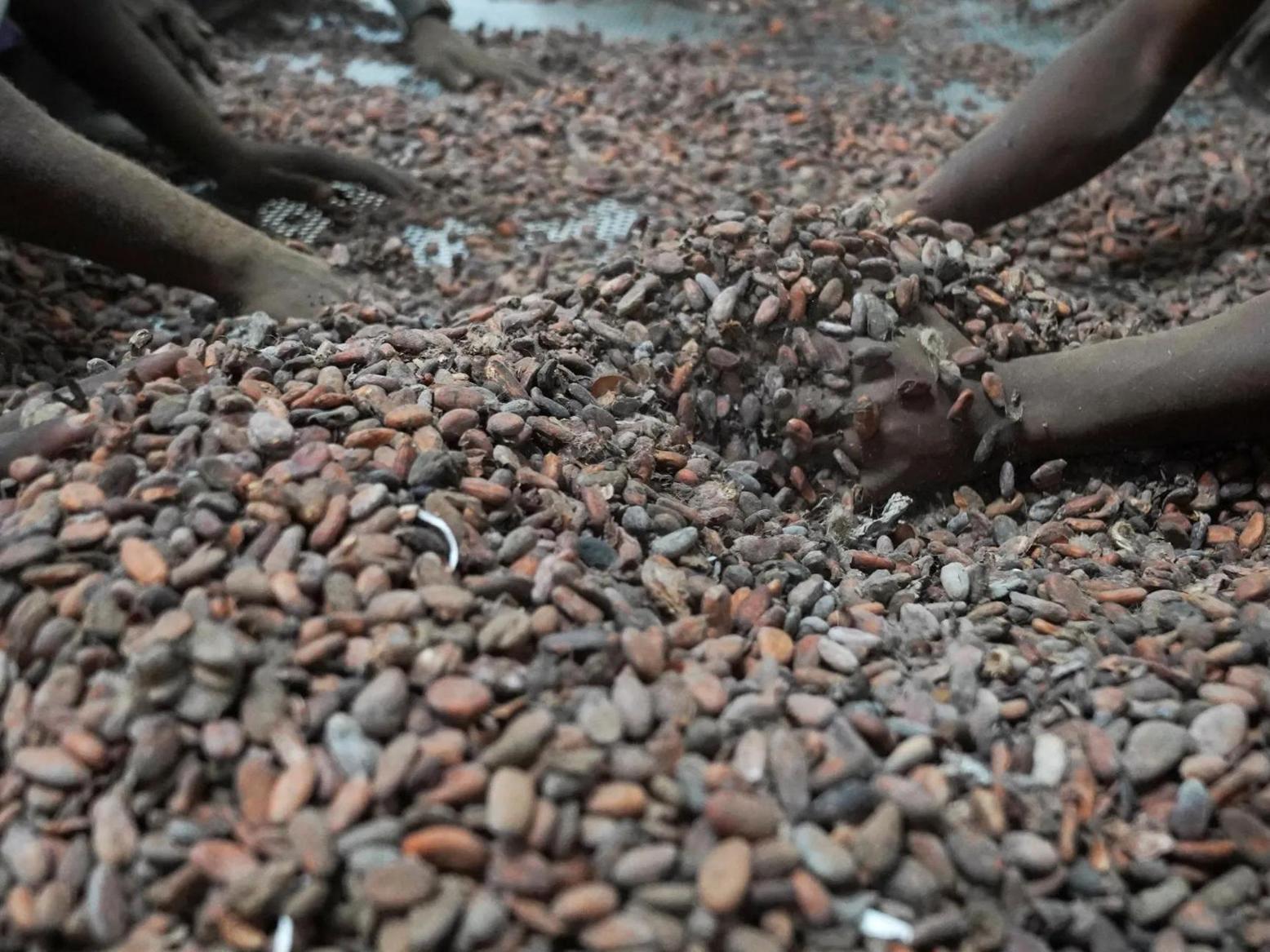
Africa-Press – Kenya. In his farm in Akure, southwestern Nigeria, smallholder farmer Ojo Ayaninola hesitated before allowing exporters to map his farm and determine its geographical coordinates in compliance with new European regulations. He only agreed after being warned by a local source, the buyer of his crop and one of the largest exporting companies in Nigeria, that he might lose access to European markets that purchase 60% of the world’s cocoa, according to a report.
Experts in the sector estimate that farmers producing more than half of Nigeria’s cocoa beans, the fourth largest producer globally, will be unable to meet European regulations when the anti-deforestation law comes into effect at the end of December. Nigeria alone has about 300,000 cocoa farmers, most of whom are small producers.
The same challenge exists across West Africa, particularly in Ivory Coast, the largest cocoa producer in the world, with potential repercussions for the region’s exports and the costs for chocolate manufacturers. The region produces about 70% of the world’s cocoa and ships about two-thirds of its production to the European Union, based on data from international financial institutions.
What Does the Law Require?
The European Union aims to reduce global deforestation by 10% through this law by banning the purchase of products linked to forest destruction. The law requires importers to prove that their products were not grown on recently deforested land by tracing raw materials back to the land where they were produced and ensuring that production complied with the laws of the country of origin. The implementation of the law has been postponed twice due to its complexity.
The European Commission has set the start date for obligations on December 30 for large and medium operators, and on June 30, 2027, for micro and small operators. The law covers goods including cocoa, coffee, palm oil, rubber, timber, soybeans, livestock, and their derivatives such as chocolate.
Compliance is described as costly and difficult in countries like Nigeria, Ivory Coast, and Ghana, where hundreds of thousands of small farmers work in rural areas. Exporters must map farms individually, verify land uses, and maintain digital traceability records across multilayered supply chains.
Half of Ivory Coast’s Cocoa Out of Traceability
The organization “Trace” reported in May that only about half of the Ivorian cocoa can be traced back to its source, as the rest of the supply chain passes through indirect routes or multiple intermediaries.
The organization noted that 48% of Ivory Coast’s cocoa exports could be traced in 2024, while 52% remained untraceable. “Trace” stated that “the prevalence of indirect cocoa supplies and the resulting lack of visibility regarding their origin makes it very difficult for companies to address issues such as deforestation or child labor.”
The report added that 79% of Ivory Coast’s forests were lost or degraded between 2000 and 2024, with the expansion of cocoa cultivation responsible for about half of this deforestation during much of that period.
Nico Dibnah, a sustainability consultant and former global cocoa trader, told a local source: “There is a clear possibility that EU importers will not be able to obtain enough compliant cocoa from source countries like Nigeria, Ivory Coast, or anywhere else in the early days of the law’s implementation.”
Dibnah estimated that pressure on supplies could continue for about two years, during which compliant exporters could impose higher prices.