
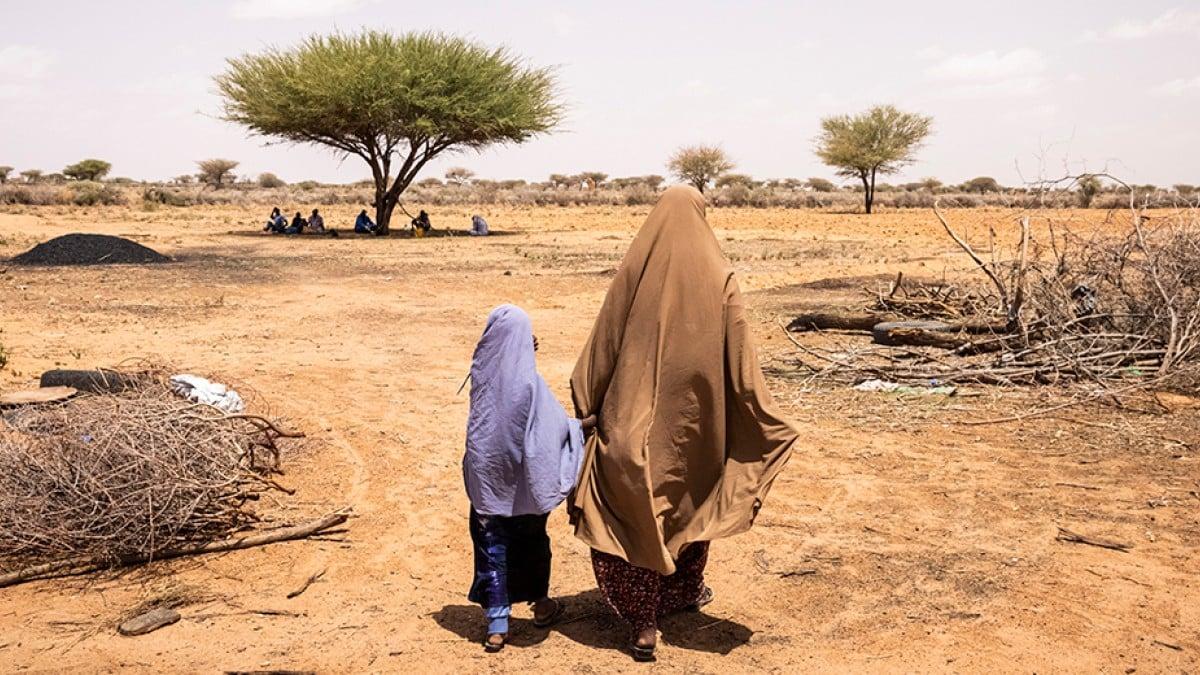
Africa-Press – Kenya. Over two million people across Kenya are facing worsening food insecurity following one of the driest October to December 2025 rainy seasons on record.
The prolonged drought has led to rising rates of malnutrition, increased risk of disease outbreaks, and disrupted access to essential health services.
According to the country’s National Drought Management Authority (NDM), the 2025 short rains, which normally bring seasonal rainfall between October and December, delivered only 30 to 60 percent of the long-term average in most areas, producing the driest season recorded since 1981 in parts of eastern Kenya.
The drought’s severe impacts are also being felt in neighboring countries such as Somalia, Tanzania, and Uganda, where millions more are at risk due to similar weather patterns and water shortages.
State data shows that 10 counties are experiencing drought conditions.
Nine counties, Wajir, Garissa, Kilifi, Marsabit, Kitui, Kwale, Kajiado, Isiolo, and Tana River, are in the “alert” phase, while Mandera is in the critical “alarm” phase.
The report shows that 13 other counties in the ASAL region are currently categorised as “normal” and are increasingly showing signs of drought stress, particularly in water and livestock indicators.
The government has warned that 2.5 million citizens are at risk of severe hunger and water scarcity if the drought persists.
World Resources Institute places the number of Kenyans who are at risk of food security at approximately 15 million people, about 28 per cent of the population.
The current state of affairs has seen Kenya ranked 103 out of 136 countries on the Global Hunger Index, with a score of 25.9, placing it on par with Mozambique and below regional peers Tanzania (91st) and Zimbabwe (90th).
The Global Hunger Index 2025 report places the country in a “serious” hunger situation, far worse than eight years ago, when Kenya scored 23.1.
Moreover, Kenya’s food inflation has exerted pressure on household budgets, with items like maize flour, sugar,r and local vegetables all recording year-on-year price increases, even as headline inflation stabilized.
“Acute food insecurity in ASAL counties could surge from 1.8 million to 3.5 million people if interventions stall,” said Agriculture CS Mutahi Kagwe.
In the optimistic rollout of emergency response to Kenya’s deepening drought, the national government recently announced a Sh6 billion allocation aimed at mitigating the worst effects of drought in the country’s arid and semi-arid lands (ASALs).
The funds to be disbursed in phases since late December 2025 are directed at a mix of food assistance, cash transfers, safe water initiatives, medical supplies, and livestock support to vulnerable households across northern and eastern counties hit by failed rainfall.
Deputy President Kithure Kindiki said the injection of funds would help to ensure enough food is available across drought-prone regions, with an additional Sh4 billion planned each month to sustain the crisis response.
“This climate-induced situation will affect the country in the short term, but the government has made arrangements to ensure that we provide enough food for the people of Kenya. They should not panic,” said Kindiki.
“We have disbursed a total of Sh6 billion with a commitment of about Sh4 billion every 30 days and we will review the situation based on the information we receive.”
According to official assessments by KNDMA and corroborated by humanitarian monitoring groups, around 2.1 million people are currently estimated to be in crisis-level food insecurity — defined as “Crisis” (IPC Phase 3) or worse.
On average, the Sh6 billion spread across two million people equates to roughly Sh3,000 per person. That’s the basis for assessing how long drought-affected families can realistically survive in a market economy where food prices have been volatile and trending upwards.
A review of current market prices shows that a Sh3,000 cash transfer offers limited relief against the rising cost of basic food items for Kenyan households.
Data from agricultural markets indicate that maize flour, a key household staple, retails at between Sh70 and Sh100 per kilogram in Nairobi.
Dry maize grain, often used as a cheaper alternative, costs about Sh50 to Sh100 per kilogram depending on the region and quality. At these prices, a family spending conservatively would still use up a significant portion of the Sh3,000 on maize alone.
Rice, another widely consumed staple, is also stretching household budgets. A 25-kilogram bag of common branded rice is currently selling for between Sh1,750 and Sh1,900, consuming more than half of the Sh3,000 allocation in a single purchase.
Cooking oil remains even more out of reach, with a 20-litre jerrican wholesaling at about Sh4, 800—well beyond what the cash transfer can cover on its own.
Protein sources are similarly costly. A 90-kilogram bag of beans, a common source of protein for many families, is retailing at around Sh9, 000, putting it out of reach for households relying on small cash transfers and forcing many to buy in very small quantities.
The government support is, however, complemented by the international community, with the WHO saying that it is supporting Kenya to map out annual health risks using the Strategic Tool for Assessing Risks (STAR), a comprehensive toolkit for evidence-based public health risk assessment.
Acting on these early warnings, in November 2025, WHO handed over assorted emergency supplies to Kenya, including cholera kits, pneumonia kits, and essential supplies pre-positioned in high-risk counties before the drought intensified.
“These supplies have the capacity to reach over 5000 people, though significantly more resources are needed to meet the scale of need.”
The global health agency says that water scarcity is forcing families to rely on unsafe sources, raising the risk of cholera, typhoid, and diarrhoeal diseases.
“Drought-induced heat and limited vegetation are also concentrating disease vectors near scarce water points, heightening transmission risk.”
It is now calling on national and county governments, humanitarian agencies, and communities to mobilize urgently.
Source: The Star