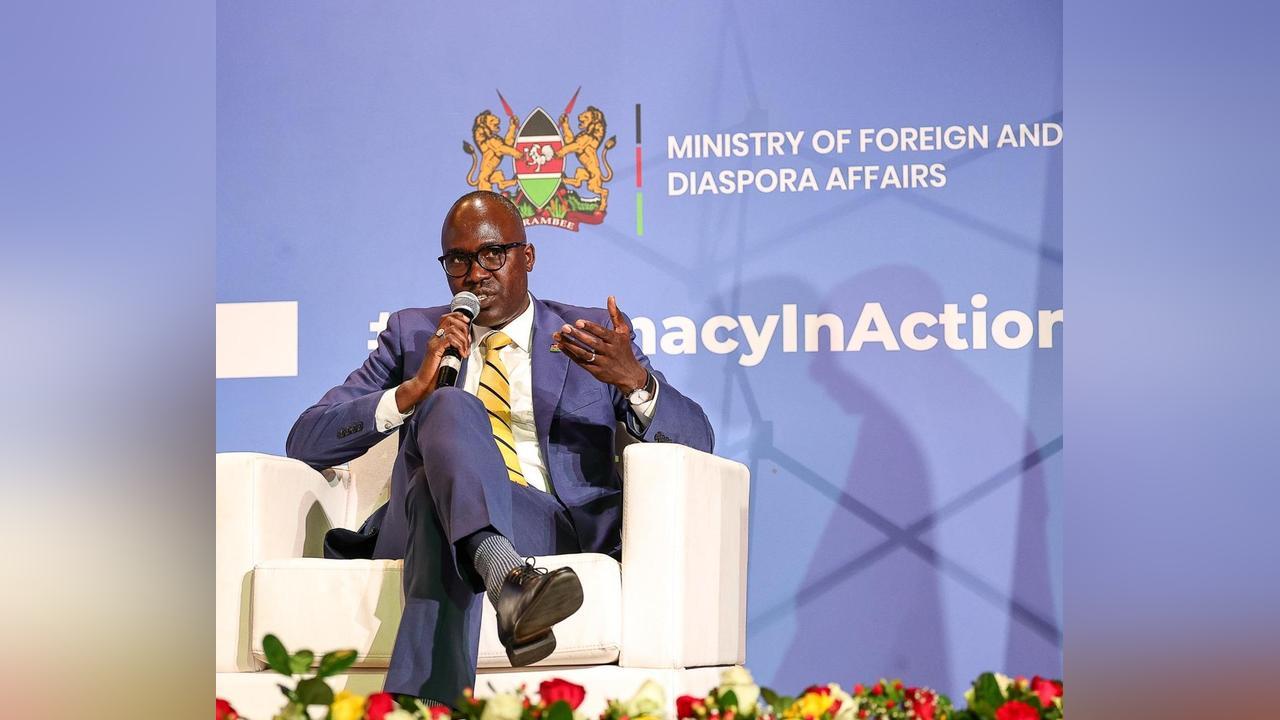
Africa-Press – Kenya. Kenya is looking to benchmark on Singapore’s foreign policy model as part of President William Ruto’s ambition to rapidly transform the country into a first-world economy, Foreign Affairs PS Korir Sing’Oei has said.
In a policy reflection, he said the President’s vision of a first-world Kenya is anchored on strong institutions, high-quality human capital and the efficient deployment of national resources.
The PS underscored the central role of diplomacy in driving economic and institutional reform.
“In the year ahead, the Ministry of Foreign and Diaspora Affairs will deepen its study of Singapore’s foreign policy model, with a view to aligning Kenya’s diplomacy more deliberately with the President’s economic transformation agenda,” Sing’Oei said.
The PS said the pillars have underpinned Singapore’s rise from a small developing state into a global economic hub, noting that Kenya would draw lessons from the Asian tiger.
The PS said foreign policy is a critical but often underestimated tool in national transformation.
He argues that Singapore’s development trajectory demonstrates how diplomacy, when deliberately aligned with economic and security objectives, can create the stability and partnerships necessary for sustained growth.
Sing’Oei pointed to Singapore’s long-standing investment in regional stability through its leadership within the Association of Southeast Asian Nations.
“By positioning itself as a neutral convener and trusted mediator, Singapore has played host to high-level international dialogue, including the landmark meeting between North Korean leader Kim Jong Un and US President Donald Trump.
“This role has helped mitigate regional tensions and secure prolonged periods of stability—an essential condition for economic growth,” he said.
Drawing parallels, Singoei noted that Kenya shares this outlook as the country’s stability and progress are closely tied to regional integration and peaceful coexistence, as reflected in its engagement with the EAC, Igad, Comesa and the ICGLR.
“Like Singapore, Kenya has sought to act as a bridge between diverse actors, promoting dialogue and cooperation in regions often marked by geopolitical friction,” he added.
Sing’Oei also highlighted Singapore’s pragmatic and agile diplomacy, particularly its ability to cultivate strong relations with competing global powers while preserving strategic autonomy.
Despite rivalry between the US and China, he noted, Singapore has maintained deep economic and security ties with both.
Kenya’s diplomatic posture, he said, mirrors this approach.
Nairobi continues to sustain strong security cooperation with Washington, while deepening economic engagement with Beijing, including under China’s Belt and Road Initiative.
Last year, Ruto held engagements with both capitals, with Sing’Oei noting that Kenya’s guiding principle remains national interest and long-term resilience rather than alignment with any single global power.
On multilateralism, Sing’Oei said Kenya and Singapore have consistently supported a rules-based international order anchored in the UN Charter.
Both countries have served on the UN Security Council and contributed to peacekeeping missions.
He recalled that Kenya and Singapore worked together under the UN Mission in East Timor in 1999, reflecting shared commitments to international peace and security.
However, Sing’Oei acknowledged that Singapore’s use of diplomacy to advance economic interests has been more sharply focused.
From independence, Singapore deliberately positioned itself as a global financial hub, supported by strong regulatory institutions and state investment vehicles such as the Government Investment Corporation (GIC), which helped finance development and reduce reliance on external debt.
Kenya, he said, has made progress in economic diplomacy through trade frameworks with the EU, China, the US under AGOA, and African partners through the African Continental Free Trade Area.
Still, he noted that stronger institutional coordination is needed to ensure these agreements translate into tangible national gains.
The Singapore agenda has, however, already drawn opposition from the United Opposition.
The opposition has said the new narrative is an attempt to mask the government’s failure to address the high cost of living and other economic challenges.