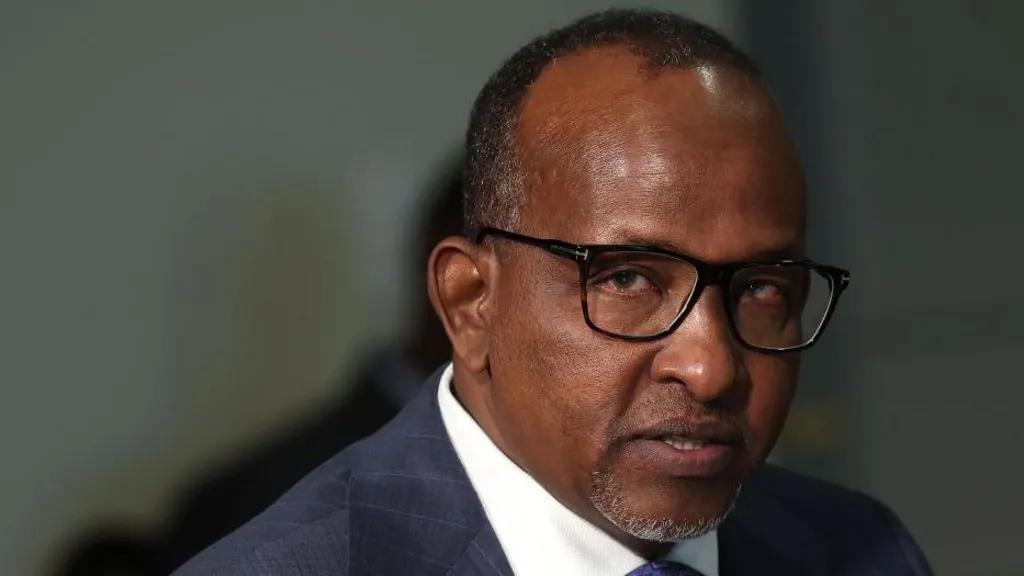
Africa-Press – Kenya. Kenyan Health Minister Aden Duale has been convicted of contempt of court for his management of a controversial quarantine center project funded by the United States, aimed at treating Ebola patients.
Last month, the High Court halted the construction of the isolation center, which has a capacity of fifty beds, at a military base in Nanyuki, pending a case brought by a human rights organization.
However, on Monday, a judge ruled that Duale had ignored the court order and allowed the project to continue.
This plan has sparked a series of angry protests in Nanyuki, located about 140 kilometers north of the capital Nairobi, where three people died during police attempts to disperse demonstrators.
Among the deceased was seventeen-year-old Sylvester Mwiga Ndongo. Eyewitnesses reported that he was shot in the head, but police stated they were awaiting autopsy results to determine the cause of the boy’s death.
In its petition to the court in May to stop construction, the Katiba human rights organization warned that this arrangement posed “serious and imminent risks” to public health.
The Ministry of Health later insisted that it had not violated the court order issued last month to halt the joint construction efforts between the United States and Kenya, claiming that any ongoing construction was being carried out solely by the Kenyan government in the national interest to protect Kenyans from Ebola.
However, the judge stated that the government could not “evade compliance by rephrasing or changing the nature of the ongoing construction work,” adding that the court order “is not a call for innovation, but a directive that must be executed.”
Judge Patricia Nyaundi added that Duale was aware of the necessity to stop all construction work at the Nanyuki site, yet allowed it to continue.
In recent weeks, Kenyan President William Ruto defended the plan to establish the U.S.-funded Ebola quarantine center, stating that he received a request from the United States to create the center, and that refusal would be “inhumane.”
He also urged Kenyans not to politicize the “serious” issue of Ebola, calling on politicians to avoid “reckless” discussions about it. The teenager Sylvester Mwiga Ndongo was one of three people killed in angry protests against the Ebola center, and police have not responded to allegations of excessive force against civilians. Kenya, the largest economy in East Africa, had not recorded any cases of Ebola as of Monday.
Affected countries include the Democratic Republic of the Congo, which has reported over a thousand confirmed cases, and Uganda, which has recorded twenty confirmed cases so far, most of which have come from the Democratic Republic of the Congo.
The U.S. plan has faced strong opposition from one of Kenya’s largest medical unions, the Kenya Medical Practitioners and Dentists Union (KMPDU), which questioned why Kenya was chosen to host a quarantine center for American citizens exposed to the virus.
The Congolese city of Bunya, the epicenter of the outbreak, is located 780 kilometers (485 miles) from Nanyuki, with Uganda separating the Democratic Republic of the Congo from Kenya.
KMPDU Secretary General Davji Bhimji Atella stated that the union “will not stand by and watch Kenya being treated as a containment colony for a deadly pathogen we did not cause to spread.”
Washington has announced its intention to provide $13.5 million (£10.7 million) in aid to support Kenya’s efforts to prepare for an Ebola outbreak, according to a spokesperson for U.S. Secretary of State Marco Rubio. This amount is part of a broader U.S. commitment of $112 million to support the regional response to the outbreak.