
Africa-Press – Kenya. Kenyan tea could fetch significantly higher prices in global markets under a new strategy aimed at repositioning it as a premium product in Europe.
This comes amid a global supply chain disruption occasioned by the Israel-US war with Iran which has affected key logistics routes and markets mainly in the Middle East, with the UAE, Saudi Arabia, Yemen and Iran as key export markets.
President William Ruto on Monday noted that the ongoing conflict in the Middle East is having a significant impact on the global economy.
“This disruption is already being felt across global supply chains and is placing pressure on economies worldwide. Africa, including Kenya, is not immune to these effects,” Ruto said.
While some key exports, particularly tea, were expected to face challenges in certain markets, Ruto said performance remains strong, supported by diversification into new markets and the strengthening of existing ones.
“The latest data indicates that we exported 81 per cent of tea offered for auction this month, compared to 75 per cent in March 2025,” the President said.
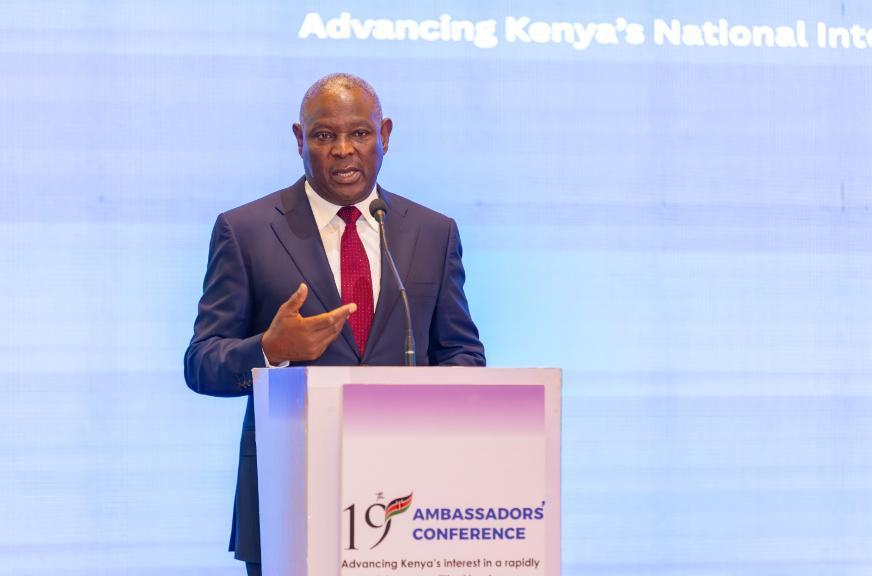
Speaking during the 19th Ambassadors and High Commissioners Conference in Nairobi, Equity Group managing director and CEO James Mwangi said ongoing engagements ahead of the Africa Forward Summit are focused on securing long-term economic value for the country.
Mwangi, who is chairing private sector participation in the summit, said Kenya has already partnered with a major European tea importers to develop specialty products targeting high-end markets.
“The first France conference in Kenya is happening, and together we have been asking ourselves: what does this mean for Kenya? We looked at French culture and asked, what if we convert tea from a commodity into a lifestyle product? We worked with one of the largest importers and developed specialty teas,” he said.
According to Mwangi, the initiative has already pushed negotiated prices significantly higher than current average prices.
He added that discussions are also underway to expand market access, including plans to open hundreds of outlets in Europe to stock Kenyan specialty tea.
“Broadly, from our engagement with France, one of the commitments expected to be signed during the first France-Africa Summit is the opening of shops in Europe to stock Kenyan specialty tea,” he said.
He noted that tea is currently trading at just over Sh100 per kilo with the initiative being put in place likely to see Kenyan tea retail at between Sh3,000 and 4,000 shillings per kilo.
“However, it will require us to secure Geographical Indication (GI) status. We need to pass the necessary laws,” said Mwangi.
If implemented, the proposed strategy could significantly boost earnings for farmers by tapping into premium international markets, in line with the government’s push for trade-driven diplomacy.
Tea remains one of Kenya’s top foreign exchange earners, but most of it is exported as bulk black tea with limited value addition, keeping prices low for farmers.
The development comes as the government steps up efforts to align diplomacy with economic outcomes.
Meanwhile, President Ruto has urged Kenyan diplomats to focus on translating the country’s potential into tangible partnerships that deliver real benefits to citizens.
“Our diplomacy must remain rooted in the everyday interests of Kenyans, the farmer seeking better prices and the entrepreneur seeking access to new markets,” Ruto said.
In 2025, Kenya exported about 652,792 tonnes of tea, a 4.35 per cent increase from 2024, reflecting growth in volume.
However, the average price at the Mombasa Tea Auction hovered around USD2.15 (Sh279) per kilo, slightly lower than in previous years.
Despite higher export volumes, earnings were Sh186.9 billion in 2025 slightly above the Sh181.6 billion earned the previous year.
Major buyers of Kenyan tea include Pakistan, Egypt, the UK, the UAE, Russia, and India, with Pakistan alone accounting for over a third of total exports in 2024.