WYCLIFFE MUGA
Africa-Press – Kenya. My theme over the last few weeks has been that, on the one hand, Kenyans have long realised that our greatest national priority is for our leaders to carve out a path to inclusive prosperity.
And yet – and on the other hand – when it comes to elections, which is the only time when voters can hope to influence the direction in which the nation will move, this issue of “development” is not what has the greatest influence on voters.
What we see instead is what is generally termed “identity politics” – more simply defined as “us versus them”.
And from this arises the odd fact that no matter what a serving Kenyan president may do to try and appease the various regional vote blocs, the only such bloc he can afford to take for granted is his own political backyard.
Kenyan presidential elections are, in essence, exercises in coalition building. And a president running for re-election needs to – more than anything else – keep the coalition he rode into power, intact. Then he needs to try and absorb at least one more major regional vote bloc and make them “one of us”.
The problem, though, is that when seeking re-election, he can easily find that a region which had been part of his coalition in the last election has since moved from being “one of us” to becoming “one of them” – the opposition.
In short, the task facing a Kenyan president seeking re-election is never easy, no matter what his core supporters may say about how much he has done, and how voters cannot wait to reward his great efforts with one more term.
Consider this pattern, which has been revealed in the votes cast for Kenyan presidents seeking re-election. (And I emphasise, “seeking re-election” not how they ended up as president in the first place).
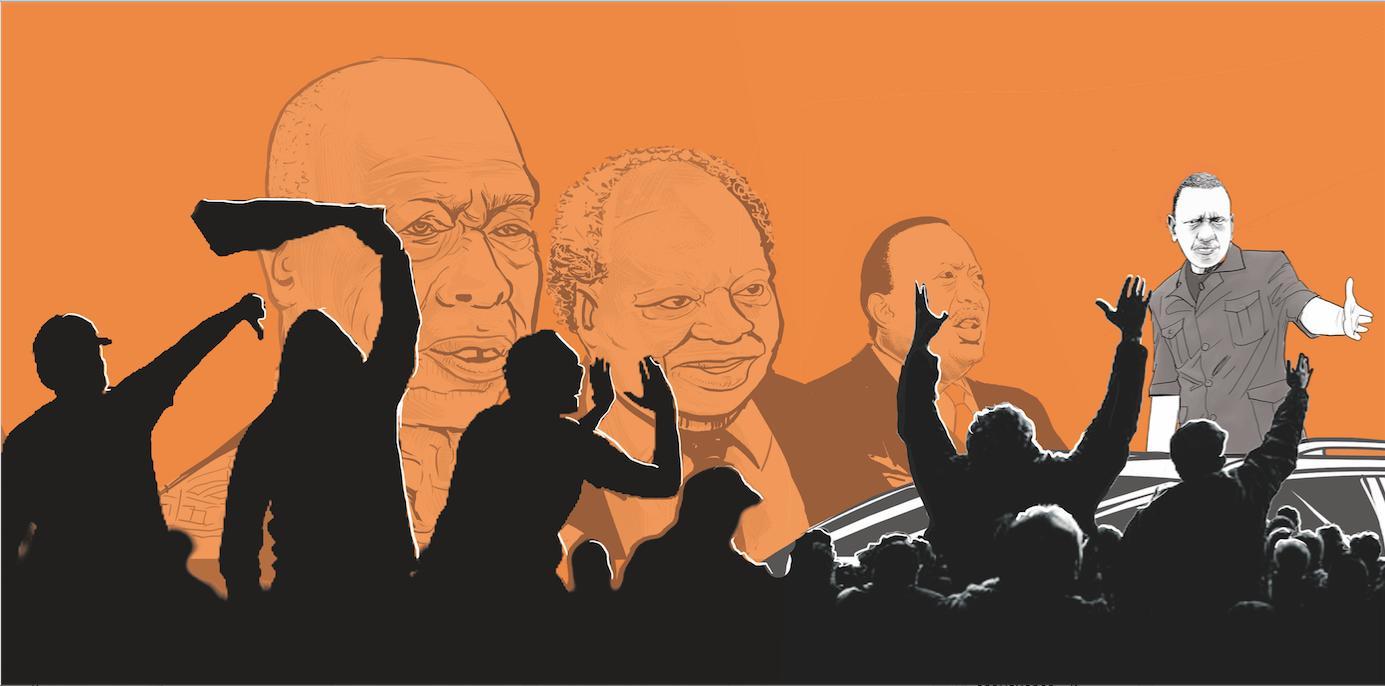
We have had three presidents win re-election since our return to multiparty elections in 1992. President Daniel Moi, seeking re-election in 1997, got just 40 per cent of the votes cast. It was enough to see him return to State House, but it was also proof that against a united opposition, he would have had no chance at all.
Then in 2007, President Mwai Kibaki, seeking re-election, did just a little better than Moi, and got 46 per cent of the votes cast. It was enough to extend his presidency by five years, but yet again, he would have lost against a united opposition.
Then in 2017, it was President Uhuru Kenyatta who sought re-election. His tally was far more impressive – 54 per cent of votes cast. But that is also the election in which Kenya made global headlines as the first African nation in which the Supreme Court nullified the presidential election results and ordered a fresh election.
In the layman’s reading of that historic Supreme Court ruling, there was a suggestion of some kind of mischief behind the scenes being a key factor in Uhuru Kenyatta securing that impressive result.
But the bigger picture is this: you cannot tell me that all these three presidents did not try their very best to ensure a glorious victory in their bid for a second term; that they did not resort to the most unrestrained and extravagant populism, unleashing the full powers of the state in pursuit of their cause; and yet they barely managed to retain their grip on power.
All this, in my view, persuasively suggests that it is much easier for the candidate seeking to unseat an incumbent president to create a winning coalition than for the president seeking re-election to do so. And that the serving president’s chances of winning are almost entirely dependent on whether or not the opposition groups can unite.
There is a stern logic behind this: the Kenyan economy, no matter who was president, has never grown at a pace that could create sufficient economic opportunity for all.
Thus, no matter how hard a Kenyan president may try, what he is met with at the end of his first five-year term is mass dissatisfaction and contempt for what are then seen as the empty promises he made during the last campaigns.
Source: The Star